

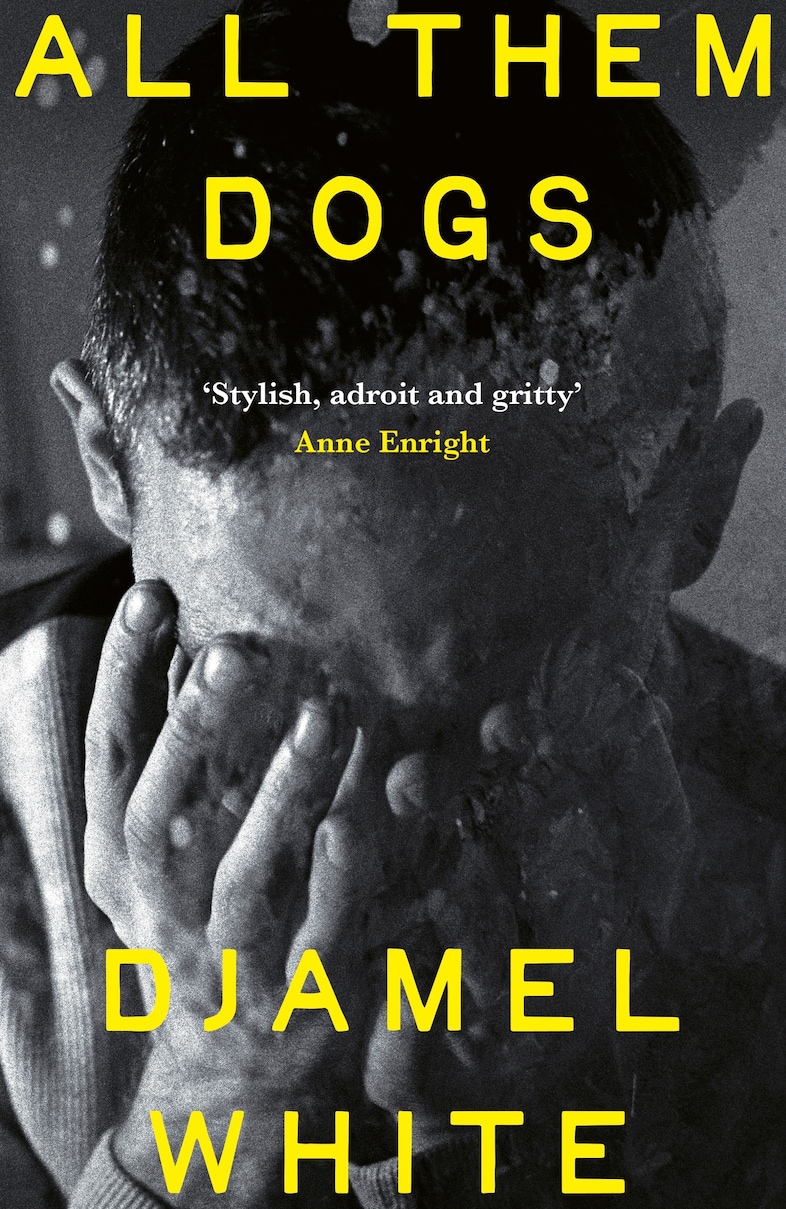
With his debut novel, All Them Dogs, Djamel White draws us into a world of threats and retribution, where gangsters with Turkey teeth and remodelled hairlines compete for money, status and power. When Tony Ward returns to Dublin after a spell lying low in England, he seeks protection from local mafioso Aengus Lavelle, who sets him to work with his top enforcer, the inscrutable Darren ‘Flute’ Walsh.
As Tony struggles to reconnect with his exhausted mother and resentful brother, who views him as a danger to the family’s safety, his partnership with Flute gives him purpose. Not for the first time, Tony finds himself falling for a man with broad shoulders in all senses. “I didn’t set out to write a capital ‘q’ queer novel,” White says, speaking on Zoom from his home in West Dublin, where All Them Dogs is largely set. “I guess this is a crime thriller, but it’s also a human story about a flawed person operating in an incredibly violent world.”
White, who left school early before returning to education to complete a degree and MFA at University College Dublin, has pulled off a subtly disruptive masterstroke. He’s injected a thrilling hit of illicit queerness into an ultra-masculine world where reputation is everything. Here, he discusses the interlocking themes that drive his novel to a frenetic conclusion.
You write about Dublin’s criminal underworld so vividly in the novel. Is it a world you’ve dipped into, or always been fascinated by?
Djamel White: I mean, Dublin is a small place, and the class lines are much more blurred in Ireland because, you know, we abolished the gentry [back in the day]. So unless you’re from a very affluent background, that [gangland] world is always accessible to you – it’s unavoidable in some ways. For me, it was always just kind of there. It wasn’t until I was much older and started meeting people from different backgrounds – quite sheltered backgrounds, I would say – that I realised not everyone had an awareness of this world. I didn’t have a particularly rough upbringing, but I grew up with a real awareness of what that world could be like. And I consider the characters in All Them Dogs, for the most part, to be from a similar social background to me.
The novel is written in the first person, from the perspective of Tony Ward, a prodigal son trying to reassert himself in this overtly violent world. How did the character take shape?
Djamel White: In a lot of ways, he’s the complete opposite to me, but I’ve observed characters like him throughout my life. I’m interested in power – what people do to take it, and the instances in which they lose it – particularly in masculine structures and settings. Growing up, there was always a kind of pecking order based on physicality. It was the biggest, strongest and most threatening [man] who was on top.
There was also this underlying kind of ambient violence between men. The one that could hurt you the most was the one who everyone kind of revered. And though it never came to [violence], sometimes when these guys talked, there would be stories about what they’d done to other people. And I guess there’s three feelings at play in that situation: fear, envy and desire. Like, ‘I’m afraid of this guy, but he has everything I want, and I kind of want to be him.’ And with this story, I was like, ‘What if we push the desire element a little further?’
Do you think there’s a performative aspect to the aggressive masculinity exhibited by Tony and other characters in the novel?
Djamel White: I think ‘performative’ is an interesting word because it implies a direct intention. Whereas with Tony, it’s maybe more instinctive – he can’t back down from anything because he’s backed himself into a corner. He’s never going to surrender, because if he surrenders to himself, the mask would slip and he would disintegrate completely. And I think the same can be said for all the characters in the book, even if we don’t get their backstories.
[Tony]’s never going to surrender, because if he surrenders to himself, the mask would slip and he would disintegrate completely
What drives Tony? He seems completely impulsive, with very little capacity for self-criticism.
Djamel White: Absolutely. And what he probably won’t admit to himself is that he wants to be accepted and connect with people. You know, his view of the world is based on the environment he came up in. The hyper-masculine hegemony of his immediate surroundings makes him think that the way to get that [acceptance] is to adhere to these hyper-masculine ideals. But of course, there’s a foil to that in that he’s a queer person, and that’s where things get complicated for him.
Tony never puts a label on his sexuality – and actually, no one puts a label on anyone’s sexuality in the novel. Do you think Tony perceives himself as ‘queer’, or does he view his attraction to other men as just another secret to keep hidden?
Djamel White: Yeah, I think it’s the latter. I don’t think he’s engaged in queer culture in any kind of broad sense. It’s established early on [in the novel] that he was taken in by a mentor, and there was some sort of imbalanced relationship there that allowed Tony to come to terms with [being attracted to men], in whatever twisted way he has come to terms with it. I think he’s doing his best not to allow his sexuality to undermine this vision of himself that he’s established in his mind.
And you know, I’m writing a very closely locked-in, first-person narrative, so there’s not really room for me to explore that [dilemma] in any great detail, because that kind of introspection wouldn’t be true to his character. I also think it goes without saying that in the spaces that Tony occupies, his sexuality has to be kept hidden. I think it would almost have felt too obvious or pastiche to bring it up in any kind of overt way. I think we all know what would happen to Tony if people found out about him and Flute.
Besides their constant physical proximity, what do you think draws Tony and Flute together?
Djamel White: Emotional security, I think. When Tony starts working with Flute, he knows there are people out there who want retribution [for his past actions], so the only place he feels safe is when he’s in the car with Flute. He knows that Flute will always defend him when they’re on a job. And going back to what we were saying about envy and desire, I think Tony quickly accepts, internally at least, that Flute is one step above him in this hegemonic world, which adds to his appeal. And obviously, we shouldn’t disregard the fact that Flute is [physically] an attractive man. Tony is definitely drawn to that!
There’s a great irony to that […] in this hyper-masculine world, there seems to be an excessive amount of grooming involved. You can see that in the wider culture today, to a much greater extent, with things like looksmaxxing
There’s a lovely moment of vulnerability in Flute’s flat when he puts on a Dusty Springfield record, which feels like an incongruous choice from a character trying to conceal his own sexuality.
Djamel White: Well, I have to have my moments of levity! It’s a moment of vulnerability for Tony, too, because he thinks he recognises the song and tries to put himself on Flute’s level by saying: ‘Ah, it’s Cypress Hill.’ Whereas it’s actually ‘Son of a Preacher Man’, the Dusty Springfield song that Cypress Hill sample [on ‘Hits from the Bong’]. So Tony kind of embarrasses himself, which unlevels the playing field immediately.
I love the way Tony describes people’s appearances, especially when they’ve obviously had ‘work done’, like veneers or a hair transplant. In the world he’s navigating, does cosmetic surgery serve a dual purpose – is it armour as well as a status symbol?
Djamel White: Yeah, and I think there’s a great irony to that, because in this hyper-masculine world, there seems to be an excessive amount of grooming involved. You can see that in the wider culture today, to a much greater extent, with things like looksmaxxing, that I won’t get into here! But in Tony’s world, it’s part of the armour and part of the image that needs to be portrayed. If you’re walking around Ireland – a country that has 90 per cent cloud coverage most of the time – with a golden brown tan and shiny new teeth, that’s a signifier of wealth and success.
I found it interesting that amid all this pimped-up machismo, Flute’s mum Melissa might be the toughest character of the lot.
Djamel White: That was about balance, and about giving Flute his own foil – the fact he’s a mammy’s boy. He’s in the driver’s seat for so much of the novel until Tony sees a chink in his armour, which is Melissa. I think it’s so much more interesting for his foil to be a woman, because it pushes against what might be expected in a story like this. And that’s something I’m always trying to do in my writing.
Despite the terrible things that Tony does, you manage to keep us rooting for him. Was it a process of trial and error to make him at least moderately sympathetic?
Djamel White: I’m glad you said that. I kind of just had to close my eyes and fucking hope that would be the case. I think the key thing was that I was sympathetic towards him, and I hope there’s some kind of shared human nature among readers that makes people latch on to that. Like, I wasn’t writing a character who I thought of as ‘gruesome’ in any way. It’s kind of hard to argue Tony’s case, but that’s what makes him so interesting to me. When we’re reading him, we’re so close to him as we see every chink in his armour and every [difficult] relationship he goes through. I think if he was written in the third person, or if the book had multiple narrators, he might be easier to hate.
All Them Dogs is out now.


