
A new video game depicts America’s H-1B visa process as a maddening slot machine — and Donald Trump as its jealous god

When Allison Yang and her team first started pitching their new video game on Chinese social media, they were baffled to discover how many commenters had replaced their profile photos with the Chick-fil-A logo.
The reason, it turned out, was a common “superstition” among Chinese coders: that paying tribute to the Atlanta-based fast food chain, and eating as much of its fried chicken as possible, would somehow increase your chances in the U.S. government’s annual work visa lottery.
“It’s not that hard to understand,” Yang, a 39-year-old journalist turned game developer, told The Independent. “In a very uncontrollable situation, I think it’s human nature to rely on something like horoscopes or fortune-telling — so that you can control something.”
Now, that sense of powerlessness is exactly what Yang and her team are trying to tap into with their new mobile game H1B.Life. It’s a surreal, satirical simulation of what it feels like to navigate America’s byzantine and often maddening immigration system.
Slated for release later this year, the game casts the player as one of the hundreds of thousands of people each year who apply for a coveted H-1B skilled worker visa, battling culture shock and bureaucracy as you strive to realize your American dream. Only around 85,000 H-1Bs are granted every year, and the U.S. government uses a literal lottery to decide who gets one.
“It is like a game,” said Yang. “Whatever card you hold, whatever paper you hold, determines your superpower and your weakness.”
Although filled with outrageous parodies and fantastical events, H-1B.Life is based on extensive interviews with real immigrants. Its creative team includes both game developers and journalists, many of whom have personal experience of the system.
“Now you can play a game that hopeful immigrants play every day in real life,” announces the game’s trailer on Kickstarter (fundraising starts this May).
Winning or losing an H-1B can change the course of your life. Just ask Tesla boss Elon Musk, LA Times owner Patrick Soon-Shiong, or Instagram co-founder Mike Krieger, all former recipients.

Yet in any given year, U.S. Citizenship and Immigration Services rejects anything from 55 to 76 percent of applications (according to official data) based on little more than a dice roll. While the Trump administration plans to reform this lottery to prioritize “higher-skilled and higher-paid” workers, reports indicate that it will still be partly random.
Now that game has become even more brutal — thanks to President Donald Trump. On top of increasing official fees for some H-1B applicants from around $5,000 to $100,000, his new social media screening requirements have also caused massive delays and backlogs.
Some H-1B holders or their families have been left stuck outside the U.S. after traveling abroad for holidays, weddings or family emergencies, while other are afraid to leave the country lest they share that fate.
“[Trump voters] have put me into this very uncertain and I would say miserable position, where I could just be thrown out of the country where I plan to live for a long time because of one executive order,” said ‘Julia’, a Chinese tech worker on an H-1B, who asked to be quoted under a pseudonym because she didn’t want her comments associated with her professional profile.
Americans, she added, are often shockingly ignorant and “uneducated” about how the system works — “but they are the ones who get to vote for it.”
Beware the ‘Orange Buddha’
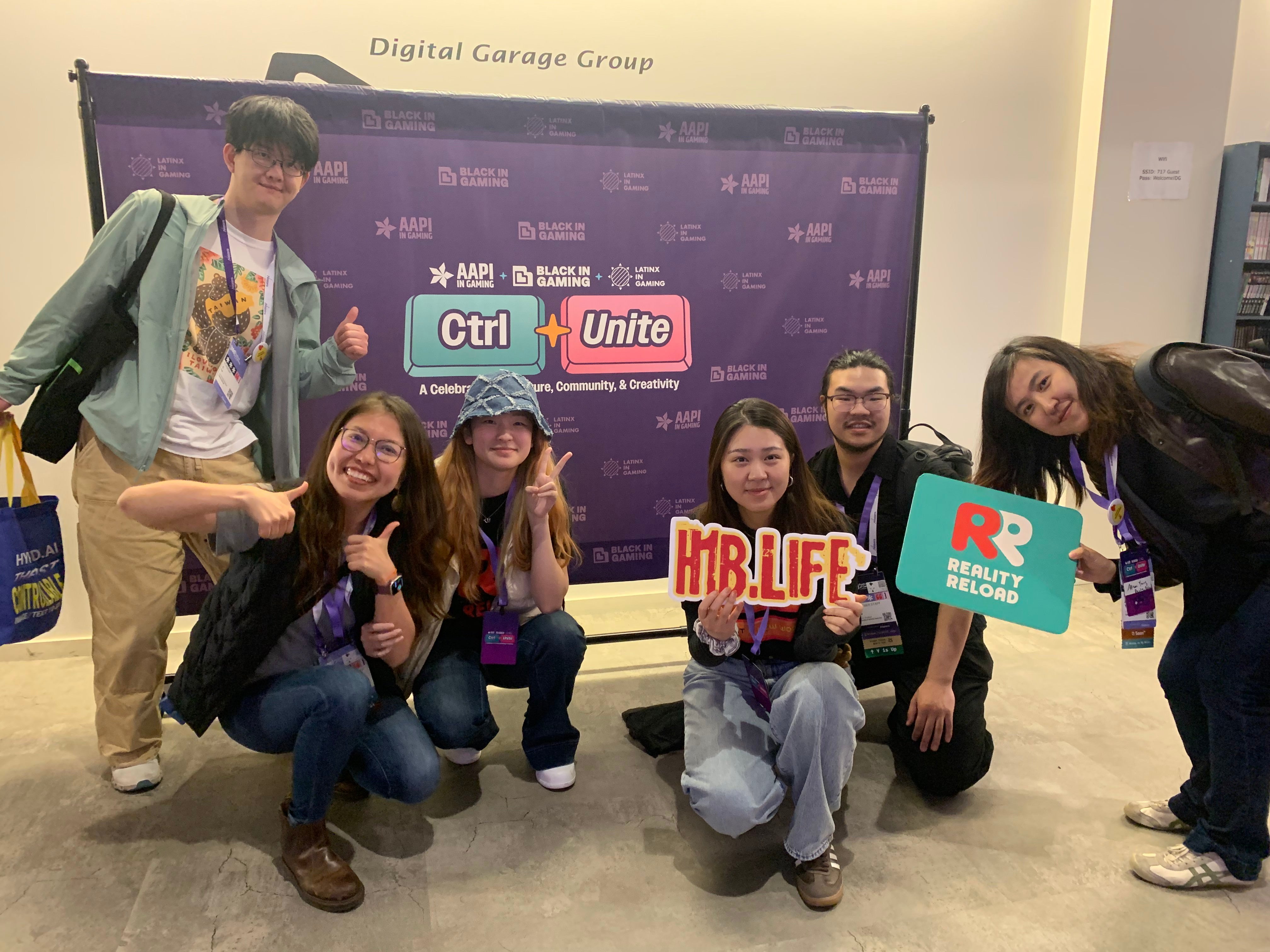
Challenging that ignorance is one of Yang’s goals with H1B.Life. Having grown up in Xinjiang in mainland China, she spent about a decade as a journalist in Hong Kong and Germany before founding Reality Road, a video game studio specializing in playful games about serious real-world issues.
First introduced in 1990, the H-1B visa lets American companies sponsor highly educated foreigners to work in specialized fields such as chemistry, medicine, or computer science.
They’re especially popular in Silicon Valley, with tech firms accounting for around 17 percent of all approvals last year according to the Silicon Valley Institute for Regional Studies.
.png)
While these jobs are often lucrative and prestigious, successful applicants are highly dependent on their employers. If they quit or get fired, they typically only have up to 60 days to find a new sponsor.
A 2016 investigation by NBC Bay Area found unscrupulous “body shops” exploiting this dynamic to keep foreign tech workers in virtual “slavery”. Critics argue that H-1Bs displace U.S. workers and depress their wages visas.
Yang’s own path to the U.S. was on a spouse visa with her American husband — far simpler than the H-1B. Once here, though, she was struck by how much the immigration system dominated the lives of those drawn by promises of opportunity and freedom.
“There’s a hierarchy that people are very sensitive to,” Yang told The Independent. One H-1B holder, she recalled, felt “guilty” talking to people on less high-end visas, but also felt unable to confide in “green card people” because they would not understand “how much she sacrificed.”
Initially, Yang and her team planned to make a realistic simulation of the U.S. immigration system. But they soon realized it was more interesting to focus on the emotional and psychological rollercoaster experienced by those caught inside it.
The cult of Chick-fil-A turned out to be the key — leading the team to lean into ideas of faith, destiny, and the occult.

“We wanted to capture the bizarre mentality around this topic,” Yang said. “A lot of things are not factual, [but] correspond to people’s dreams or desires or fears.”
H1B.Life plays like a cross between a choose-your-own adventure and a casino game — though Yang warns that everything is subject to change before release. Players guide their characters through life decisions big and small, managing stats such as “intelligence” and “social support” while trying not to fill their “burnout” meter.
In the demo I played, you start out as a young Chinese journalism student, drawn to New England by an obsession with Gilmore Girls and dreams of a better life. Then things get weird.
On the plane to America you fall asleep and dream of a supernatural casino. When you wake, you’ve acquired a magical miniature slot machine on your keychain, inhabited by a kaleidoscopic squad of immigration Buddhas.
These Buddhas are central characters, each delivering different benefits or dangers. The Coder Buddha, for example, presides over computer skills, “technical interviews”, and “abundant offspring” — a reference to oat-sowing Chinese plutocrats such as video game billionaire Xu Bo, who has reportedly fathered more than 100 U.S.-born children via surrogacy.

The Crispy Buddha, a fried-chicken-themed deity based on the Chick-fil-A myth, who delivers unpredictable “blessings or curses.” The Free Buddha represents liberty, democracy, and prosperity — but her powers are “inconsistent” and “often questioned.”
Then there’s the Orange Buddha. “A relatively new Buddha. He claims to govern everything,” the Kickstarter says. “You go to sleep, and by the time you wake up, he’s already caused havoc in the heavenly realm five hundred times.”
To H-1B holders and their families, it’s all too familiar. Yang’s team interviewed people who urgently flew back from weddings or family funerals for fear of being subject to Trump’s sudden $100,000 fee.

Julia, too, recalls that day vividly. Initially, the Trump administration did not make clear whether its announcement would also apply to U.S. residents renewing their H-1B’s. So Julia’s productivity tanked as she anxiously scrolled for updates, while her colleagues — mostly white male American citizens — seemed unaffected.
“Obviously, no [company] is gonna pay $100k for an H-1B employee, in most cases,” Julia said. “If this is true, a lot of people are gonna lose their jobs due to this unjust process. And people around me are not the ones who made this happen, but they are gonna benefit from this…
“The privilege is just very real. It’s not some term that we talk about in a social science class. It is right there. I’m gonna have to leave this office, and they don’t have to, if that [news] is true.”
‘Why are we punished if we did everything right?’
Honoring these feelings of powerlessness while still making the game fun to play is one of Reality Rebound’s key challenges.
Part of the solution, Yang says, is “burnout mode”. Mental health meltdowns are a perpetual threat for many H-1B holders, especially because their whole life in the U.S. depends on keeping their jobs.
But when you fill your burnout meter in H1B.Life, you won’t actually lose. Instead, you slip into a weirder, even more unpredictable version of the game, in which impossible things become possible.
You might drop out of mainstream society and become an undocumented drag queen, before meeting a closeted immigration agent who falls in love with you and proposes marriage. Or you might go from highly-strung concert musician to funeral raver, holding midnight rock concerts in cemeteries.
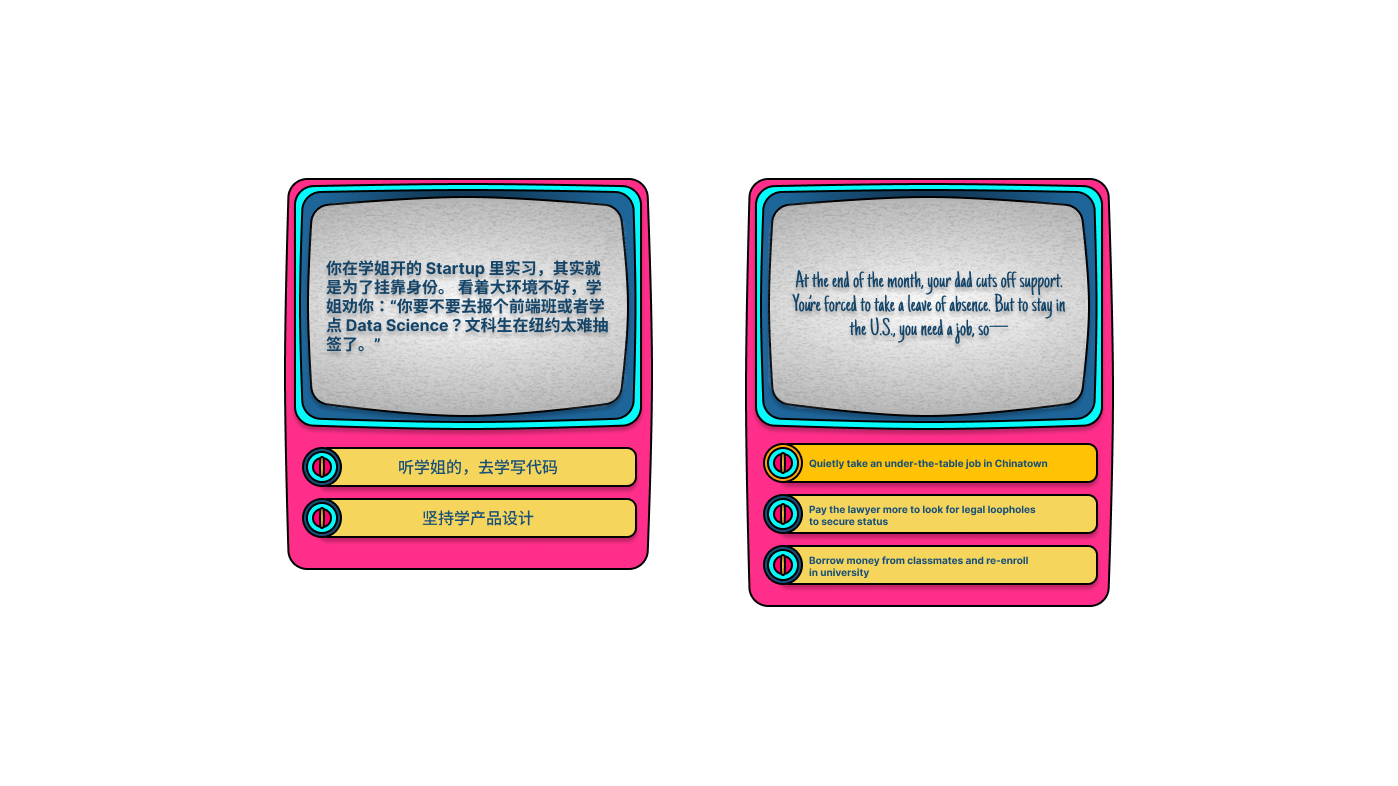
These plot lines were directly inspired by roleplaying sessions in which interviewees were invited to transmute their experiences into fantastical narratives. Fantasy, Yang argues, is one way people reclaim a sense of personal agency in the face of this implacable system.
She says it’s all too easy for immigrants to fall into “a very passive feeling” — “like, ‘oh, we’re the victim, we’re suffering, we’re miserable, we’re hopeless. We can do nothing.'”
“But in reality,” Yang continues, “It’s not like that. People do have agency, and people are strong and resilient. When you don’t feel safe, you take action… it doesn’t have to be very real, but even if you can dream differently, that’s also some power.”
Even so, there’s no denying how much the U.S. immigration system distorts people’s lives. Yang tells stories about smart young migrants who actually dislike coding but nevertheless become software engineers for a shot at prosperity, or a friend who almost went bankrupt because she didn’t think she’d be in the U.S. enough to need good car insurance.
Indeed, Julia notes that getting an H-1B is only the beginning of a long and arduous journey. “After you win this game, you still have a lot more steps to go,” she said. “I think for a lot of immigrants, at least Chinese immigrants, their whole life plan is dependent on this… it’s shaped American Chinese culture deeply.”
Today, Yang argues the American dream is “collapsing” due to the nativist backlash against legal immigration. Many Americans have decided H-1B holders are “stealing American jobs” and “don’t deserve to be here,” she said.
For immigrants, it’s the crumbling of an entire “belief system” in which they have invested their lives and savings.
“Most of these people — they were good students in school. They were very good at following all the rules, ticking all the boxes,” said Yang. “So it’s very hard for them to understand: why are they punished if they did everything right?”


.png?width=1200&auto=webp&trim=0%2C100%2C0%2C100&w=390&resize=390,220&ssl=1 "Bruce Springsteen performs anti-ICE song at ‘No Kings’ protest | News")
