

The price of oil has hurtled well past the $100 barrier and sits above $106 on Monday morning – a rise in price of well over a third (37 per cent) in the space of a week, something which promises a big impact on people’s finances.
What we refer to as oil is typically the contract price of Brent crude – a global benchmark for pricing of the commodity regardless of its origin. Brent crude comes from the North Sea. Its price rises and falls in line with supply and demand for oil as a whole, not just of its own type.
Rising oil costs will naturally push energy bills higher, but it’s far from just about turning the heating on – higher fuel costs impact manufacturing, transport, food and everything else.
The longer that the price of oil is high, the more difficult it is to absorb those spikes, making it more likely they will feed through into the cost people pay at home. Ending the situation in the Middle East is therefore the limiting factor on how high bills might go.
“You never know exactly the timeframe of this, but, in the worst case, this is a weeks not a months thing,” US energy secretary Chris Wright said yesterday. But the longer it goes on, the more likely it is that prices remain higher afterwards.
So what do you need to know and what’s going to go up?
Petrol
Chris Wright was specifically talking about the price of petrol at US gas stations, but if matters are settled soon with Iran, the same principle applies in the UK. However, there is a lag to be aware of.
Part of the issue is not just the hampered supply now, but the fact that storage quickly becomes a problem too, so oil-producing nations cut their output. Then, once oil is flowing again, it takes them time to ramp production back up to normal levels, leaving a scarcity in the meantime and prices staying higher as a result, even once tankers can move again.
Iran has cut its oil output drastically, only now producing a quarter of what it was before the first US strikes fell.
“This is roughly 3 per cent of global oil supply lost in a single event. Shockingly, this is worse than the oil supply situation after Russia attacked Ukraine,” noted XTB research director Kathleen Brooks.
Get a free fractional share worth up to £100.
Capital at risk.
Terms and conditions apply.
ADVERTISEMENT
Get a free fractional share worth up to £100.
Capital at risk.
Terms and conditions apply.
ADVERTISEMENT
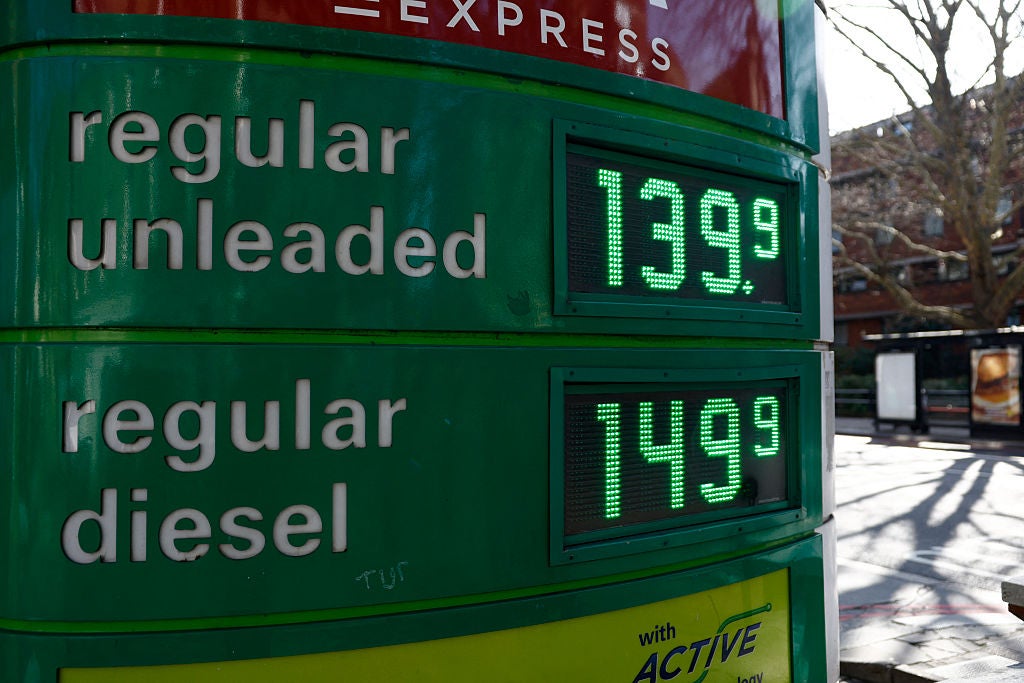
On Friday, the RAC reported the average price of a litre of petrol at UK forecourts as 137p, rising nearly 4p since conflict in the Middle East resumed.
Inflation and interest rates
As a Barclays analyst note put it on Monday, “persistence, not the peak” is important when it comes to high oil prices and the economy.
The data we get from the Office for National Statistics (ONS) is naturally backward-looking and lags a month, so we won’t know what the impact of right now is until further down the line.
But generally speaking we don’t need to know the specific numbers: if costs go up of energy, raw materials or labour, prices go up in response. Prices going up is inflation.
How much of an inflationary impact the Middle East situation has is the important aspect. Inflation has been on a downward path in the UK over the past year or so but this is likely to derail the expected route back to the target of 2 per cent, which some analysts had predicted would be met by early Spring.
If prices start to surge again, one of the key measures the Bank of England has to control inflation is to raise interest rates.
As the cost of borrowing increases, firms and households spend less and borrow less, reducing demand for certain services or products and therefore helping to prevent prices from rising any higher.
However, matters are complicated in the UK due to a weak economy and rising unemployment, which higher interest rates could harm even further.
Mortgages and savings
Interest rate changes have two important knock-on effects on most households: debt and savings. The interest rate going up means you pay more on the amount you’ve borrowed, if you don’t have a fixed deal.
Debt can be shorter term like loans, or longer term, like mortgages. Mortgage deals on the market don’t tend to move in lockstep with the Bank of England base rate, they move up and down in anticipation of what might happen in future – with the swap rates, as they are termed.
As such, mortgages prices had been headed downwards, but with this new threat to a possible rising of interest rates, swap rates have edged up. Accordingly, some lenders have now raised their rates on new fixed-term mortgages.
.jpeg)
NatWest, HSBC, Nationwide, Santander, the Co-operative Bank and Skipton Building Society are among those to have done so in the past week.
On the other hand, higher interest rates mean better deals for savers.
A slew of banks and building societies have slightly increased interest rates on savings accounts or brought out new and competitive deals for easy access, ISA or fixed-term bonds over the past week, giving those with cash to stash more options and a better chance of earning inflation-beating returns on their money.
Stock market and pensions
If inflation and interest rates are potentially heading up, the opposite is true for the stock market.
The FTSE 100 is down 1.2 per cent on Monday morning, having fallen more than 5 per cent across last week after the chaos in the Middle East began. Only 11 of the companies in London’s main index are showing a positive return after two hours of trading at the start of the week – unsurprisingly with Shell and BP, the energy giants who will benefit from rising oil prices, being two of the biggest risers.
If you invest in an ISA or hold a pension where you regularly check in to see how it’s faring, it’s important not to panic and make rash decisions over selling funds or shares if you notice it dropping this week.
Unless you are approaching retirement age, drops in the market are a normal (though sometimes worrisome) part of the investing journey and selling at a lower price point can lock in losses that might otherwise smooth out over a longer period of time.


