

Donald Trump promised to usher in a renaissance for American manufacturing.
But the president’s vision of a “golden age” manufacturing boom — tapping into midcentury nostalgia for American cities teeming with with factories — is more likely a fantasy, experts tell The Independent.
Thousands of people lost work after his administration pulled federal funding for dozens of clean energy projects. Uncertainty over the president’s volatile global tariff agenda pulled back investments. Housing manufacturing employment has plummeted. Overseas factories aren’t returning to American shores.
To boost support for his agenda, the president’s election campaign tapped into the economic anxieties of an American workforce under siege by immigrant labor and crushed by foreign production, automation and the decline of once-booming factory towns. But in the nine months after he declared “Liberation Day” with sweeping tariffs to rebalance global trade and revive the American workforce, there are tens of thousands fewer factory jobs.
“It’s just fantasy,” says Dean Baker, senior fellow and co-founder of Center for Economic and Policy Research. “There’s literally nothing that would support his claims of a renaissance.”
Last April, Trump said manufacturing would come “roaring” back to the country and “supercharge” domestic production, but things appear to be going in reverse.
There were 5,000 manufacturing jobs added in the first month of 2026, according to the Bureau of Labor Statistics, but that’s still down 83,000 jobs since the same point last year.
A recent analysis from Democratic members of Congress revises that number even higher, finding that the U.S. lost more than 100,000 manufacturing jobs in the first year of the Trump administration.
“While President Trump promised us a manufacturing boom, the reality of his first year has been a bust,” Senator Maggie Hassan, the top Democrat on the Senate Joint Economic Committee, said in a statement with the report.
“It is critical for both our national security and our economic future that we grow our manufacturing sector,” she said. “The president has instead spent his first year burdening manufacturers with reckless tariffs, and this loss of jobs is the result.”
The era of American factory jobs peaked in 1979, when 19.5 million people — nearly one-quarter of the workforce at the time — were working in manufacturing. That number has been slipping ever since.
Factory jobs increased during Trump’s first term, then plunged during the pandemic. President Joe Biden pumped subsidies and other incentives into the economy to spur investments but those gains evaporated by the end of 2024. Trump gutted what remained of Biden’s efforts, erasing thousands of new jobs.
Modern-era manufacturing construction spending peaked by August 2024 and has been steadily declining since, according to the Federal Reserve.
But the industry is hopeful, despite Trump’s tariffs raising prices on the materials manufacturers need to actually make things. They point to potentially lower interest rates, favorable tax rates and a wave of investments in artificial intelligence and data centers that will increase demand for equipment, according to Alliance for American Manufacturing.

Trump, whose administration invokes midcentury-inspired images of construction workers on steel beams on social media, promised that “factories, jobs, investment and trillions and trillions of dollars will continue pouring into the United States of America because we finally have a president who puts America first,” during his State of the Union address earlier this week.
The word manufacturing didn’t appear once in his remarks, the longest-ever for a State of the Union speech.
How sweeping tariffs hurt the manufacturing economy
In remarks from Georgia on February 19, Trump said “the whole country would be bankrupt” without his tariffs. The next morning, the Supreme Court struck down a bulk of them, finding that the president does not have authority to impose tariffs and taxes under his use of a federal law to regulate international commerce during an emergency.
The billions of dollars levied against American importers are now likely tied up in litigation, and the president’s ultimately futile attempts to land “trade deals” are likely to cause long-term damage to the U.S., according to left-leaning think tank Center for American Progress.
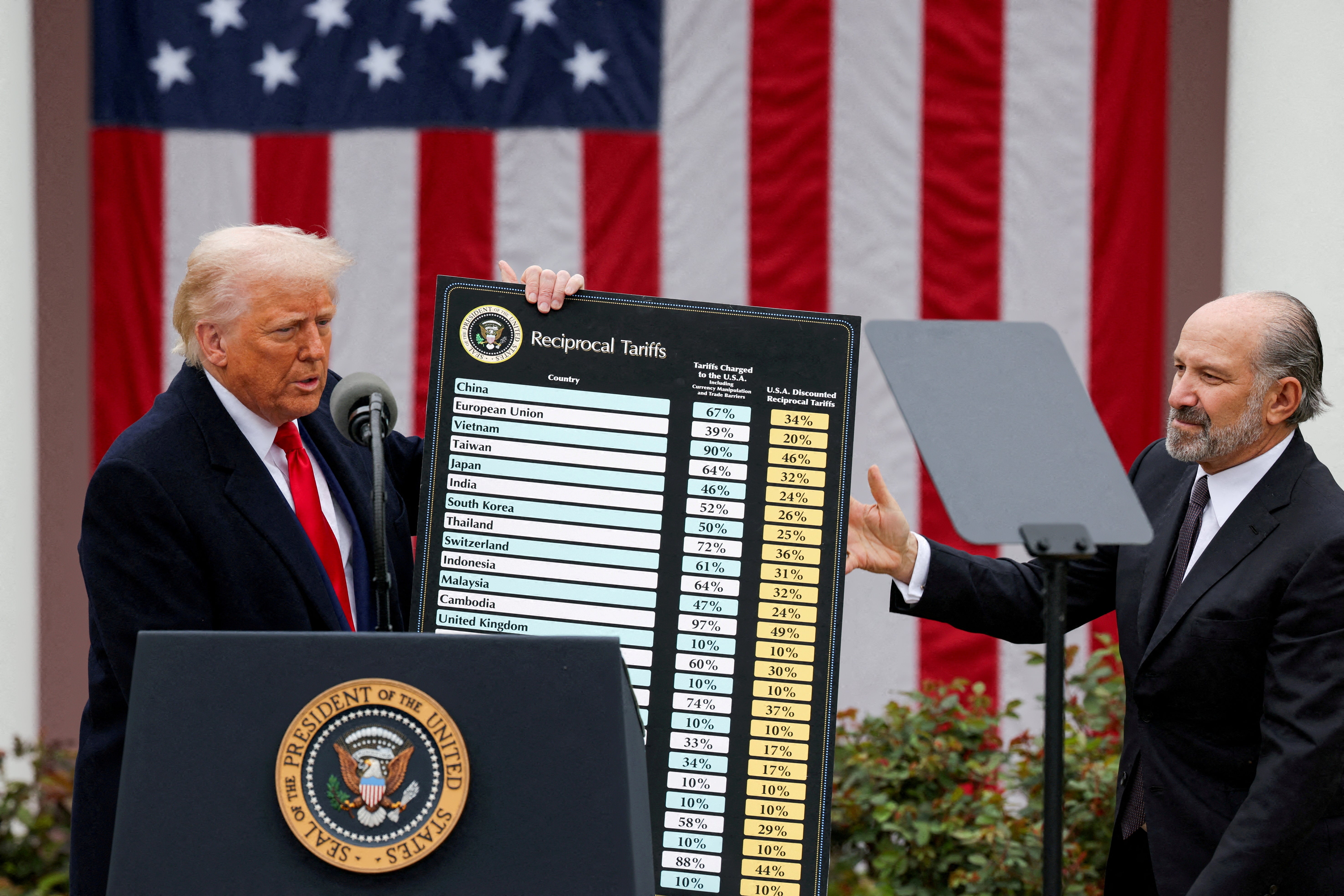
Trump continues to falsely claim that the levies are paid by foreign countries but believes they will one day “substantially replace the modern-day system of income tax, taking a great financial burden off the people that I love,” he said at the State of the Union.
The administration may have tried to leverage tariffs to pressure companies to return production to the U.S. to avoid paying them, but roughly half of U.S. imports are “intermediate” goods used to make other products. Tariffs may protect American manufacturers from foreign competition but end up raising costs overall.
“The classic story you might tell about tariffs is that they help manufacturing, but they hurt the rest of the economy, because they’re pulling money out of people’s pockets,” Baker told The Independent. “But when you put tariffs on intermediate goods, which most of our imports actually are, then you make manufacturing more expensive here.”
Steel tariffs boosted US production but spiked prices for consumers
As Trump toured the Coosa Steel facility in Rome, Georgia earlier this month, owner Andrew Saville hailed the president’s tariffs as a “game changer” for the company.
“We were competing with China. They were producing racks at $90 a piece. Our costs alone are $150. You leveled it. The playing field is back,” he said. “Our quotes, our orders — we’re so busy, we don’t know what to do.”
Erica York, vice president of federal tax policy at nonpartisan research group the Tax Foundation, called the moment in Georgia “a great example of how tariffs raise prices.”
“The protected firm can now profitably sell its higher priced goods because of the tariffs, but it does so at the expense of all the downstream users who now have to pay those higher prices,” she wrote.

Trump imposed stiff tariffs on steel and aluminum in an attempt to force production back to American factories — ultimately forcing manufacturers to raise their prices to meet growing costs, which then flatten sales growth and risk job losses. Any jobs saved in the domestic steel industry likely came at a high cost to consumers.
The domestic steel industry has seen Trump’s tariffs as an overdue market correction, with spokespeople routinely characterizing imported steel as an existential threat, though domestic production has remained relatively flat over the last five years despite reduced imports.
From 2019 to 2025, domestic steel production dropped from 97 million tons per year to 90 million tons, according to the American Iron and Steel Institute. Domestic shipments increased more than 4 percent from 2024 to 2025, however.
‘Drill, baby, drill’ killed off thousands of clean energy projects
While Trump heralds a manufacturing boom, his administration pulled the plug on dozens of clean energy manufacturing projects that were already in the works.
The Trump administration’s energy policies have shuttered electronic vehicle parts and battery manufacturing plants, solar panel manufacturing plants, offshore wind projects and other facilities, killing off thousands of jobs in the process.

Since Trump’s election, more than 350 clean energy projects or companies have canceled new projects, delayed investments, laid off workers or lost federal funding, resulting in the loss or delay of nearly 173,000 jobs, according to climate advocacy group Climate Power.
Within the three years after the passage of Biden’s Inflation Reduction Act in 2022, which allocated tens of billions of dollars for clean energy projects over a decade, companies announced 385,000 new jobs.
But by 2030, Trump’s cuts are expected to deliver a $980 billion loss in cumulative GDP and cost 760,000 jobs, rising to 900,000 by 2032, according to a report from nonpartisan energy and climate policy think tank Energy Innovation.
In his State of the Union, Trump instead promoted American oil and gas production, saying he kept his promise to “drill, baby, drill.”
Trump’s tech boom shed thousands of jobs
Trump has repeatedly centered domestic manufacturing in semiconductors and other technology as a key part of his economic and national security agenda.
The president has touted billions of dollars in investments from several major chip makers, though those factories may take months or years to develop, with job growth not yet fully realized. Many of the actual subsidies and incentives for those plants to land in the U.S. have moved through the 2022 CHIPS and Science Act, which was passed under Biden.
Growing costs for materials have also especially hit semiconductor manufacturers and others making technologically complex goods. Semiconductor makers have shed more than 13,000 jobs since April, according to the Federal Reserve.
AI data center bubble is likely to pop
While the Trump administration courts the tech industry’s growth in the U.S., states are increasingly forced to deal with a growing surge of data centers trying to get a foothold in communities across the country.
State lawmakers are juggling whether to hand out tax incentives or pause their construction entirely, balancing fears of exploding utility costs and environmental impacts against potential jobs and other investments.

Trump has proposed federal legislation to protect energy ratepayers from having to cover their costs, signaling that the administration won’t step in to block their expansion.
AI data centers are not only a concerning bubble, they likely won’t end up producing that many jobs, according to Baker with the Center for Economic and Policy Research. Most of the materials for their construction will need to come from overseas, and the centers themselves employ only a handful of people.
“I don’t think that’s going to be quite the huge story that I think a lot of people are banking on,” he said. “Even in the most optimistic scenario, you’re not gonna talk about major manufacturing employment there.”


