

A Language We Share: Beverly Price and Gordon Parks
Gallery / 20 images
“I don’t even know if I’m really a photographer,” Beverly Price confesses to me ahead of her latest exhibition, A Language We Share: Beverly Price and Gordon Parks. “I think I’m more of a channel.” Whatever title Price chooses is almost immaterial, considering her intimate, striking portraits of life in her hometown of Washington DC speak for themselves. “I really just want to capture a moment that I feel is sincere, and that has to speak to something real,” she explains.
That desire is clear in Price’s latest exhibition, which places her work in conversation with Gordon Parks, the legendary photographer and filmmaker who, beginning in the 1940s, became known for documenting Black American life. Price, who grew up on Capitol Hill, first discovered Parks in eighth grade, when she was tasked with writing a research paper on the late artist. “I don’t remember exactly what I was writing about, but I remember the photographs touching me,” she says. The works of Parks, who moved to the capital city after landing photography positions in government offices, focused on highlighting the bigotry, segregation and struggle he witnessed in 1940s DC, which Price notes isn’t so different from the present. “I think he saw something in DC that I still see in DC today,” she says.
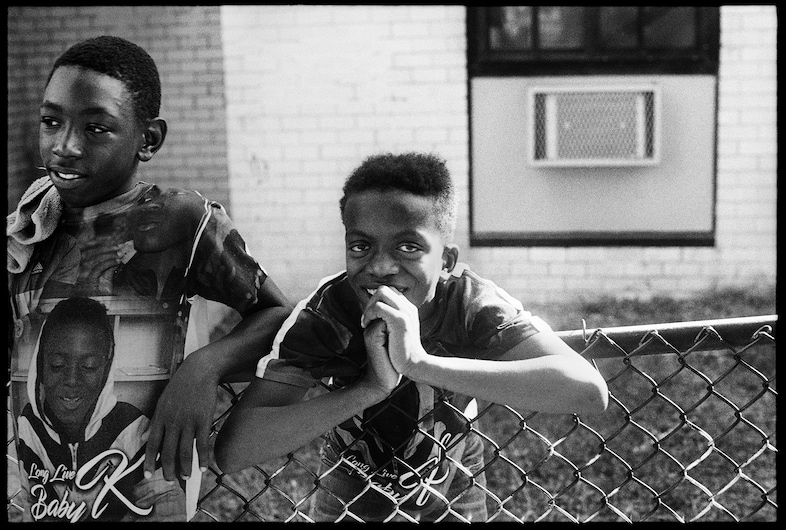
The joint exhibition coincides with not only the 20th anniversary of Parks’ passing, but also the 20-year mark of Price’s returning home from incarceration in 2006. Price’s photographs on display in A Language We Share were shot after her release and capture the city’s young people in moments of both play and resistance. “I feel like what drew me to youth is that I lost my innocence pretty young,” says Price. “I saw something in those kids that I wish someone had seen in me. I think that’s why my work is deeply rooted in preventive justice – it’s this element of showing the importance of children being allowed to be children.”
Centred on DC’s Southeast Anacostia and Barry Farms neighbourhoods, Price’s photographs capture the very same spaces Parks captured decades earlier. Though she didn’t realise the geographical connection until later on, she was originally drawn to the areas for the community she found there, something that had become increasingly difficult to find in the rapidly gentrifying city. “I didn’t feel welcome in my old neighbourhood,” Price says of Capitol Hill, which, in the years since her family sold her childhood home, has seen its Black population decrease dramatically. “Moving to Anacostia later on, I was able to feel like I was back at home again because of all the Blackness in the community over here. At one time, too, when I was locked up, I would look out the window from DC Jail at [Anacostia] park – so, I just think there’s just a lot of correlation that connects me to this community.”

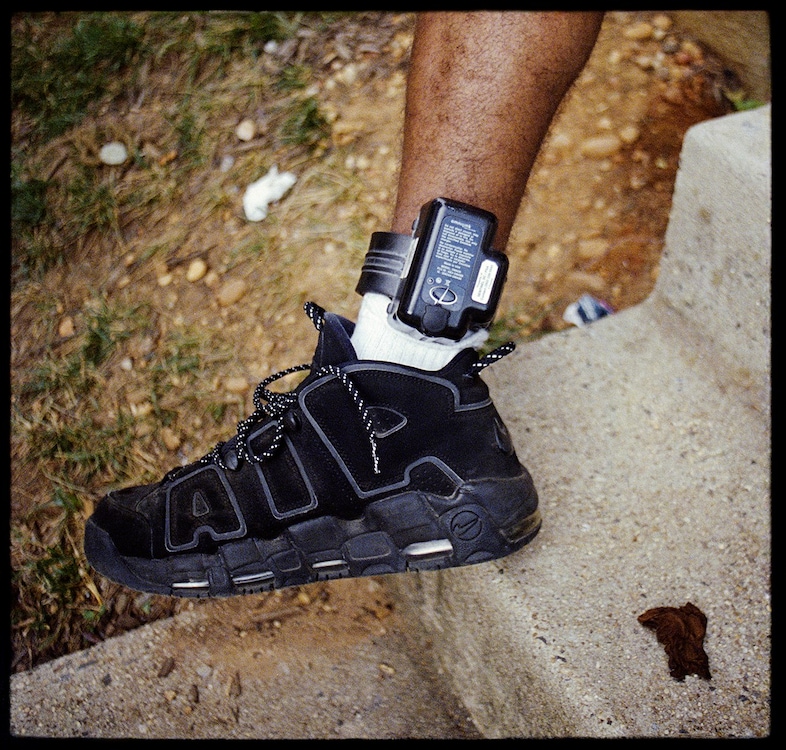

Aside from location, there’s also a thematic link between the works of Price and Parks. One pairing in the exhibition brings Park’s Untitled, Chicago (1957) side by side with Price’s Air (2018). In Park’s photo, a young man is inside a jail cell, surrounded by cigarette smoke, with only his hands visible. In Price’s photo, a young man wearing Nike sneakers is sitting outside, with the word “AIR” visible on his shoe and an ankle monitor attached to his leg. “For me, the pairing reflects both the experience of incarceration and the reality of returning home and living under systems like probation,” says Price. “It shows how freedom and restriction can exist at the same time.”
That juxtaposition is evident throughout the entirety of the collection, where ease and unrest are shown side by side. Price’s shots of children biking outside and playing in a marching band are contrasted by images of young people holding protest signs and streets crowded with demonstrators; it’s a collection of work that shows her city’s joy, but also its reality. Like her hero, and in a way, now collaborator, Parks, Price’s concern is with human nature itself. She concludes, “I’m interested in seeing people’s spirit, not just the surface.”
A Language We Share: Beverly Price and Gordon Parks is on view now through June 19 at The Center for Art and Advocacy in Bed Stuy, Brooklyn.


