

The prime minister has threatened to withdraw thousands of NHS training posts if resident doctors refuse to call off their six-day strike after Easter.
Sir Keir Starmer on Monday gave the British Medical Association (BMA) a 48-hour deadline to reconsider the government’s offer, which would have given resident doctors a pay rise of up to 7.1 per cent, increasing pay for the most experienced resident doctors to more than £100,000.
The union said the offer was not enough, given that inflation is expected to rise and demanded pay be restored to 2008 levels, representing a 26 per cent pay rise.
Writing in The Times, Sir Keir slammed the BMA’s rejection of the offer as “reckless”. He said: “Last week, the BMA resident doctors’ committee rejected a historic deal.
“They now have 48 hours to reconsider. For patients, for the NHS, and for the doctors they represent — they should.”
The six-day strike is due to begin on 7 April, and will mark the 15th round of action in the past three years.
Responding to the prime minister’s comments, the chair of the BMA resident doctors committee, Dr Jack Fletcher, accused the government of moving the goalposts on the deal at the last minute.
He said: “These negotiations are not about arbitrary cut-offs as the prime minister seems to think. Any ‘deadline’ disappears the moment there is a credible and sustainable offer on the table. Our focus remains on getting a good deal for both doctors and for patients, and we are seeking to talk once again with the government later today (Tuesday) with every intention of achieving a meaningful outcome that could see the strikes called off and a pay deal we can support.”
Resident doctors, formerly known as junior doctors, are qualified doctors in their first years of training. A fifth are completing their first two foundation years, while the remainder are in core or speciality registrar training.
The newly agreed salary for those on foundation training is between £38,831 and £44,439, with specialist training salaries rising to £73,992. That includes the 5.4 per cent increase awarded last year, but does not include London weighting.
But the BMA wants pay boosted to between £47,308 and £54,274 for foundation doctors, and up to a maximum of £90,989 for residents in specialist training at the highest end, over a flexible negotiated period. It is estimated that every 0.1 per cent pay rise across the NHS will cost an extra £125 million each year, according to the NHS Confederation.
While the pay rise requested is only for resident doctors, who account for 75,000 of the workforce, the difference between what the BMA is requesting and what is currently paid could cost millions or even billions.
How much are residents paid compared to other doctors?
Resident doctors’ current salary of between £38,831 and £44,439 a year is for a 40-hour week, and does not include extra pay for working more hours or night shifts, which vary significantly per person.
Doctors in core or specialist training can earn £52,656 a year, going on to earn up to £73,992 a year at the highest end.
The government has said that this sits at around an average of £54,300 across resident doctors of all stages of training.
Meanwhile, consultants, who have specialist knowledge in a particular medical field, earn a basic salary of between £105,504 and £139,882 a year.
After two years of foundation training, it generally takes around five to eight more years before doctors can become eligible for consultant roles, though this can be longer.
Nurses start at a lower salary band, around £32,073 per year for a newly-qualified nurse, according to the Agenda for Change.
This can go up to £54,710 for ward managers, and £96,000 for the most senior specialist nurses.
Dentists employed by the NHS start at £52,532 a year and progress to £112,360 for the most senior roles and £145,478 for dental consultants.
This puts resident doctors in a similar starting range to dentists, and 22 per cent higher than nurses.
How far is pay behind inflation?
Inflation is central to the BMA’s demands, arguing that even after the uplift, pay for resident doctors has been eroded by 20.9 per cent since 2008.
With the current 5.4 per cent uplift, the BMA says doctors won’t see their pay restored for 12 years, or until 2036.
Instead, resident doctors are seeking a 26 per cent pay rise, which Mr Streeting has called “completely unreasonable”.
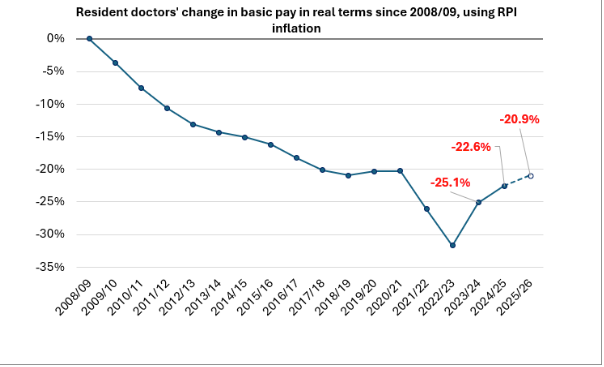
However, the BMA’s figures are calculated using retail price index (RPI) inflation, which is no longer used as a national statistic. This includes factors such as housing prices, council tax, and mortgage rates.
Using the official measure of inflation, the consumer price index (CPI), the Nuffield Trust calculated that doctors’ pay has fallen by a more moderate 4.7 per cent in the same period.
In cash terms, excluding inflation, foundation-year resident doctors have seen a substantial pay boost in recent years.
First-year foundation doctors were paid just £29,384 in 2022, which means the new 5.4 per cent uplift amounts to an overall 32 per cent pay rise on that figure.
While 2022 saw a four-decade-high rate of inflation, and doctors’ salaries had already been falling behind, this is a more sizeable increase than seen by other public sectors.
Nurses, for example, have seen starting salaries rise by just 14.8 per cent in the same period, less than half the rate of resident doctors.
Doctors’ pay compared to other public sectors
Doctors and medical staff provide essential public services. So, how does their pay compare to that of police and firefighters?
According to the Firefighters Union (FU), a trainee will earn around £29,169 a year, bumped up to £38,881 once they become a fully “competent” firefighter in one to three years.
At this point, overtime is paid at £26.63 per hour. Firefighters generally work a two-day, two-night shift pattern, with four days off in between.
The highest salary for “area manager” firefighters is at £74,360, according to the FU, not including London weighting.
Meanwhile, figures from the Police Federation suggest that constables begin on £31,164 a year, without London weighting, rising to £50,256 for the highest pay band.
Chief inspectors can earn as much as £75,855 in London at the highest range.
This suggests that resident doctors start at a moderately higher salary range, with more potential for upward movement. But comparing these fields of work is a challenge.
Doctors must complete several years of medical school before qualifying.
This saddles many doctors with debt before entering the workforce – something which is not a requirement for other emergency services, including firefighters and police.
Low doctor pay compared to other countries
In France, most doctors are self-employed, except for a minority who are directly employed by hospitals. Starting salaries are already expected to be around £3,400 per month, tallying at £40,800 a year.
The average salary for a general practitioner is £84,000, according to data from the public health service. This can go up to as high as £350,000 for radiotherapists.
In Canada, low starting salaries for doctors are around £46,000, according to national data. But average salaries sit around £122,000, with peak pay at £236,000 a year.
The US has the highest salaries for doctors overall, with significant variation by state. Since private healthcare pay is unstandardised, it is hard to directly compare starting salaries.
But resident doctors in the US are paid on average between £51,000 and £86,000, according to Glassdoor, with some surgeons earning upwards of £500,000 a year.
It is important to note that the NHS is relatively unique because it is funded by the taxpayer.
Canada has a similar system, which covers 70 per cent of healthcare spending, known as Medicare. Most doctors are paid in a fee-for-service model, not a set salary.
France has a reimbursement model where patients mostly pay upfront, and may be partially or fully refunded by the state.
And the US has some form of free health insurance, known as Medicaid, but this covers a shrinking fraction of the population. Ultimately, doctors are privately paid through forms of insurance, even if the state subsidises some healthcare.
In this way, the UK is somewhat unique in how the taxpayer shoulders the burden of public healthcare salaries, excluding private doctors.


