
Dreamy photos from an ‘illlicit’ Hudson River swimming spot

Caleb Stein, Down by the Hudson
Gallery / 15 images
Not long after moving to Poughkeepsie for his studies in 2013, Caleb Stein fell in love. First with Andrea Orejarena, a fellow student at Vassar College, who remains his partner and close collaborator to this day. And then with the local watering hole she introduced him to: an “edenic spot” along the Hudson River, tucked away behind a drive-in movie theatre on the outskirts of town.
“It instantly became the place we’d spend all our free time,” the photographer tells Dazed. “I was fascinated very early on by the way it allowed people from all walks of life to come together, let their guard down, and cool off.” Stein returned each summer for more than a decade to document the recurring rhythms of friendship, rest and release that unfurled in its waters. These images are gathered in his new photobook, Down by the Hudson – a loving portrait of people and place.
Raised between London and New York, Stein was compelled to capture small-town life in Poughkeepsie, but his early work was “episodic and unstructured”, only finding its focus at the swimming site. Reached by ignoring multiple warning signs – “like something out of the Looney Tunes” – slipping through the woods, and wading out to a sandbank shaded by trees and a rope swing, the creek had a “joyfully illicit” character that proved irresistible. “The Hudson Valley is filled with watering holes, but this one felt more like a secret. I saw people behave differently there because they’re kind of sharing that secret.”
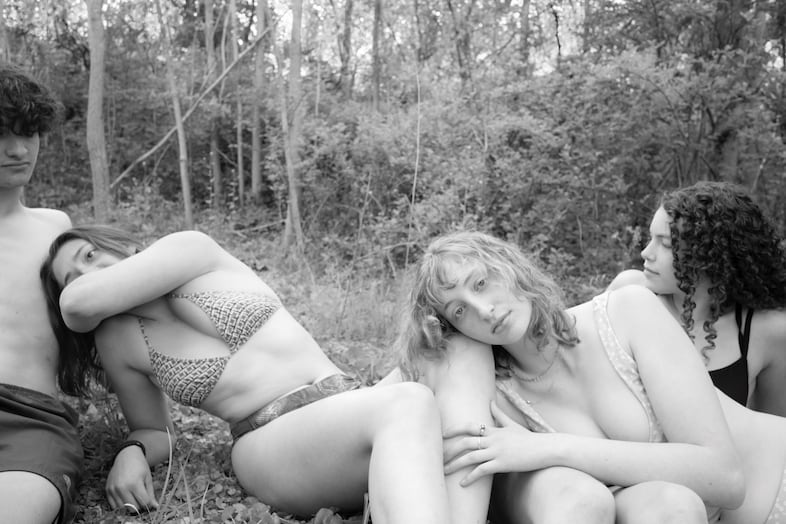
Stein invited that playfulness into his exchanges with his subjects, some of whom grew up alongside the project and became close friends, while others appeared for a single swim. “Not everything was a ten-year relationship, but none of the photographs were made without a conversation,” he explains. Working digitally, he showed people the images on the back of his camera and welcomed their collaboration. We see them play-fighting, floating, and flirting with the river, which embraces them like a second skin. His portraits of young men are surprising in their softness, as vigour gives way to vulnerability.
A swimmer since childhood, Stein has always felt “more comfortable in water than out of it”, and cherishes its transformative potential. “When you’re in water, you have to breathe differently. It’s a complete reset. It’s like being suspended or held, in a way that is sort of addicting,” he reflects. Despite shooting in black and white, the element is vividly felt throughout the book, whether in the liquid glow of the photographs or in the grain of the Danshi Snow paper that ripples across the pages of the accompanying essays.
For Stein, the work cannot exist apart from its political context. Poughkeepsie was once a booming manufacturing hub for IBM, before the computer company downsized in the early 1990s, slashing thousands of jobs and leaving the town to grapple with the consequences of deindustrialisation. By 2016, when Stein’s project really began to take shape, presidential and local elections were almost neck-and-neck between political parties, “to the point where you could have fit the difference into a bar on a Saturday night”. He continues, “And then there was the watering hole, where everyone came to cool off. You’re seeing undocumented people at risk of being deported by ICE swimming off the same rope swing as people that are blatant Trump supporters. And for a brief moment the political intensity and the very high-voltage feel of the US kind of dissipates, even if it’s just for an afternoon.”


Stein approached the project with a filmmaker’s sensibility and a lover’s gaze. By looking closely and for long enough, this same small space continued to reveal something new – about the world within it and the world around it. He sees this level of care and attention, and the intimacy of all the accumulated details, as an antidote to pessimism. “Rather than documenting the struggles often associated with small-town America, it was much more challenging and perhaps more necessary to photograph something that was actually working,” he explains. “There has to be a hyper-focus on something if you’re suggesting an alternative.”
Accompanying him through many stages of life, the decade-long project also became a document of his own growing up, and his eventual marriage to Andrea, to whom the book is dedicated. “It’s a love letter,” he adds. “Unapologetically, it’s a love letter.”
Stein still goes back to swim sometimes, though the last time he visited the police had closed off the spot following Fourth of July celebrations. Publishing the book has also brought its own kind of release. “I feel really lucky to have found this place and I don’t know what could ever replace it in terms of something that could warrant the same love and attention and time,” he says. “But after years of gathering images, looking for the right pieces, holding it all together, it’s like I can finally exhale. I can let it go, let it float down the river.”
Down by the Hudson is published by Palo Press, with images on show at Palo Gallery from 10 September through 3 October 2026.
