
Oil prices jump back above $100 a barrel as Donald Trump’s Strait of Hormuz blockade threat looms

The price of oil has jumped again to above $100 a barrel after President Trump said the US would blockade the Strait of Hormuz from Monday.
The US president threatened to stop tankers from entering or leaving the key oil and gas shipping lane in response to the failure of talks with Iran.
The move caused global prices to spike on Monday morning, with the price of oil jumping around 7 per cent back up to $102, settling back just slightly lower by 9am BST.
A ceasefire deal, which was due to last two weeks, only came into effect last week and saw the barrel cost of Brent crude oil drop from around $110 to the mid-90s.
But it slowly inched up again over the following days as it became clear the agreement was a fragile one and the Strait of Hormuz, where about a fifth of the world’s oil supply passes through, remained effectively closed.
With Trump reportedly considering resuming air strikes on Iranian infrastructure, fears will be stoked of another surge in price closer towards the $120 level.
However, markets seem less inclined to make the huge day-to-day jumps they were at the start of the conflict, partially due to investors remaining wary of the US president’s habit of going back on statements and failing to follow through on threats.
“The announcement of a US blockade of the Strait of Hormuz effective today, an apparent refusal by Iran to abandon their nuclear ambitions and the likelihood of a renewed conflict, led to another surge in the oil price,” said Richard Hunter, head of markets at interactive investor.
Get a free fractional share worth up to £100.
Capital at risk.
Terms and conditions apply.
ADVERTISEMENT
Get a free fractional share worth up to £100.
Capital at risk.
Terms and conditions apply.
ADVERTISEMENT
“Inflationary concerns are therefore back on the table, and other commodities such as fertiliser also rose on supply concerns. It now remains to be seen whether the US President’s latest threats will be enforced, with the muted market reaction thus far implying that it could turn out to be a negotiation tactic.”
The same response was seen across stock markets on Monday morning, with the FTSE 100 down, but only by 0.4 per cent. Spain’s Ibex 35, France’s CAC 40, Germany’s DAX and the Euro Stoxx 50 are likewise falling, but only around 1 to 1.2 per cent rather than the 3 and 4 per cent drops seen on a regular basis a month or so ago.
Asian shares were mixed overnight, falling in South Korea, India and Japan for example, but rising slightly in Saudi Arabia, China and Taiwan.
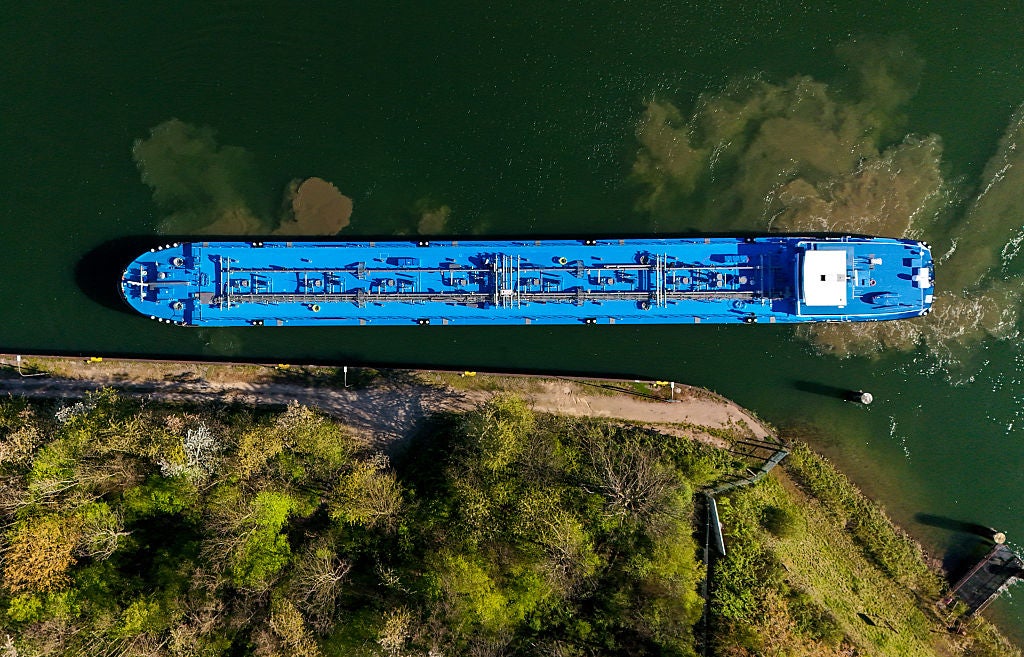
It leaves the picture of investors and money markets remaining wary, when it comes to further oil price changes, but far from totally risk-off right now, amid expectations that further talks might take place, as noted by Kathleen Brooks, research director at XTB.
“Figures from the Iranian regime have hinted that [additional discussions with the US] is the case. Even though President Trump is planning to blockade the Strait of Hormuz, from 4pm BST today, the President is notorious for changing his mind and switching positions, so his threats are losing market impact,” Ms Brooks said.
“At the start of this week, traders are partly reversing last week’s moves, but they are not back to panic levels, and some may argue that the sell-off could have been worse.”
Separately, the price of heating oil on Monday has remained around the same level as last week so far, at around 122 pence per litre.
Heating oil, which is subject to different pricing conditions compared to the above Brent crude oil, can move in cost very fast in both upward and downward directions. It had an average price in the UK of around 56 or 57 pence per litre in the months prior to the Iran war, before rapidly jumping to over 134p by the first week of March.
Since then it has pulled back slowly and slightly, but remains at elevated levels about 115 per cent higher than the pre-war price.


