
The artist pushing beauty culture to its ugliest extreme

Ivana Vladislava, Inner Beauty is for Ugly People (2026)
Gallery / 20 images
Ivana Vladislava has spent years messing with the idea of what a woman is supposed to look like, first by trying to become it, then by pushing it too far. She exaggerated and reconstructed her own appearance until her body became both an artistic medium and a fixation. Now she’s turning that same scrutiny on us.
Born in Poland and raised in the post-communist 1990s, Vladislava moved to Berlin at 14. She went on to become an artist, muse and fixture of the city’s queer scene, with her own body becoming one of her most recognisable works. Enough has never really been enough for her – she calls her aesthetic “post-communism wealth”. Why settle for one thing when you can have the whole fantasy?
Vladislava has never exactly been a neutral observer of beauty. She has had the surgery, bought the products, chased the ideal and pushed her own transformation until, by her own account, she ended up “completely disfigured”. She now describes herself as “a prisoner in a self-made hell of silicone and lip filler.” That’s precisely why she isn’t offering another solution to an imperfection we never knew we had. Instead, she’s confronting us with the problem itself.
For Inner Beauty is for Ugly People, Vladislava has created a beauty brand that looks real enough to fall for. The products are ridiculous. The fact that you might believe they’re real is, too. Consider the fake beauty brand a warning shot: the opening act of Vladislava’s new exhibition at Robert Grunenberg in Berlin. She isn’t interested in giving us another lecture about why beauty is bad. Instead, she wants to see how much bullshit we’re willing to buy if it’s packaged well enough. Judging by the beauty industry, the answer is quite a lot.
Your exhibition is called Inner Beauty is for Ugly People. What does the title mean to you?
Ivana Vladislava: Unless you are born pretty, beauty has a price. Being ugly is free.
You’re launching a beauty brand that initially appears completely real, only for it to be revealed as part of the exhibition. What made you want to scam people?
Ivana Vladislava: The power of perception. Some say beauty is a scam. But am I a scammer if my scam is the most honest of them all?
What does it say about the beauty industry that even the most absurd product can feel believable if it’s packaged well enough?
Ivana Vladislava: It proves that we never buy a product; we buy a good story. For example, you see a mascara ad with a beautiful nepo baby or supermodel; you convince yourself to buy this mascara because something in you believes it will make you look as good as her. It won’t, but it’s the hope that motivates us to keep pushing.
And what does it say about us?
Ivana Vladislava: That we are still primaeval beings; we just switched witches for plastic surgeons and fortune-tellers for ChatGPT. Beauty is a virus, and it spreads, like Hannibal Lecter said: ‘We begin by coveting what we see every day.’ Humans don’t search far for things they want… desire grows from the immediate environment. We are slowly becoming more like Buffalo Bill, wearing someone else’s skin… Would you fuck me? I’d fuck me… I’d fuck me hard.
What is more absurd to you, the products you invented, or the real products people are already willing to buy in the name of beauty?
Ivana Vladislava: Neither. The absurdity lies in the system. Beauty = Value. You’re not ugly… you’re just broke! The beauty industry sells solutions. What if I ‘sell’ the problem?
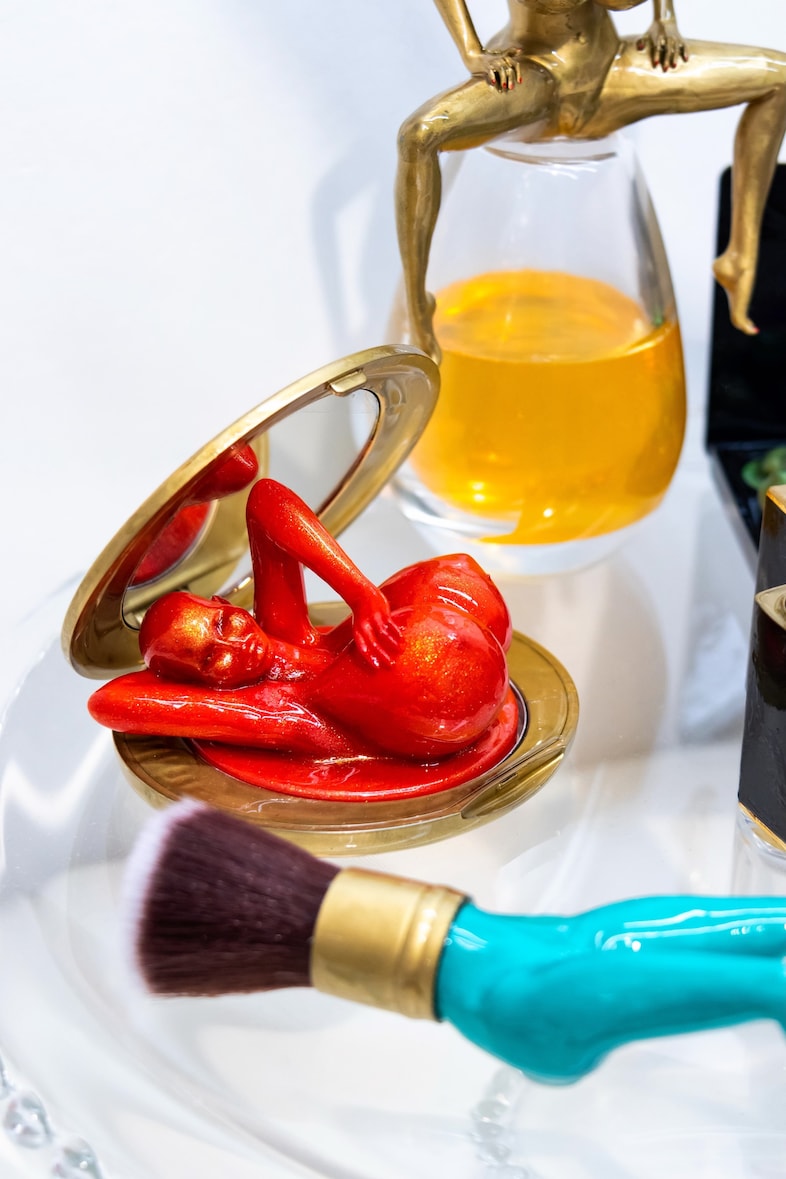
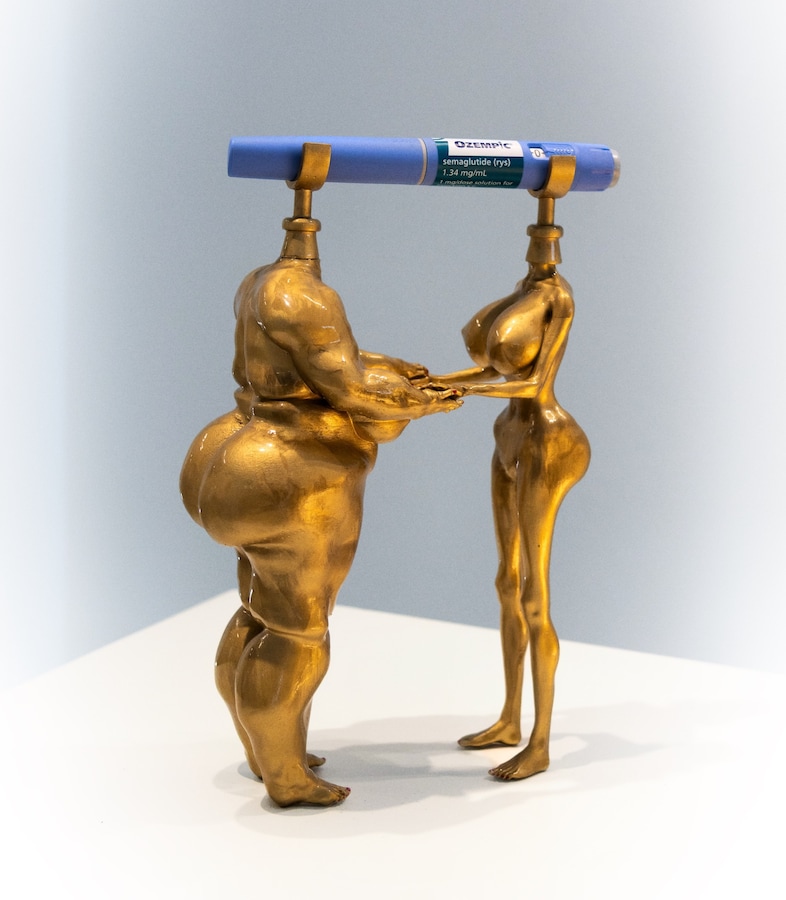
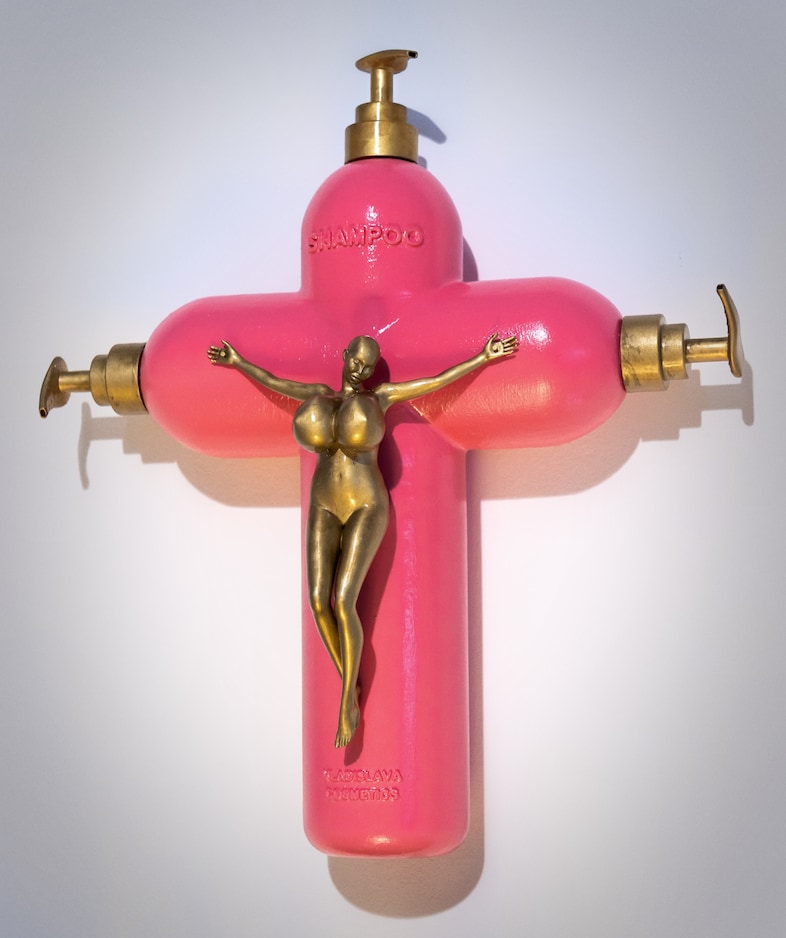
For example: a Looksmaxxing Hammer, anatomically designed to ensure maximum bone-smashing comfort for a perfect jawline. A Crucifix Shampoo. Are your split ends forked like a demon’s tongue? No problem! Pray your bad hair day away! Believe it! Or a luxurious Ozempic stand, designed to provide a tasteful storage solution for your skinny pen, because only poor people put their Ozempic in the freezer. Ew!
Also, maybe my favourite: a Marlbotox Ashtray, in case your hand gets tired during a Botox session, you can comfortably put your syringe to rest. Perfect for your next Botox party.
What made you want to push beauty products to such absurd extremes?
Ivana Vladislava: I’m a consumer myself. I ‘invested’ in my looks. I disfigured myself through excessive surgeries, and now I have to live with it. I’ve been damaged by the system and, funny enough, now I’m depending on it more than ever. I’m a prisoner in a self-made hell of silicone and lip filler.
First, I got surgery to look better and use less make-up, but now I need even more to cover my scars. I’m an endless pit of vanity.
You’ve spent much of your life actively transforming your appearance. At what point did beauty stop being something you wanted to achieve and become a medium you could work with?
Ivana Vladislava: You know… when your face is so tightly lifted that your mouth snaps open by itself when you bend over… that’s usually the moment you should stop and focus on other things!

Do you genuinely love beauty, or are you more interested in our societal obsession with it?
Ivana Vladislava: I love beauty, but I’m also afraid of the power we give beauty… Why is there no Disney movie about an ugly princess? Why are they always pretty?
Would you still transform yourself if nobody else could see the result?
Ivana Vladislava: No, I wouldn’t. Would you?
The beauty industry constantly tells us that we can improve ourselves. Where do you think self-improvement ends?
Ivana Vladislava: It ends with perfection, and perfection is artificial… like a doll. To be perfect, one must become a doll.
Has beauty become a form of class privilege, and what does that look like?
Ivana Vladislava: No, actually the opposite. Once, a surgically altered face was the ultimate status symbol because surgery was only obtainable for the rich. Now, however, since surgery comes in instalment payments and promo codes, the hair transplant, lip filler, cat-eye, Istanbul nose and teeth Insta-face package became a symbol of the “proletariat”.
So naturally, the trend shifted back to natural faces for the rich. Plastic faces look cheap – natural faces look rich.
Can self-objectification be liberating?
Ivana Vladislava: Yes, because you take back power over your body, but please don’t forget to be human. You shouldn’t be an object for longer than an exhibition… my suggestion.
What can you say through your own body that you couldn’t say through a sculpture or an image?
Ivana Vladislava: If my body could talk, it would scream: “Help, help me, stop it! Enough!”
If the beauty industry succeeded in making everyone beautiful, what would it sell us next?
Ivana Vladislava: Ugliness! It worked very well for fashion; wearing something repelling became a powerful statement.
Do you think ugliness could ever become the new luxury?
Ivana Vladislava: Absolutely, because luxury is rare, and if everyone can be pretty, where’s the fun in being pretty?
Beauty is only fun when everyone else is ugly.
Inner Beauty is for Ugly People runs until September 3 at Berlin’s Robert Grunenberg Gallery
