
Hurricane Rachel intensifies to Category 3 off Mexico coast as US hit by flooding

Want to bookmark your favourite articles and stories to read or reference later? Start your Independent Membership today.
Already a member?
Log in
Hurricane Rachel has intensified into a Category 3 system off Mexico’s Pacific coast, hitting the region just as parts of the US Southwest and northern Mexico recover from widespread damage and severe flooding triggered by the remnants of Hurricane Polo earlier in the week.
Positioned roughly 235 miles (380 kilometres) south of Baja California’s southern tip, the storm is crawling west-northwest at 3 mph (6 km/h). Forecasters at the National Hurricane Center expect further strengthening on Friday, followed by a gradual weakening over the weekend.
By Thursday evening, maximum sustained wind speeds had reached 120 miles per hour (193 km/h). Ocean swells created by Rachel are likely to produce life-threatening surf and dangerous rip currents along the Mexican shoreline, the NHC advised.
Mexican authorities said Thursday they remain on alert because of forecasts of very heavy rain in the states of Baja California Sur, Sinaloa, and Jalisco, and the possibility of landslides, rising river levels, overflowing rivers and flooding in low-lying areas.

On Wednesday night, the U.S. Embassy in Mexico warned U.S. citizens in Cabos San Lucas, a popular vacation destination for Americans, of beach and port closures and deadly rip currents.
The Pacific has seen an unusually busy hurricane season, which experts have attributed to El Niño, which has fueled crippling droughts in Mexico and Central America and floods in other parts of the region. In the Pacific, it has resulted in warmer waters and wind patterns that act as fodder for hurricanes. Tropical Storm Nolo continued its northwest approach away from Hawaii on Thursday, though the National Weather Service said it could strengthen into a hurricane by the weekend.
Northern Mexico still reeling from Polo
Parts of northern Mexico were still reeling from floods and wider destruction left by Polo. Hundreds of people remained displaced or had their homes destroyed, and at least 13 municipalities remained flooded Thursday night, according to local authorities.
Lucía Vegas, who lives in the small town of Bacabachi in the border state of Sonora, said it was a miracle she survived severe flooding as it swept through her community. She, her husband and three children were left homeless.
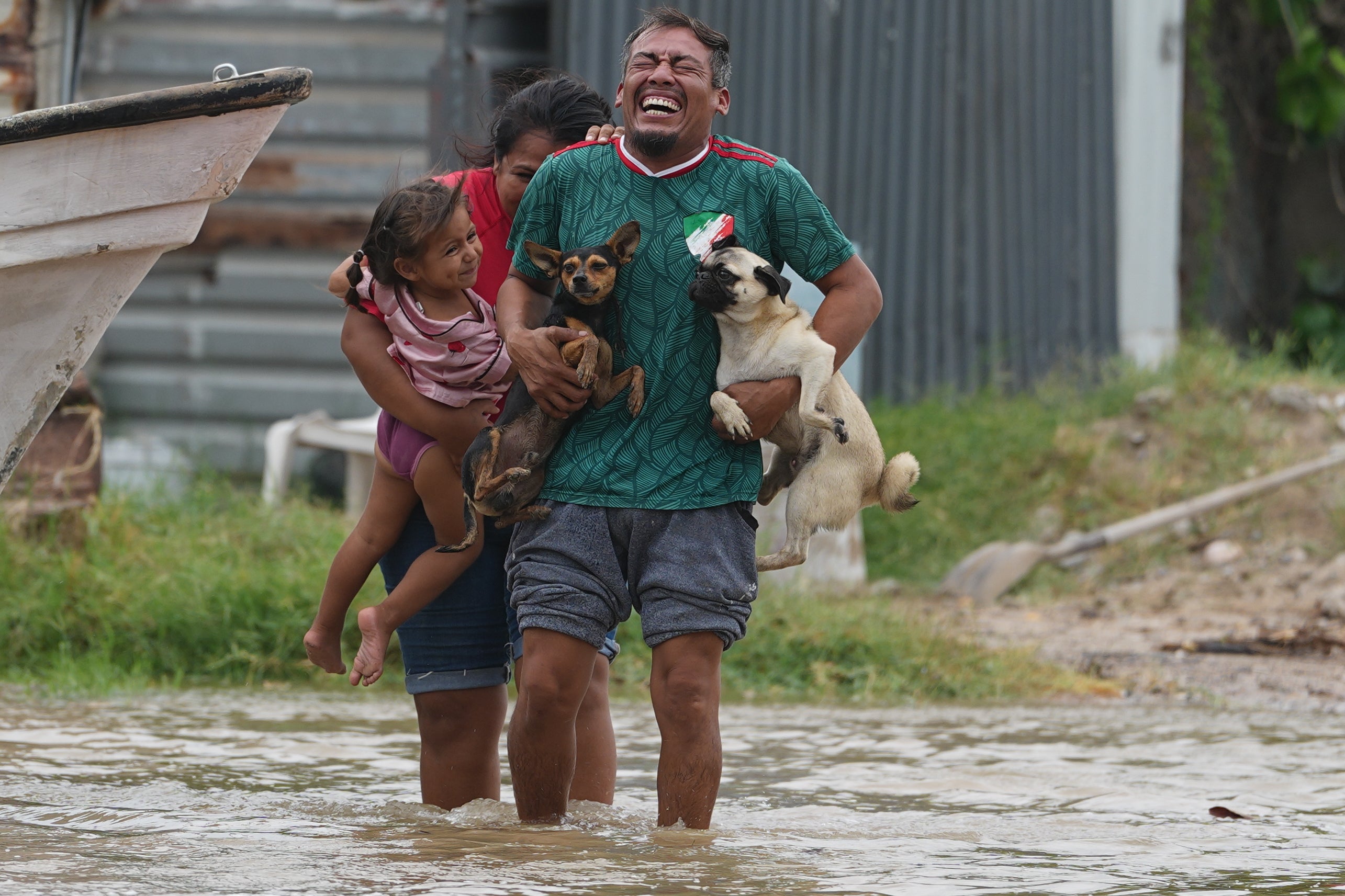
Vegas said she and her family managed to survive thanks to their dog. In the middle of the night, as the floodwaters were rising, the dog woke her by shaking water off herself, giving the family enough time to climb a ladder onto the roof of their home just minutes before it was completely flooded.
“Right now, we have been left with nothing,” the 39-year-old woman said through tears.
Storm remnants drench central U.S.
Areas in Texas, Nebraska, Missouri and Iowa were still under flood watch Thursday afternoon as storm remnants continued to batter the region, flooding streets and neighborhoods and setting off water rescues.
Wednesday was the wettest day on record for Lincoln, Nebraska, which received 6.1 inches of rainfall, according to the University of Nebraska-Lincoln Climate Office.
In Omaha, which received 4.7 inches of rain Wednesday, the fire department said it responded to 80 water rescues over a three-hour period ending early Thursday. Some floodwaters reached depths of 8 feet. Schools remained open. But many buses never made it out of flooded parking lots, prompting officials to ask parents to transport their students to school.

San Antonio, Texas, was under a flash-flood warning through Thursday evening, and the city urged residents to avoid unnecessary travel. More than 19,000 residents across the state were without power Thursday afternoon, according to PowerOutage.us. Videos posted on social media showed floodwaters in Texas creating waves along Interstate 35 in Denton.
In Chicago, a wastewater treatment and stormwater management utility urged residents to conserve water use to prevent flooding and stormwater backup.
“We encourage everyone to conserve water when possible to create more capacity in our systems,” utility President Kari K. Steele said in a statement Wednesday.
In Kansas, Gov. Laura Kelly issued an emergency proclamation on Wednesday ahead of the storms that allows state resources to assist first responders in hard-hit communities.
