
Our Hero, Balthazar: A dark comedy on incel culture and gun violence

Oscar Boyson knew he was making a risky film. In late 2022, he and a journalist, Ricky Camilleri, started writing a screenplay inspired by a revelation from the Uvalde school shooting in May that year. On the morning that 18-year-old Salvador Ramos killed 21 people, he messaged a 15-year-old girl from another country about his murderous intentions. In the aftermath, the girl, who had never met Ramos, received online vitriol for her inaction. In Germany, she was later prosecuted for not alerting the authorities.
The resultant film is Our Hero, Balthazar, a dark comedy that’s as uncompromising as its Robert Bresson-referencing title suggests. Tackling gun violence, internet loneliness and incel culture, Boyson’s directorial debut balances its eye-catching subject matter with a starry cast, many of whom are former YA heartthrobs: Asa Butterfield, Jaeden Martell, Noah Centineo and Avan Jogia. However, even with critical acclaim, the button-pushing feature almost didn’t get a UK cinema release.
“It’s very hard right now, unless it’s a horror movie, for an independent film to cut through,” says Boyson, 42, a New Yorker who admits his movie was rejected by Sundance, SXSW and Cannes. “We didn’t get that festival anointment that indie films need, but I knew the movie worked. It sucks when festivals function from a place of ‘I don’t want to offend anyone’. Every time we’ve put it in a theatre, people have a memorable, emotional experience.”
A co-founder of Elara Pictures with the Safdie Brothers, Boyson has producer credits on indies like Uncut Gems, Good Time, and Frances Ha. He’s speaking to me with Butterfield, who’s just flown into London for a preview screening. “People hear the words ‘school shooter’ and think, ‘We can’t show this,’” says the 29-year-old English actor. “People are reluctant to show something so potentially charged, but it’s a reality of what’s going on for young people.”
Whereas The Drama hid from its marketing that the plot revolved around an abandoned school shooting, Our Hero, Balthazar has been upfront about its subject matter. Perhaps too upfront. A common misconception is that Boyson’s film centres around its opening act in which a spoiled teen, Balthazar (Martell), uploads tearful YouTube videos about gun violence to woo a girl he has a crush on. When Eleanor (Pippa Knowles) expresses scepticism about his motives, Balthazar decides upon a solution: he tracks down a stranger, Solomon (Butterfield), who he believes is going to commit a school shooting. By talking Solomon out of mass murder, Balthazar will win Eleanor’s heart.
“This film isn’t about a school shooting. It’s about loneliness and isolation”
It is, indeed, a seductive setup: Balthazar catfishes Texas-based Solomon through AI-generated images, pornographic promises and an insistence that he’s a genuine woman whose sexual urges can’t be fulfilled in New York. However, it’s when the two men encounter each other in Texas that the film truly starts: instead of expressing outrage that his online girlfriend doesn’t exist, Solomon is delighted that someone travelled so far to meet him.
“There’s a certain kind of person who wants it to be those first 20 minutes, and, when it changes, they get uncomfortable,” says Boyson. “But that’s the point. This film isn’t about a school shooting. It’s about loneliness and isolation. School shootings are like a performance today. Political assassinations get meme-ified. If you’re on the internet, you think about what you play in that performance. For Balthazar, it’s the public victim, and for Solomon it’s the shooter – to the extent that Solomon admits in real life he can’t do that.”
Known for playing sweet kids in Hugo, The Boy in the Striped Pyjamas, and Sex Education, Butterfield deliberately sought a contrasting role. Sporting dyed hair and a Texan accent, Solomon certainly does the trick: he streams Pornhub on his phone in public; a female co-worker complains he’s creeping her out. If Solomon identified with a Martin Scorsese character, it’d be Travis Bickle in Taxi Driver, not the title character of Hugo. Butterfield is delighted when I confess to not realising he was in the film until the end credits.
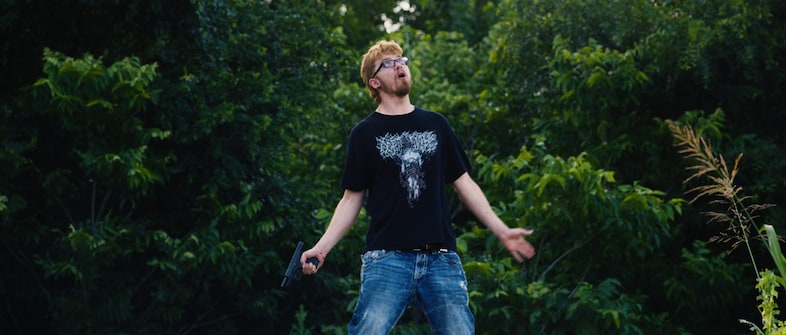
“I wanted to challenge myself,” says Butterfield. “We sent each other pictures of real people and school shooters, and were drawing on real things to build Solomon. There’s one in particular of this guy with blonde hair and glasses. Oscar asked me to dye my hair. At first, I wasn’t sure, but I’m so glad we did.” Can he disclose the identity of that real-life figure? “Um, I don’t know,” says the actor. “We haven’t thus far. Oscar?”
Boyson claims the answer is more nuanced: he names two non-aesthetic inspirations in Anderson Aldrich and Randy Stair, whose YouTube videos were archived. “When you go deeper into a lot of cases, it’s like: this kid, if they had anyone to talk to, it could have been avoided,” says Boyson. “Of course, gun laws would help, but we can also do better for young people.” He refers to the 18-year-old Tumbler Ridge shooter, who described his plans to ChatGPT. “Employees of ChatGPT flagged it to their bosses, and their bosses said, ‘No, we don’t get involved. If we did, that would mean we know we’re responsible in some way.’ OpenAI don’t want people reading about that story.”
Able to cry on command, Balthazar takes to weepy vlogging as his privileged childhood is devoid of friendship and romance. Likewise, Solomon is a self-hating loner, just one who lives in poverty in a trailer park with his ill grandmother. Upon meeting, the pair switch: Balthazar reveals himself to be a violent sociopath, while Solomon’s sensitivity emerges when he, unlike Balthazar, can cry genuine tears. Were there concerns about humanising characters inspired by school shooters?

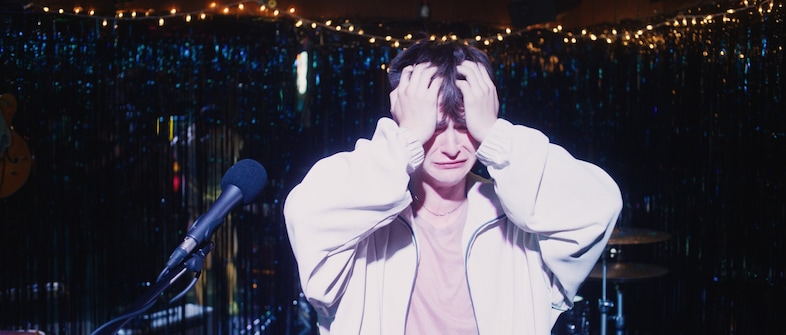
“You need to find the humanity inside characters to put yourself in their shoes,” says Butterfield. “A big challenge was getting audiences to empathise with Solomon despite his abrasiveness, misogyny and loud, uncomfortable behaviour. How do we show audiences why he’s like this, and for them to think they failed him?”
“It’s connected with those two guys [Aldrich and Stair] I mentioned,” says Boyson. “You can’t help but feel bad for them. The media has no interest in everything leading up to the tragedy. It’s always: ‘These are the good guys, these are the bad guys.’ This movie was a response to that. It’s about the decisions, nuances, behaviours, and failings that lead to violence, instead of the movies we usually get where people survive this terrible thing, break through the trauma and keep on. That, to me, is not interesting, and kind of offensive.”
Is it fair to label either character an incel, or is that a reductive term that avoids exploring their psychologies further? “It’s a new thing to take your loneliness, the way Balthazar does, and to make it public on social media, even if nobody’s listening,” says Boyson. “Being an incel is part of that. People take on this identity that they’re never going to get laid, and make it public.” However, Solomon denies that he’s an incel. Boyson debated using the word in the film at all. “For me, it’s a little reductive.”
The three of us end up in a conversation about the inherent shame of being lonely in the age of social media, apps, and 24/7 connection. “The internet has made people lonelier because you’re aware of how big the world is, and how tiny you are within it,” says Butterfield. “This movie shows how dangerous that can be.”
“There’s another part to that shame,” says Boyson. “The number-one gun violence in America is people killing themselves. For every kid who goes online and tries to make a friend, there’s probably a lot more who don’t even try, and just waste away in isolation.”
Our Hero, Balthazar is available on Digital HD now.
