
‘They want to break us so they can own us’: Canadian PM warns of US threat ahead of Alberta vote

Want to bookmark your favourite articles and stories to read or reference later? Start your Independent Membership today.
Already a member?
Log in
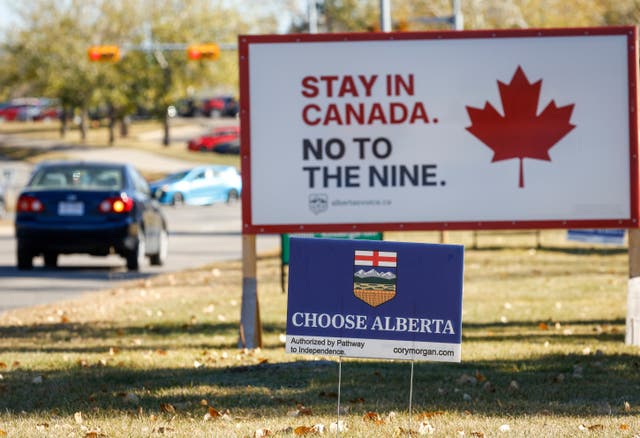
Canadian Prime Minister Mark Carney warned on Thursday that the United States is trying to break Canada apart to gain control of the country, urging voters in oil-rich Alberta to reject the path toward separation in Monday’s referendum.
The ballot is not a direct vote on immediate independence. Instead, citizens in Alberta—home to the world’s fourth-largest proven oil reserves—will decide whether to remain a province or direct the government to initiate legal procedures for a potential future vote on separation.
“This referendum comes at the worst possible time,” Carney told a crowd gathered for a pro-Canada rally in Calgary. “The world has become more dangerous and divided. Some outside our borders are working to break us so they can own us.”

While Carney did not explicitly mention the U.S. or President Donald Trump during that portion of his speech, he has made direct references in previous addresses.
The prime minister’s warning comes amid an ongoing trade dispute launched by U.S. President Donald Trump, following repeated threats from Washington to make Canada the 51st U.S. state. Carney has argued that Canada must build domestic economic resilience to decrease its reliance on the United States.
Carney urged Albertans not to treat the referendum as a symbolic protest against Ottawa, emphasizing that a decisive outcome could settle the separation question for years.
“Don’t be fooled by the idea you can ‘send a message’ with your vote,” Carney said. “This is not poker. A vote against Canada is a dangerous bluff that will lead to years of deep division and great uncertainty.”

Carney, who grew up in Alberta, spent Thursday campaigning in Calgary before speaking at the Forever Canadian rally at the BMO Centre. Organizers estimated that roughly 5,000 people attended the event, with attendees waiting over two hours to clear security screenings. A second rally with Carney is planned for Friday in Edmonton.
Earlier in the day, he highlighted the ties connecting the province to the rest of the nation, pointing to Albertans born or educated in other provinces, as well as firefighters arriving from across Canada to combat local wildfires.
Addressing the rally, Carney also acknowledged the deep-seated grievances driving regional alienation.
“The frustrations that many Albertans have felt are real,” he said. Growing up in the region, Carney recalled how federal decisions made locals feel “like our resources weren’t our own,” while more recent policy debates left residents feeling as though their energy contributions were “against the tides of history.”
This political stance marks a notable departure for a Liberal prime minister. Alberta has maintained a decades-long feud with Liberal governments in Ottawa over natural resources and federal reach.
However, Carney has diverged from policies set by his predecessor, Justin Trudeau, fast-tracking approval for a proposed oil pipeline to the Pacific coast while describing Canada as an energy superpower.
Carney framed the Pacific Link pipeline as tangible proof of a renewed partnership, stating it would generate over 140,000 jobs and fund vital social programs.
His line about reducing Canadian reliance on the American market drew the loudest applause of the event.
“Careful, they might think that’s election interference. A little touchy,” Carney joked, prompting laughter as he referenced U.S. Ambassador Pete Hoekstra’s prior warnings against Canadian involvement in U.S. elections.
Pro-independence organizers acknowledged Carney’s political skill while pushing back on his message. Tanya Clemens, co-chair of the group Let Alberta Decide, described him as “formidable for sure,” but argued his commitments to Alberta Premier Danielle Smith were merely “pinky promises” that leave long-standing grievances unresolved.
Keith Wilson, another leader within the pro-independence movement, dismissed Carney’s claim that global instability made the timing inappropriate.
“The worst timing for this, why? I don’t understand what’s the logic,” Wilson said. “Then it’s the best time for him to get back to Ottawa.”

Wilson argued that Carney should direct Parliament to repeal federal measures that separatists say harm Alberta, including authorities that could potentially tax oil exports in response to U.S. policy. Despite Carney stating he sees no value in using energy exports as leverage against the U.S., Wilson claimed federal intervention remains likely.
“It’s one cabinet meeting away,” Wilson said. “He’s gonna do it. He has to do it.”
Premier Danielle Smith, who called the vote but supports remaining within Canada, cast her ballot early on Wednesday in favor of remaining. She acknowledged that support for separation remains higher than she would like.
“Canada can still work,” Smith said following her vote. “We just need to make some changes.”
Daniel Béland, a political science professor at McGill University, observed that Carney’s reception in Alberta is “highly unusual” for a Liberal prime minister. He noted that Carney has benefited from a “Trump effect,” as trade tensions and statehood comments from Washington have united Canadians behind federal leadership.
The push for separation has grown from a fringe movement into a provincewide vote following the COVID-19 pandemic and the 2022 Freedom Convoy. Activists who initially organized against vaccine mandates eventually shifted their focus toward provincial independence.
Clemens noted that the pandemic era provided activists with valuable political organizing experience, adding that supporters view Monday’s referendum not only as a potential step toward independence, but as vital leverage in future negotiations with Ottawa. Advance voting ends Saturday before Monday’s final vote.
