
Biomorphic tattoos: The botanical trend for our hyper-digital times

Biomorphic tattoos
Gallery / 30 images
As anxieties around AI and the climate crisis reach a fever pitch, people are turning to nature as a source of resilience. The act of guerilla gardening, spearheaded by community-led organisations like Grow to Know, has swept the streets. Elsewhere, that impulse has taken a more literal form, like the viral TikTok videos of people making DIY “natural tattoos” by slapping a fern onto their arms or tote bags. Now, a new tattoo style is taking that affinity for the natural world one step further, etching botanical forms directly onto the body.
Rooted in the 20th-century Biomorphism art movement, these inky, botanical abstractions are increasingly cropping up on digital feeds and Instagram carousels. Characterised by fine-line etchings of organic forms, biomorphic tattoos often draw on naturalistic elements – the “spiral of a snail’s shell or the amorphous shape of an amoeba”, as art critic Jennifer Higgie describes them in relation to original movement, for example – and reconfigure them into new, abstract designs. While manifestations of plants in body art can be traced to centuries-old cultural rituals like Mehndi or seen in the proliferation of botanical tattoos in late 19th-century Western Europe, this trend feels more attuned to the intricate structures of biological cells than to literal botanical forms.
Goldensu, an East London-based tattoo artist operating out of Mercury Design Studio, has witnessed the growing popularity of these designs. “A few years ago, styles like Cybersigilism and mechanical geometry were incredibly popular. While those aesthetics still have their place, I’ve personally felt a noticeable shift in what my clients seek,” she tells Dazed. The style reflects a broader resistance to artificial structures, turning instead to primordial, organic forms for inspiration – a shift Goldensu links to technology’s increasingly dominant role in our lives.
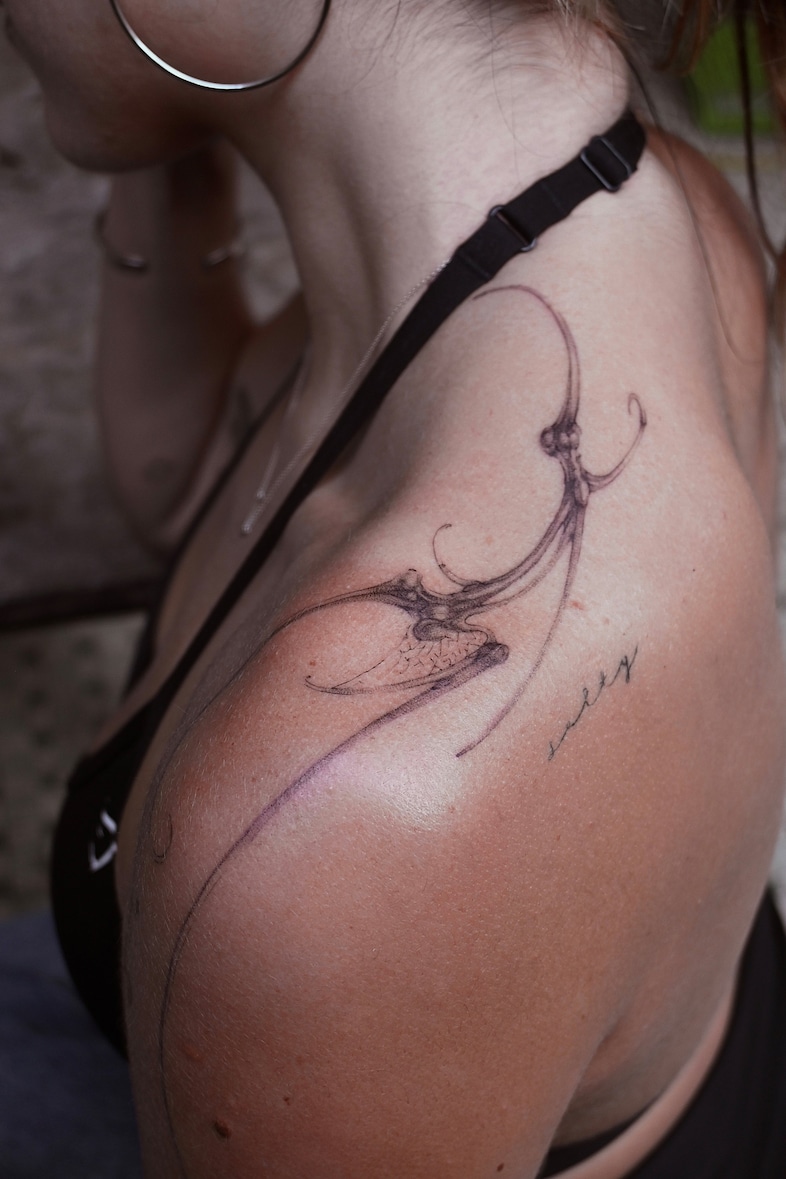
“As AI and screen-based activities continue to dominate our routines, people seem to be looking for something contrasting on their bodies, forms that are raw and deeply organic,” she says. Goldensu’s designs draw on experimental graphic aesthetics, infusing them with subtle nods to nature. Many of her pieces are created freehand, lending them a fluidity that complements both the subject matter and the natural contours of her clients’ bodies, such as vine-like tendrils that sprout over a collarbone and trail down an arm. In one design, she plays with negative space and light diffusion to create a relief of an indeterminate climbing plant.
Biomorphic pieces can also symbolise someone’s commitment to themselves. “People are paying much more attention to their personal well-being and spirituality now,” Goldensu says. “Many of my clients choose botanical designs during major life transitions or healing journeys. These kinds of tattoos help to conceal scars but also change how someone views a part of their body they might have previously struggled with.” The trend also draws on the long history of the natural world as a source of symbols for queer and gender-fluid identities, from the literal (like the many plants that change sex) to the metaphorical. In reference to the works of the ancient lesbian poet Sappho, sprigs of lavender and bunches of violets are often used as subtle queer tattoos. Beyond offering self-assurance, the mental health charity Mind suggests that being surrounded by nature can help us cope with fears around climate change. Perhaps, by etching these positive reminders onto the body, we can draw on them as a source of resilience while navigating an evolving world.

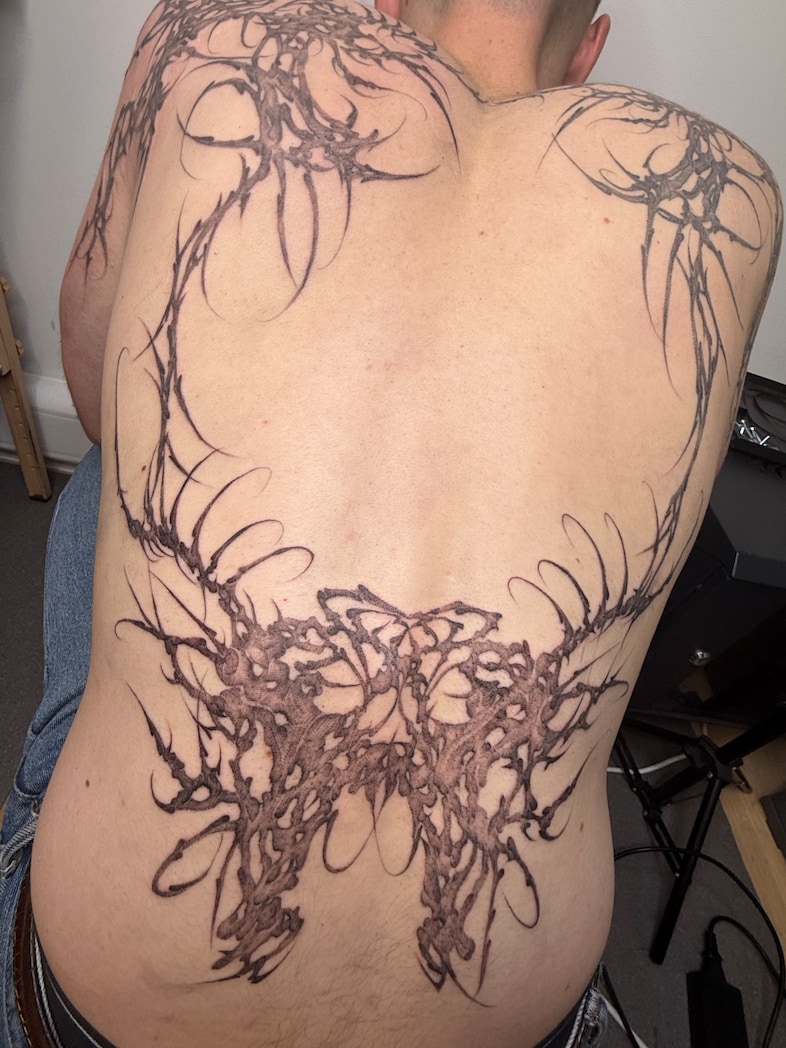
While today’s internet is awash with anxiety about AI and dystopian visions of the future, tattoo artist Sofia, known as Pale.vine online, envisions a future grounded in nature’s capacity for evolution and adaptation. She sees biomorphic tattooing as a way to imagine what a more harmonious, symbiotic relationship between technology and nature could look like.
Based in Belgrade, Serbia, Sofia describes her tattoo style as biopunk, an offshoot of the xenobiology aesthetic that twists organic structures through a science-fiction lens. Playing with scale, her drawings are often magnified until they seem to creep across the body like sophisticated, futuristic parasites. “What I find especially interesting is that nature and technology no longer exist as two completely separate worlds,” she says. “Through my designs I’m not imagining nature in direct opposition to a technological future, but creating one where it has already inspired the foundations.”
Sofia’s artistic influences range from Dutch fashion designer Iris van Herpen and Pierre Huyghe’s immersive installations to her own curated Instagram carousels, which feature photos of Ermine moth cobwebs, shed snakeskin and microscopic structures of otherworldly plants. Her clients often don’t know why, exactly, they gravitate towards her organic abstractions. “Sometimes people simply see my work and say, ‘I don’t really know what it is, but I want something like that on my body.’ And I love that reaction. I don’t think we always need to be able to rationally explain why we are drawn to a certain form.” In a society increasingly reliant on quantitative data, from hyper-individualised health-tracking wearables to social media KPIs, maybe it’s simply refreshing to embrace a tattoo style that resists easy definition.
