
Carrying: The Substance meets Rosemary’s Baby in this trans body horror

You’d be hard pressed to find a single cliché in Samantha Josephs’ debut novel, Carrying. One sentence reads: “Her heart drops to her surgically-constructed vagina”. Another: “You’re too cunt to die”.
For the author, this was entirely the point. On the phone, she tells me she approaches crafting a sentence similarly to Ocean Vuong, who believes writers should aim to write sentences the human species has never encountered. With Carrying, a comedic trans body horror hitting shelves on October 6, there was ample room to work with – trans fiction is still a ‘small’ genre in the publishing industry. “It carries that burden of knowing this book will be representing people who have not been represented as much,” Josephs says. “But it also just feels really fun, fertile ground.”
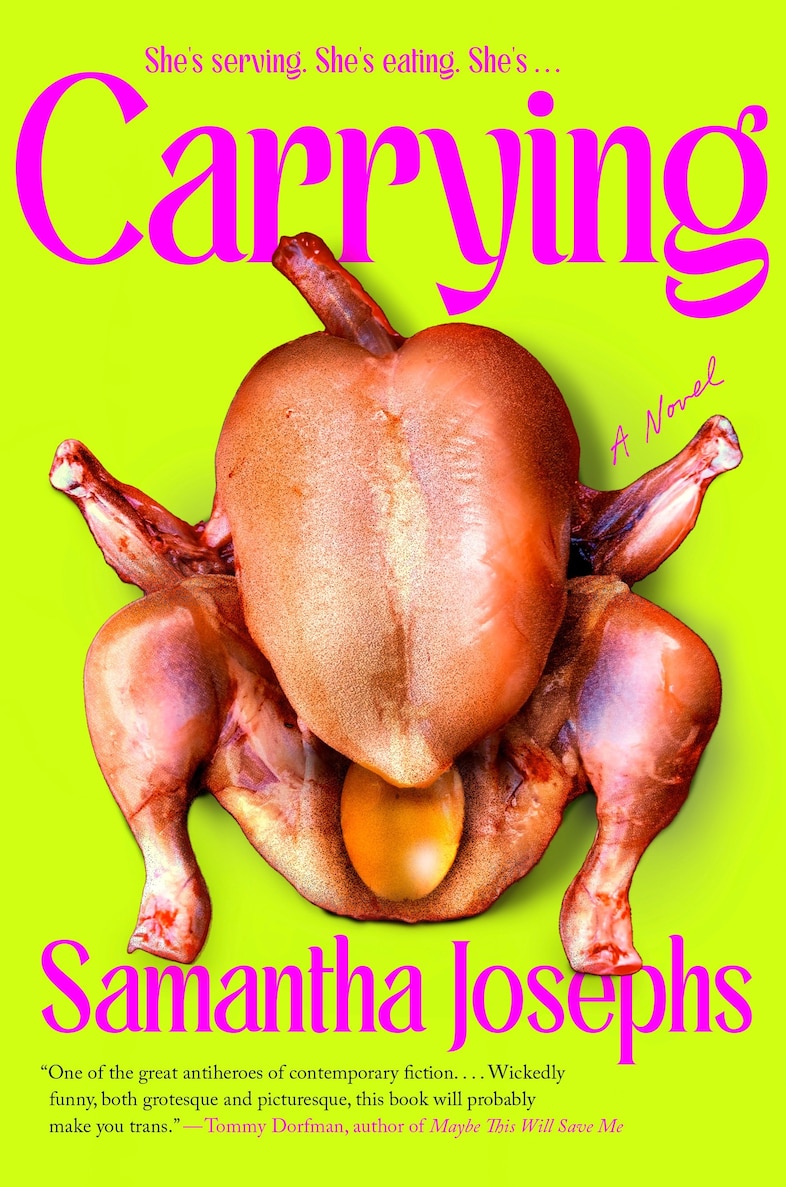
Speaking of fertile: Carrying follows Martha, a perfect wife and stepmother whose husband, Leon, doesn’t know she is trans. After some faked miscarriages (which she calls “a solo performance”, needing “a whole cast” for IVF), Martha actually falls pregnant. What follows is what Josephs refers to as a “five minutes in the future” sci-fi story, blending the horrors of pregnancy with the realities of being a trans person, and the pressures that unite all women. All of this is wrapped up in a tale of a housewife – which Josephs is fascinated with because the figure is both an iconic and “unbelievable goal” for trans women, but also a labour position, where your husband is your boss.
Before writing Carrying, Josephs picked up writing gigs for apps, video games and podcasts after studying screenwriting at the University of South Carolina. She even had a stint as an erotica writer – a story that starts with her sexting an editor at an erotic magazine, and being so good at it that she landed a role. “That is the one instance I’ve ever slept my way to the top, and it also was not the top in any way,” she laughs. On the side, she’s also a “semi-retired” drag queen.
Josephs knows that the idea of a woman keeping her transness a secret from her husband and experiencing motherhood is controversial, especially in today’s political climate. The idea for the novel itself came from taking two transphobic tropes – that trans women are “tricking” straight men, but you can “always tell” when someone is trans – and combining them to reveal the inherent contradiction. “You can’t actually trick someone if you can always tell,” she says. “I wanted to explore how it would feel for a trans woman to do things you could consider tricking someone and ask, why would she do this? How would she feel doing this? Because those stereotypes are always from the perspective of the outsider.”
“With a baby, there’s a literal new life, and in transition, there’s a new life of your own”
Another trope that Josephs played with is the idea that trans women can never be “real women” because they can’t get pregnant. This, of course, reduces womanhood to the ability to reproduce alone. And even the act of getting pregnant is spoken about in culture through such polarities. On one end, it’s presented as a beautiful “miracle of life”, but anytime a pregnant person shares that their nose has gotten bigger or their experience of childbirth, it’s deemed so horrendous that others comment: “Adding to my list of reasons not to get pregnant”. Josephs’ writing thrives on this juxtaposition.
Josephs says she knew the quest for love and family would be a good conduit for a larger audience, drawing from her own experience of medically transitioning to map gender dysphoria onto pregnancy. “For Martha, desire is deeply entwined with her body and specifically her medical transition – how painful that is, how expensive it is and how much time it takes out of your life,” she says. “Having gone through many of those procedures myself, I knew imagining a baby undoing all of those things would put her in a position of deciding what’s more important to her: the looks or the baby.” Throughout the book, Martha and Leon’s sex life fades and flutters in a way that isn’t uncommon during pregnancy, which shakes her relationship with herself.


While Martha knows she is a medical marvel, perhaps the scariest thing about Carrying is that every single symptom she experiences is a version of pregnancy symptoms that are possible. Her treatments, however? Those are delightfully made-up: like eating rancid, raw chicken, putting gasoline up her asshole and putting electric cables on her nipples. After digging through TikTok pregnancy horror stories, Josephs says she was thinking about what mentality you have to have to get through that. “With the threat that you can die, how do you accept all of that as the cost you will pay for a child?” she says. Each of Martha’s chosen “treatments” has different deliberate tie-ins: Josephs says the gas, for example, was a nod to LA car culture, and the electricity is a reference to not only Frankenstein but the history of electroshock therapy for gay and trans people.
Josephs says medically transitioning was an act of “giving birth” to herself in a way. “This super painful, risky thing is going to turn me into an unrecognisable monster with the hope that on the other side there’s this completely new life for me,” she says. “With a baby, there’s a literal new life, and in transition, there’s a new life of your own.” While working Carrying, however, Josephs watched court cases against trans people emerge, like the one of Ciara Watkin, who was sentenced to prison for allegedly “deceiving a man into sexual activity”. After Watkin’s photo was released on social media, she said she watched her be mocked and ridiculed. “That was a scary moment of these themes becoming someone’s real life and putting them in jail,” she says.
“Horror reminds us that no matter how in your head you are, you are flesh and blood and the line between alive and dead, maimed or in pain is so thin”
Amid the attack on trans rights and the perpetuation of tropes that have dangerous consequences for trans lives, Josephs found safety and freedom in the genre of queer horror fiction – a medium and genre largely immune from having a Fox News anchor pick it up, although, as she says, “no press is bad press”. The result is a read that feels truly unique, holding the weight of serious and timely topics with complexity, humour and a similar energy to other great body horrors like Rosemary’s Baby. With the success of The Substance in 2024, another one of Josephs’ influences, it’s something people are definitely craving right now. (Carrying has even already secured an upcoming movie adaptation.)
“People feel so disembodied, looking at emails and spreadsheets all day,” says Josephs. “Horror reminds us that no matter how in your head you are, you are flesh and blood and the line between alive and dead, maimed or in pain is so thin.” Without spoiling the ending, which is a fun one, Josephs says the beauty of pregnancy books and films is that you know it’s all leading to “something big”.
