
GTAVI: An exclusive deep dive into the video game of the decade

GTA VI – The Autumn 2026 Issue
Gallery / 7 images
This story is taken from the autumn 2026 issue of Dazed, which is on sale internationally from September 10. Pre-order a copy of the magazine here.
On the sweltering Leonida Keys, sweat slicks the skin of two lovers on the run as they toast new beginnings, watching the sun set over the water. A breeze blows through their hair, and you can almost feel the condensation dripping from the cold beer bottles in their hands; in the background, locals gather on the weatherbeaten dock, indifferent to the story unfolding between the outlaws. Elsewhere, a few miles north, tanned bodies of all shapes and sizes swarm the sand on Vice Beach. Further north still, locals are caked in mud, kicked up from the back of a dirt bike or spattered on a stars-and-stripes bikini. And as night falls back in Vice City, sweaty crowds surge to deafening hip-hop beats, spilling out from clubs on to the neon-lit streets.
It’s been 13 years since Rockstar Games released Grand Theft Auto V, one of the most acclaimed – and controversial – video games of all time. And it’s been roughly the same amount of time since work began on its sequel, Grand Theft Auto VI, which transports the action from San Andreas (closely inspired by real-life southern California) to Leonida (based on Florida). That’s more than a decade of anticipation, meaning there’s “unprecedented pressure” on the follow-up to meet expectations, as Rob Nelson, head of development and co-studio head at Rockstar North, tells Dazed: “However, I don’t know that any amount of external pressure could compare with the pressure we put on ourselves as a team.”
If you accept that video games are an artform, then Rockstar Games has produced two of the most significant works of the 21st century so far: GTAV and the western-themed adventure Red Dead Redemption 2. The numbers speak for themselves: in 2013, the former broke the record for the fastest-selling entertainment product of all time, earning a billion dollars in just three days – more than any book or Hollywood film. Five years later, RDR2 took the second spot. But the latter also came with a gear shift. While GTA satirised modern life with wacky characters, high-octane car chases and explosive gunfights, RDR2 was hailed as one of the most realistic and immersive games to date, with a slower, more emotional tone suited to its storyline.
GTAVI promises something in between the two. The open-world game is set in the same fictionalised US that serves as the backdrop for the rest of the series, with all the weapons and supercars you’d expect, but the world is more grounded and reactive than before – gone are the days when you could traverse the city like a god. Now, players’ actions have consequences. Walk down the street with a rifle, and the city will have something to say about it. More and more, the games are converging on real life, and non-player characters (NPCs) are acting… well, less like NPCs than ever. For some gamers, there’s a fear that what GTAVI gains in immersion, it loses in the chaos and anarchy that have been part of the series’ DNA since the outset, but for Rockstar, the goal is to create a world of total immersion, which reacts more realistically than ever to what you choose to make of it.
“We look back at our previous games with a critical eye and see where we want to evolve based on what we didn’t do as well as we would have liked to, either because we didn’t have the time, resources or technological capabilities, or in some cases things we just didn’t do as well or consider as fully as we could have,” says Nelson. “A lot of what we do is very iterative – we adjust a lot of things by feel based on what is working and what isn’t.”


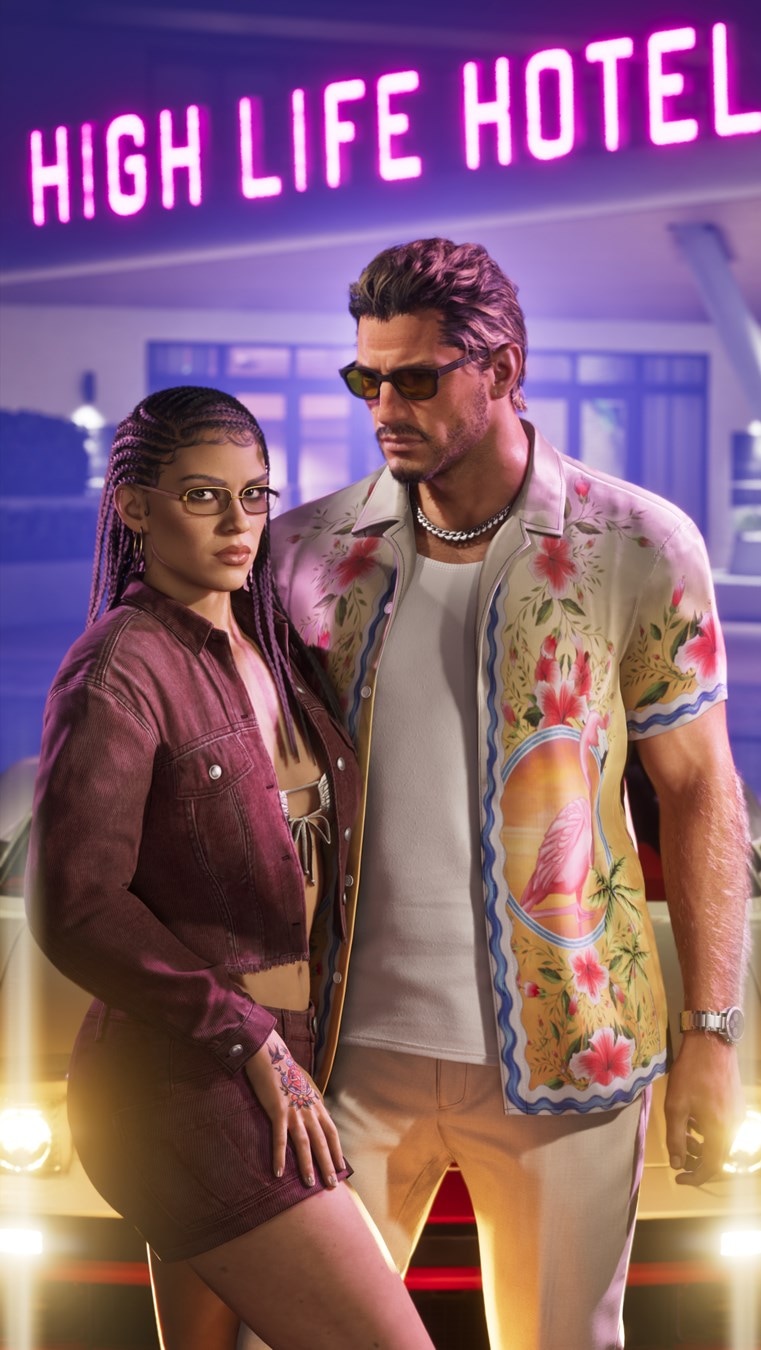
The story has evolved, too, with higher stakes and characters grounded in all aspects of the world they inhabit. Players step into the shoes of Jason Duval and Lucia Caminos – an ex-military drug runner and a fighter fresh out of prison, respectively – and can choose to either play as a couple, or go off and cause chaos independently. This marks the first time that a GTA game has featured a playable couple in the lead role, which makes for some unique scenarios: on the way to a job, for example, players can cruise along the highway as Jason, or swap to Lucia in the passenger seat to scroll on the in-game phone. (Yes, there are working social media feeds – what satirical take on 2020s America would be complete without them?) When the job inevitably goes wrong and spirals into a car chase, the fluid system enables players to take the wheel in one moment, then fire on pursuers out of the passenger window the next. And afterwards, when it’s all blown over, they can skim across the waves on a jetski, admiring the Leonida seascape and leaping dolphins with their arms wrapped around their partner’s waist.
True romance like Jason and Lucia’s usually takes a back seat in GTA games, which, when it comes to matters of love and sex, are more commonly associated with strip clubs and underground sex work. But GTAVI is very consciously staged as “a Bonnie and Clyde-type narrative”, says Rupert Humphries, senior vice president of narrative at Rockstar. The trailers alone feature a slew of intimate cutscenes from Jason and Lucia’s own fugitive tale, which showcase the special attention that Rockstar’s art and technology teams have paid to how bodies look and feel – a hand on a ribcage, hips swinging on a packed dancefloor. For some gamers, the story might even serve as one of their earliest encounters with a romantic (albeit crime-ridden) relationship, where their choices can have repercussions that cut much deeper than Rockstar’s previous titles or “honour” systems that reward conscientious game playing.
“The thing we love about this medium is the way these characters aren’t empty avatars that you can do whatever you want with… Their story becomes a journey you share with them” – Rob Nelson, head of development and co-studio head at Rockstar North
Lucia is also the first fully fleshed-out female lead in a mainline GTA game. Before her, it’s male protagonists all the way down, dating back to 1999. (Grand Theft Auto’s 1997 debut featured a 50-50 split of male and female protagonists.) Previous instalments, including GTAV, drew criticism for misogynistic themes and underdeveloped female characters, but the series has evolved, and hopes to attract more female gamers to its previously male-heavy player base. In Lucia and Jason, they have created characters with rich, complex identities, while still leaving ample room for players to make them their own. “The thing we love about this medium is the way these characters aren’t empty avatars that you can do whatever you want with,” says Nelson. “Their story becomes a journey you share with them.”
The joy of GTA is as much about what players do with the moments in between story beats, though. And Rockstar offers what has been – up until now – as close to true freedom as you’re going to get within the confines of a virtual world. “We want to enable as much self-expression as possible,” says Nelson, “without losing the essence of the characters.” Take GTAV’s version of 2010s Los Angeles, for example: you could rampage through the streets with an assault rifle or a tank, cruise by the Pacific in an open-top car blasting Frank Ocean, or even relax with a round of golf. RDR2 pushed things further: between shootouts, the player-controlled protagonist Arthur Morgan could retreat into the wild to fish, hunt big game and make a campfire under the geographically accurate stars, or lose time drinking and gambling in remote frontier towns. Come down out of the mountains a few in-game weeks later, and he’d have grown a long beard and a mane of hair, and visibly lost some weight (or gained it, depending on your skill with a bow and arrow). Bar fights, meanwhile, would leave him bruised and scarred.
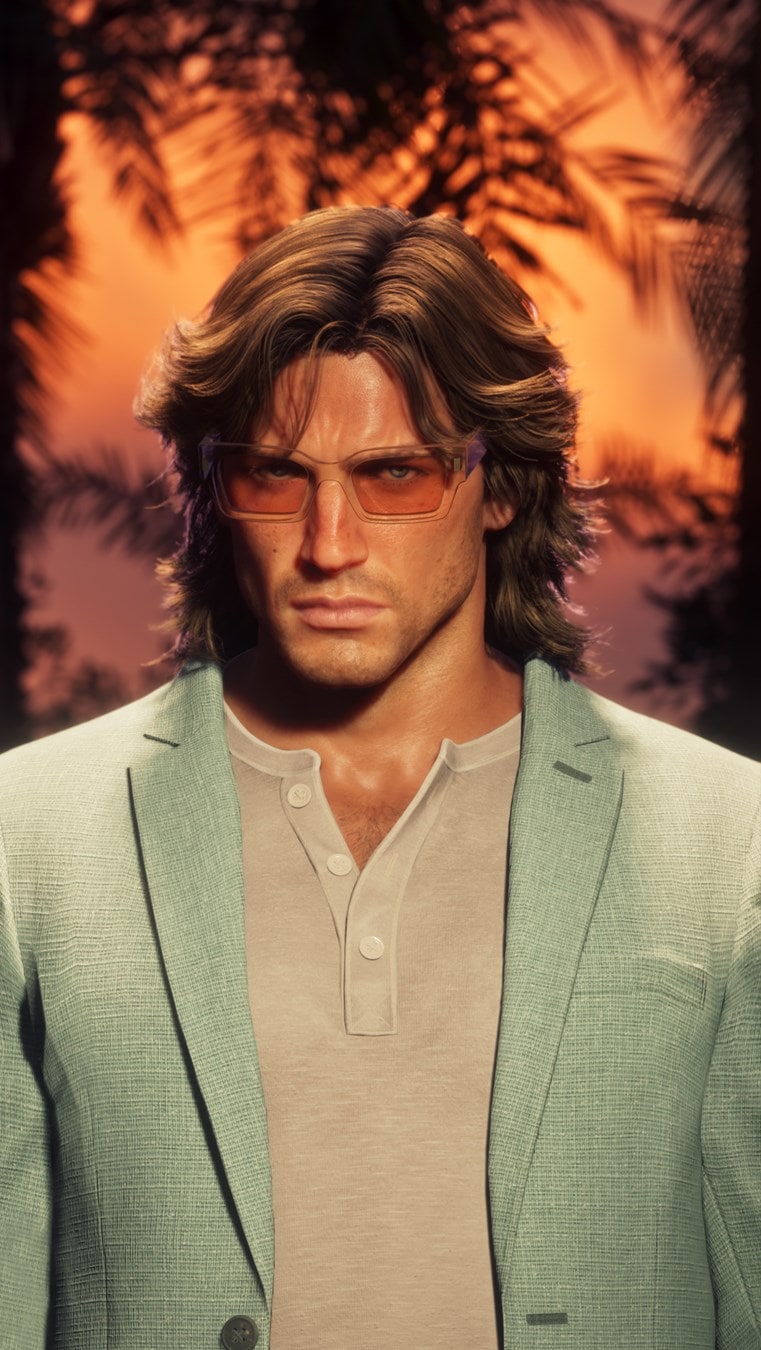

GTAVI marks the return, and expansion, of these interactive systems that alter the protagonists’ bodies. Food affects Jason and Lucia’s weight, while exercising visibly builds and tones their muscles. And, if you end up spending a long time away from your bed, on the run from police or on a multi-day bender, their features are going to pay the price for that as well. The effect is a bit like The Picture of Dorian Gray – only, instead of your soul being recorded on a spooky painting in the attic, your habits and sins are written on to the faces and bodies of the game’s avatars. This kind of interactivity is unique to video games, shaping the virtual world and the player’s responses to it in turn. Between visual feedback mechanisms, deep relationship mechanics and the heightened realism of the world they inhabit, people might even think twice about going on the arcade-style rampages of GTA games gone by, once they land in Leonida.
“We will meet with ex-criminals, law enforcement, club promoters, gun dealers and anyone notorious or influential who’ll take our calls. We hang out, get a feeling for the place, listen to the stories…” – Jamie-Lee Lloyd, senior art director for characters
Vice City, the heart of GTAVI’s Leonida, is based on Miami. This means players can expect encounters with virtual iterations of Florida Man, the cultural archetype-turned-meme known IRL for wrangling alligators, drunken antics and literal grand theft auto. But these outsized characters are just one bizarre facet of a world built with “an open mind, a genuine appreciation and a deep curiosity” towards the culture it’s based on, says GTAVI game writer Michael Wiafe. “It’s easy to go in with a cynical view and say, ‘Well that’s weird, put it in the game,’ but we couldn’t just stop there. We have to bring a sense of discovery to the players too, not just repeat cliches that already exist.” To do that requires years of on-the-ground exploration: various groups of Rockstar employees have visited Miami and its surrounding areas over the last decade, and there is a dedicated research team embedded in the city. “That firsthand context helped us understand the visual markers and nuances that define the identities we wanted to represent,” explains Jamie-Lee Lloyd, senior art director for characters, “while filtering them through the unique lens of GTA and the stories we wanted to tell.”
Humphries agrees that these experiences are essential, noting that a majority of the game’s characters are born out of this research, which includes meeting real people who call the state home. “We will meet with ex-criminals, law enforcement, club promoters, gun dealers and anyone notorious or influential who’ll take our calls,” he adds. “We hang out, get a feeling for the place, listen to the stories, cross-reference that with books and journalism, and try to get to the heart of which characters will bring the city we are creating to life.”

In GTAVI, this cast includes various criminals, from old-school drug runner Brian Heder and his conspiracy-obsessed associate, Cal Hampton, to suave bank robber Raul Bautista. Elsewhere, the lines are blurrier. Vice City legend Boobie Ike oversees a private empire including the Jack of Hearts strip club (a GTA staple) and a music studio, overseen by the young, opportunistic Dre’Quan Priest. “We love Miami music, particularly Miami bass, going through to more recent Miami artists like Kodak Black and Sexyy Red,” says Humphries. “We were also really interested in how the hip-hop scene in Miami exists in house parties in Overtown, clubs like Booby Trap on the River, and then high-end places on South Beach where bottles can cost thousands of dollars. We needed characters who could take us through those worlds.” In the years since the release of the last game, the music industry has witnessed a shift in focus towards female artists, as represented in the game’s rising stars Real Dimez, whose journey can be traced via in-game viral social media posts.
“[GTA VI’s] brands reflect the aspirations, aesthetics and lifestyles of the people that inhabit our world’s spaces” – Stu Petri, vice president of 2D/UI design
With characters like these, anchored in a specific place and time, is there a risk of tipping back into reductive Miami parodies, especially given the game’s long lifespan? If today we look back on GTAV’s hipsters and geeky tech bros as a kind of 2010s time capsule, what kinds of cultural archetypes will we look back on when we revisit GTAVI in another 13 years, and will they remain true to how we experience them in the present day? The artists, writers and developers at Rockstar are conscious of the tightrope they’re walking. Take Stu Petri, vice president of 2D/UI design, who has overseen much of the careful world-building in GTAVI, including the many in-game products, brands, shops and campaigns that bear more than a passing resemblance to their real-life counterparts. “Our vision is to build a vibrant, believable culture,” he says, meaning that every brand, from fashion label to car company, has to feel like more than just a one-off joke, as if it actually exists and serves a real purpose in Leonida’s cultural ecosystem. “These brands reflect the aspirations, aesthetics and lifestyles of the people that inhabit our world’s spaces.” Drop into the game as Jason or Lucia, and they come to reflect your inner life as well, lending an extra layer of meaning to each haircut or outfit choice.

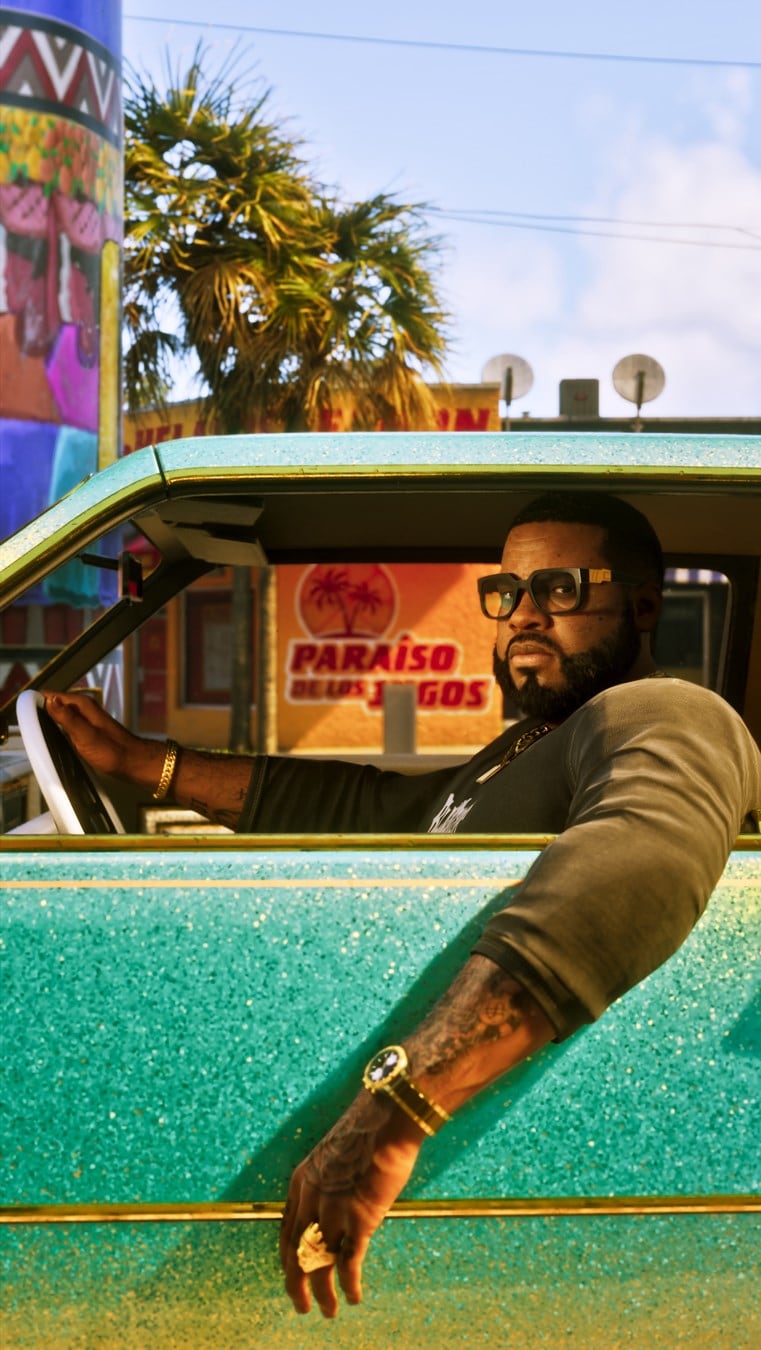
The potential to explore a diversity of cultures and lifestyles is partly why the series ended up circling back to Vice City and the state of Leonida in the first place, Nelson suggests: “Florida and Miami have perhaps one of the most diverse and interesting populations in the world.” Few know this better than Miami-based stylist Jillian Carr, who has worked with Rockstar since 2023, designing an in-game “fashion ecosystem” that aims to reflect all the nuances of “taste, lifestyle, affluence and individuality” that are displayed in the city, and in America as a whole. “Vice City is built around vanity,” says Carr. “Between social media, celebrity culture and a constant flow of tourists, appearances carry significant weight, and trend cycles turn over quickly.” This brings us back to the background NPCs. Young and old, tall or short, tattooed, pierced or modified with plastic surgery, wearing throwback Hawaiian shirts, sharp suits, luxury fashion or muddy combat gear, the bodies and clothes of the virtual masses are also far more varied than in previous games, and more tailored to their local environments, from Vice City’s Little Cuba to the wilderness of Mount Kalaga national park.
“To bring that diversity to life in-game, we developed new tools and pipelines that enabled us to build the most detailed and varied character population we’ve ever created,” says Lloyd. But ultimately, he adds, making that population feel authentic comes from more than appearance alone. “It’s the combination of how a character looks, moves, interacts and expresses themselves, brought together through collaboration across multiple teams.” Wiafe hopes that all of these systems working together deliver “a landscape that players feel they’ve been dropped into and are made to endlessly roam around in.”
“Vice City is built around vanity. Between social media, celebrity culture and a constant flow of tourists, appearances carry significant weight, and trend cycles turn over quickly” – Jillian Carr, stylist
To pull off the technical and cultural feats required to build a world of the scale, depth and interactivity of GTAVI, the Rockstar team has more than doubled in size since the release of Red Dead Redemption 2. It has offices around the world, with one branch in LA dedicated almost solely to the world of in-game pedestrians (NPCs). More than 50 real street artists were brought in to design murals in places like Vice City’s Stockyard (based on Wynwood, Miami). The team that deals with vehicle handling is made up of literal race-car drivers.
Again, it all adds up to a lot of pressure, and not only because the investment of time, money and effort is on a par with several wonders of the world – at the time of writing, there’s an online rumour that the game cost more to build than the Burj Khalifa in Dubai. But also because, if all goes well, this is a work of art that people could spend the next decade with… at least. “It is a lot of pressure internally and externally, but that pressure is ultimately a privilege we know we are fortunate to have,” says Nelson. “All we want to do is deliver for our audience.”
This story is taken from the autumn 2026 issue of Dazed, which is on sale internationally from September 10. Pre-order a copy of the magazine here. Grand Theft Auto VI is out on November 19 for PlayStation 5 and Xbox Series X/S.
