
A coming-of-age story told across 1,000 photographs

Nick Haymes, Chronograph (2026)
Gallery / 6 images
“A lot of my projects tend to be a little oversized,” says Nick Haymes, a photographer who can spend years – sometimes decades – with his subjects. His previous books, to mention just a few, have followed a group of skateboarders, a young actor navigating sudden fame, and his friend Love Bailey through 15 years of transition. Now, with Chronograph, he’s surfacing 25 years of photographs made closest to home: his partner Lina Kutsovskaya, their sons Philipp and Lawrence, and the ordinary, unruly business of being a family.
Published by SPBH Editions, an imprint of Mack, Chronograph brings together nearly 1,000 photographs made between 2001 and 2026, spanning over 448 pages and the distance between New York and Los Angeles. The images track children growing, bodies changing, birthdays and holidays, arguments, accidents, illness and loss. The photographs are affectionate without being sentimental, and funny without smoothing over the harder parts. “A lot of it is very relatable nothings,” Haymes says. “There’s no crazy thing. It’s all very obvious. But those nonsensical things make you aware of living more than big monumental moments. Everybody you know, or probably 90 per cent of us, have had a family album at some point that you’ve gathered around and looked upon. It’s the bad things and the useless things that suddenly become the most important and make the most sense to you in life.”
Haymes was born in Stratford-upon-Avon and moved to New York in 2000, working editorially for magazines including Dazed, i-D, Vogue and The Face until the digital era arrived and his commercial career stalled. “I was sort of a failed photographer,” he says. “Digital photography was a cool new thing, and I was still slogging it out with film. So things just didn’t come my way.” As his wife’s career took off, he became the family’s stay-at-home father, later founding the LA imprint and gallery Little Big Man Books. “At certain points you can’t go out because your kids take priority, so they inevitably become the subjects.”
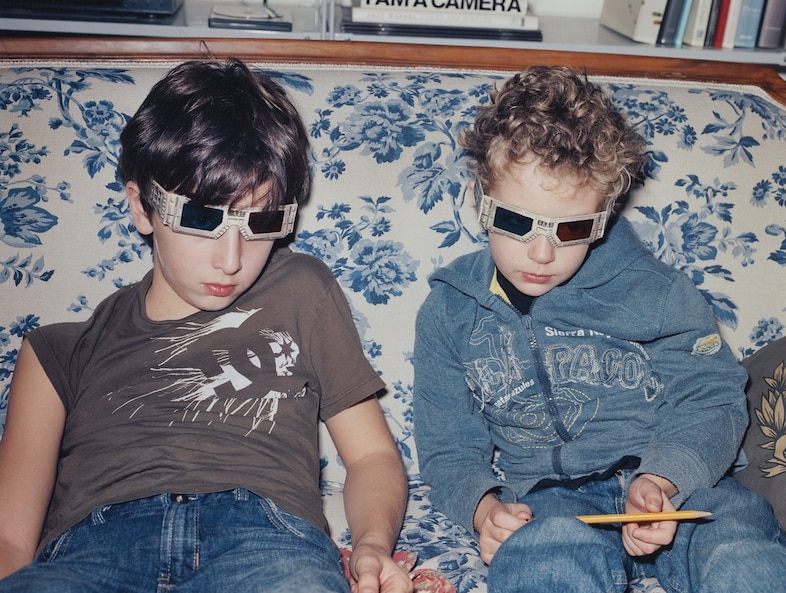
But he never set out to make a book from it. His publisher, Bruno Ceschel, first asked about the project around a decade ago, and Haymes didn’t feel ready. It was only after the passing of Lina’s parents, and watching his sons speak at their funerals, that the archive began to feel definitive. “It’s their coming-of-age story, and to see them speak at the funeral – they were very mature and they had to deal with a lot. That felt quite conclusive. They moved out this year, and they’re all on their own now, big kids.”
Much of the book’s first half was made while the family lived in an 800-square-foot, open-plan New York apartment – nowhere to retreat from one another, cramped but indisputably full of love. “The cameras were just there, littered around. If it was a point-and-shoot camera, it was in my pocket. I was just continually snapping. It became – that’s just what dad did.” Eventually, the boys grew aware of the lens, and in their early teens they would deliberately give him a thumbs-up and grin whenever it appeared, knowing it would make him lower the camera. “They rebelled and realised what I was doing,” Haymes says. “At some point Lawrence commented, ‘You’re the only parent who would sit and watch me cry with my nosebleed and take the photo, whereas another parent would be a bit more attentive.’” Haymes doesn’t dispute it, and there’s a photograph of Lawrence in that exact moment, standing in the shower, blood threading down from his nose.
Haymes’ response to the archive is less about favourite photographs than the things he wishes he had taken. He edited down from around 40,000 frames, letting the book run largely chronologically – a structure that gives Chronograph its sense of accumulation, and its title. It begins with the Twin Towers collapsing, before narrowing into smaller, domestic events that follow: small hands stacking a Jenga tower on a kitchen table, wood catching the flash of the camera; Philipp submerged in bathwater, hair fanned around his face. “It starts with something quite massive that shapes contemporary history, and moves to something that becomes more personal and insignificant, but it’s still just as important in the shaping of your life as a person.” The cover, a cropped photograph of the boys as children against one of them grown, wasn’t Haymes’ idea – it came from the publisher’s designer, who wanted a single image to carry the whole arc rather than a scrapbook wall of thumbnails. “I don’t see them as individual pictures,” he says. “I want it to be like a slideshow, a constant stream, so you see that evolution and growth.”

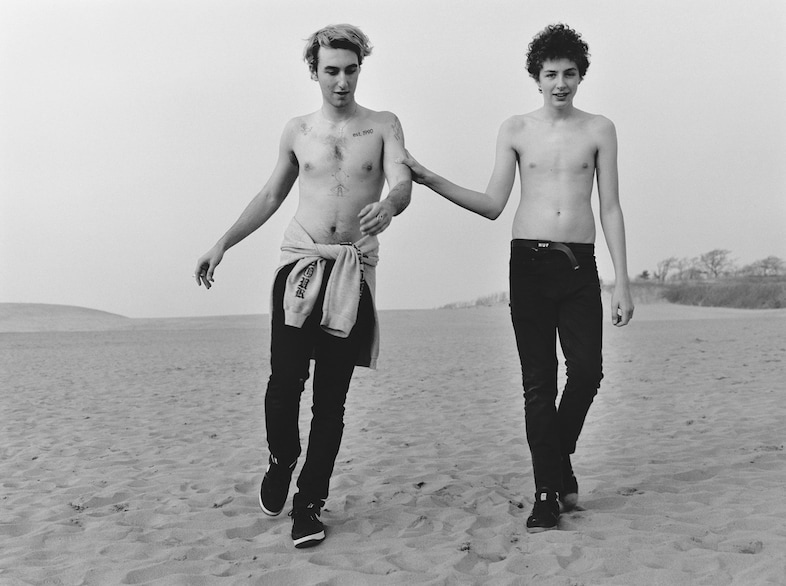
The family’s reaction has been good, Haymes says – and he made a point of running the photographs past his sons before publishing, particularly where nudity was involved. But he was surprised by how differently they remembered the same moments. “Sometimes you explain the photos to them, or it prompts a completely different response and memory to the one that you had, which is quite nice because you hear their take.” Ultimately, he says, “It’s not really a book about kids. It’s more of a book about life.”
And life, he has discovered, moves faster than his projects do. “When people disappear from your life, you realise maybe you should have shot them more. That brings you back to the consequences of time.” He is already five years into his next one, a youth culture project shot to “stay very contemporary” – though, he laughs, “by the time I’m finished with it, everybody’s going to be adults. So, another fail.” But perhaps that is what keeps Haymes drawn to youth – the possibility of change, and the pleasure of watching someone become themselves. “There’s always a nice sense of optimism when you’re young that you can beat the system and change it. And I like to be around that because it’s better than hanging out with boring 40-year-olds or something else.”
For now, though, Chronograph has left him with a simpler lesson. “Time is actually quite short, and you do have to make the most of whatever you have. How present are you as a person in the company of others? I think that’s the most important thing. The insignificant things do become the most poetic and beautiful at some point, other than searching for this monumental thing.” He adds, “At some point, it was painful being a parent. You go through love and hate, and I didn’t enjoy it. There are those anxieties that you have when you’re dealing with it daily. I would think a lot of people would say that, but in hindsight, it was pretty fantastic. I don’t regret anything.”
Chronograph (SPBH Editions, 2026) by Nick Haymes is published by MACK.
