
Ethel Cain meets Inde Navarrette: ‘Two crazy bitches saying exactly!’

Ethel Cain – The Autumn 2026 Issue
Gallery / 9 images
This story is taken from the autumn 2026 issue of Dazed, which is on sale internationally from September 10. Pre-order a copy of the magazine here.
In the first week of July, Paris was baking under its second major heatwave of the summer. At Dior’s AW26 couture show in the gardens of the Musée Rodin, the sun was oppressive, clothes were sticking to skin and the electric fans offered to guests were working overtime. It was here that Ethel Cain first met Inde Navarrette. Hours later, when the singer posted a picture of the Obsession star on her Instagram Stories, the heat spread online, sending fans of the pair into a collective meltdown.
As it turned out, their friendship had actually been brewing for months. When Obsession hit cinemas in May, Cain was entranced by it –so much so that she went back to see it five times in its opening week. She then sought out Navarrette on Instagram to tell her as much. “You are mindblowing,” she commented under one of her posts. The actress, who had coincidentally been listening to Cain to help get into character for the project, replied in disbelief: “um i luv u. just in case u were wondering.”
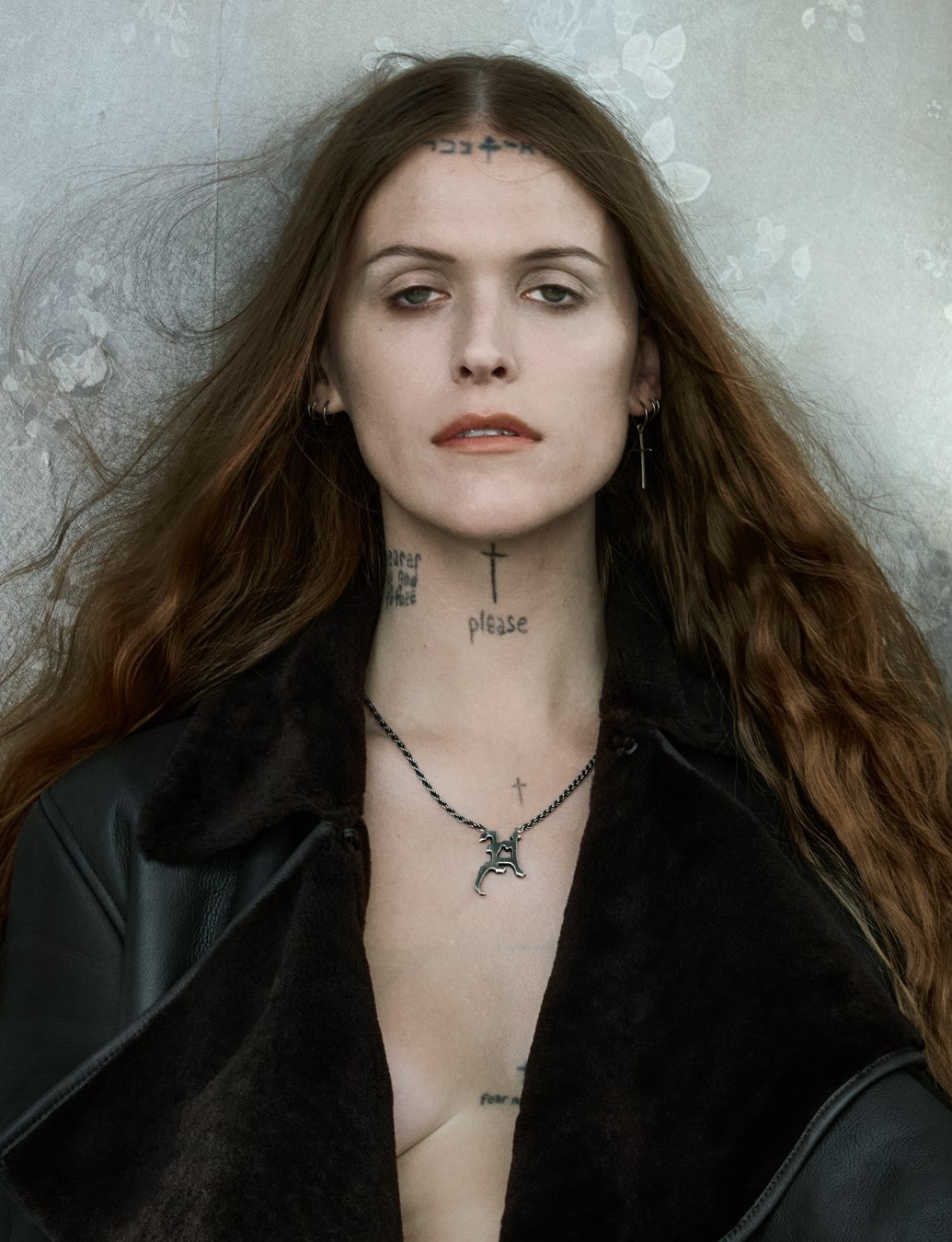
The affinity won’t come as much of a surprise to anyone familiar with their respective bodies of work. These are two women unusually at home in the dark. Ethel Cain – the musical persona of 28-year-old Hayden Anhedönia – is an artist whose work is steeped in religious trauma and bodily horror. On her 2022 debut album, Preacher’s Daughter, Cain constructed an entire southern gothic mythology around her fictional alter ego: the daughter of a preacher in the American deep south, who escapes an abusive religious upbringing only to be abducted, exploited, murdered and, finally, cannibalised by a lover. This was followed by 2025’s Perverts, a commercially hostile, 90-minute sprawl of drone and dark ambient and, later that same year, Willoughby Tucker, I’ll Always Love You, a doomed teenage love story. These are all much more than albums; they are worlds in themselves, dense with darkly intricate lore and cinematic in their scale. (Cain herself has long wanted to go into filmmaking, and it shows.)
Navarrette, meanwhile, stunned audiences in Curry Barker’s Obsession, her first major role in a feature film and the biggest horror success story of 2026. The 25-year-old stars as Nikki, a woman whose co-worker uses a magical trinket called a “One Wish Willow” to make her fall in love with him, with brutal consequences. What could have been a one-note “psycho girlfriend” role becomes, in Navarrette’s hands, something far more chilling. Her expressions stretch and snap like elastic, shifting between comic neediness and abject terror. It isn’t hard to see what Cain was drawn to: like the women in her music, Nikki is undone by desire, propelled towards violence, and trapped inside a fate she never chose.
The pair catch up over Zoom a few days after the Dior show. Cain, now back at home in Florida, joins the call first. As you would hope, her surroundings are suitably gothic: swathes of dark fabric hang from the walls, alongside framed artworks filled with unsettling, spectral scrawls. An old 80s TV set sits in the background, while the subtropical sun seeps through the blinds at her window. “Inde was such a sweetheart [in Paris],” says Cain, pausing every so often to take a swig from a litre bottle of Pepsi. “We wound up just kicking it the whole time.” Moments later, Navarrette joins the call, looking comparatively prim in oversized black Dior sunglasses and French tips. Within seconds, they are talking to each other at great speed, with the easy familiarity of friends who have known each other for far longer than they actually have.
INDE NAVARRETTE: I have questions for you, madame.
ETHEL CAIN: And I have questions for you, madame. I’m just going to ask you a whole bunch of bullshit. But we’ll have fun.
IN: OK, so, I’m a texture person. When I’m watching movies, I assess the characters by their materials. Like, that person is a couch that’s really fucking itchy and gross. Or that person is like silk: no wonder I want to touch them so much. What material are you?
EC: It’s funny you say that. I had the first inkling of the Ethel Cain character because I bought this handmade linen prairie dress on Etsy, and it was low-key claustrophobic. It had these heavy linen ties to snatch your waist, so you’re locked in like a straitjacket. Even though it was handmade by the sweetest old lady, there was an inherent pain-as-beauty situation in the textiles. I was like, ‘This is what it would feel like to be a stuffy, suffocated southern woman.’ That’s where Ethel Cain was born. ‘I can’t breathe. Let me go write a song.’

IN: What about as Hayden?
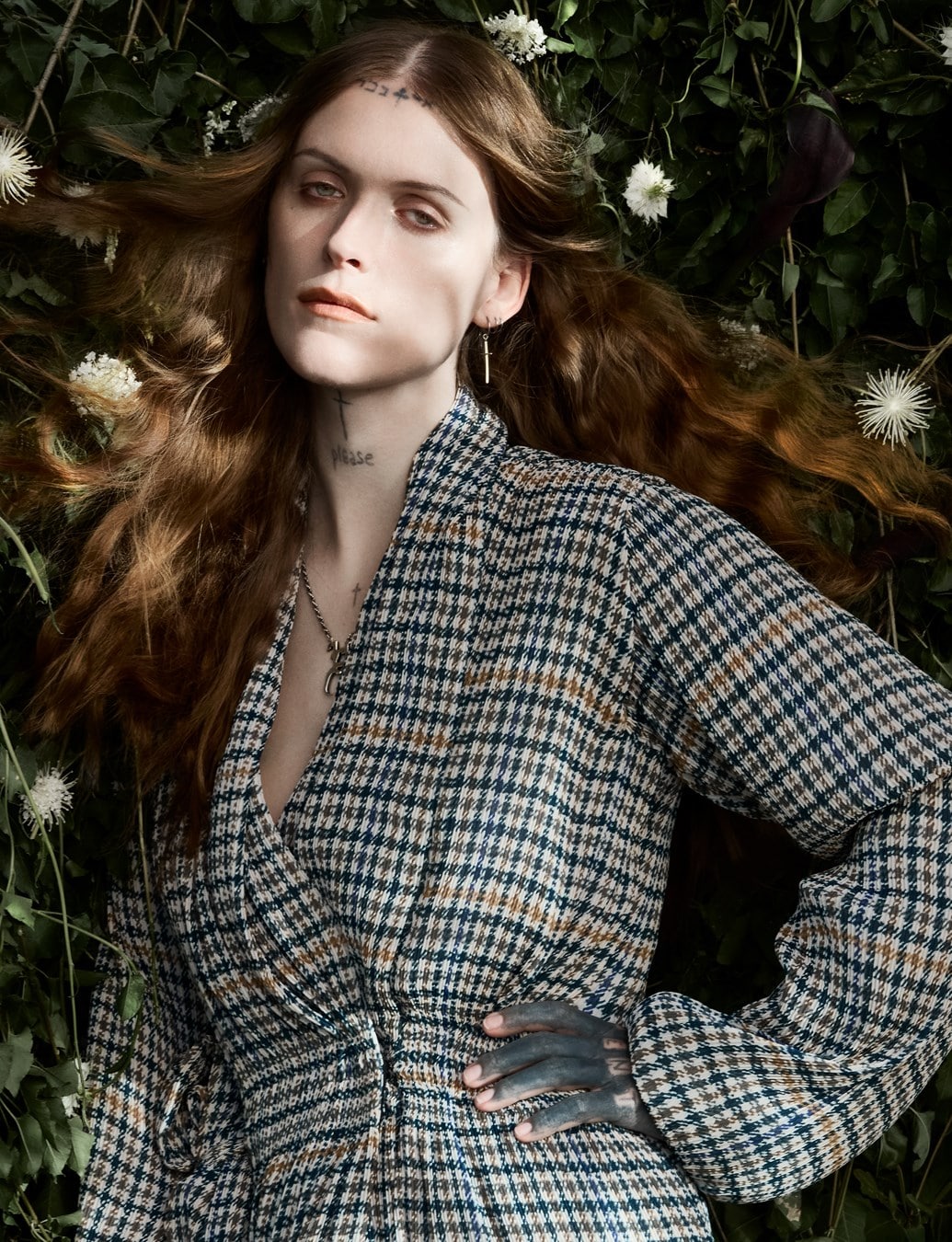
EC: I’m a huge baby. I have really bad sensory issues, and I can’t deal with things touching me. I can’t deal with my hair touching me; that’s why it’s always behind my ears. I used to wear tight clothes, but the older I get, the worse my sensory issues get. I have to wear giant sweaters and jeans. I love soft cotton, wool, knits and worn-in denim. I like a free range of motion – maybe at the expense of showing off the young, hot body I’m not going to have forever. But I don’t care.
IN: It’s our secret.
EC: It’s our secret. I know I look banging under here. How about you?
IN: Inde is a family nickname; it stems from being super independent. As Inde, I wear nothing but black. It has to be soft, super thin, see-through, light and flowy. I think that I hide my emotions very well, but everyone in my life thinks that’s bullshit and that [they can see everything written on my face]. That’s what I mean by super thin. OK, next question. What’s your favourite art piece in your house?
“I ask myself all the time, ‘Am I a psychopath?’”
EC: It’s an Antony Gormley piece called Untitled. I also have it tattooed on my arm. It’s inspired multiple projects of mine and has such a grip on me; I have it framed on my wall. Right under it, I have a pencil illustration of a live oak [tree native to the southern US] in St Augustine, Florida, by an artist in Alabama, where I used to live. I would always pass it in his shop window. They’re my favourite pieces because they split the difference between me: I love live oaks and southernness, but I also love this weird, alien, brutal, futuristic, apocalyptic whatnot.
Now on to my stupid questions. I know you’re a fellow gamer. I feel like there’s an inherent drive to disappear into the characters you’re playing. Does life ever start to feel like a video game for you? Do you ever get spooked?
IN: Yeah. I get spooked all the time because I’m terrified of being a psychopath – and I’m scared that my ability to turn off my emotions or compartmentalise has secretly made me one. I find crying in real life strange because the moment I do it, my brain thinks it’s fake.
While we were filming Obsession, I kept thinking that certain moments [in my normal life] would have made for a really good take. So then I felt split – am I really this psychopathic, nasty little sicko who can’t feel real emotions like a real girl? And if I am both, how do I take care of both? During Obsession, I played video games because they let me turn off my brain. If the game was violent, it overstimulated me so much that I didn’t have to think. It was almost like a different level of dissociation.
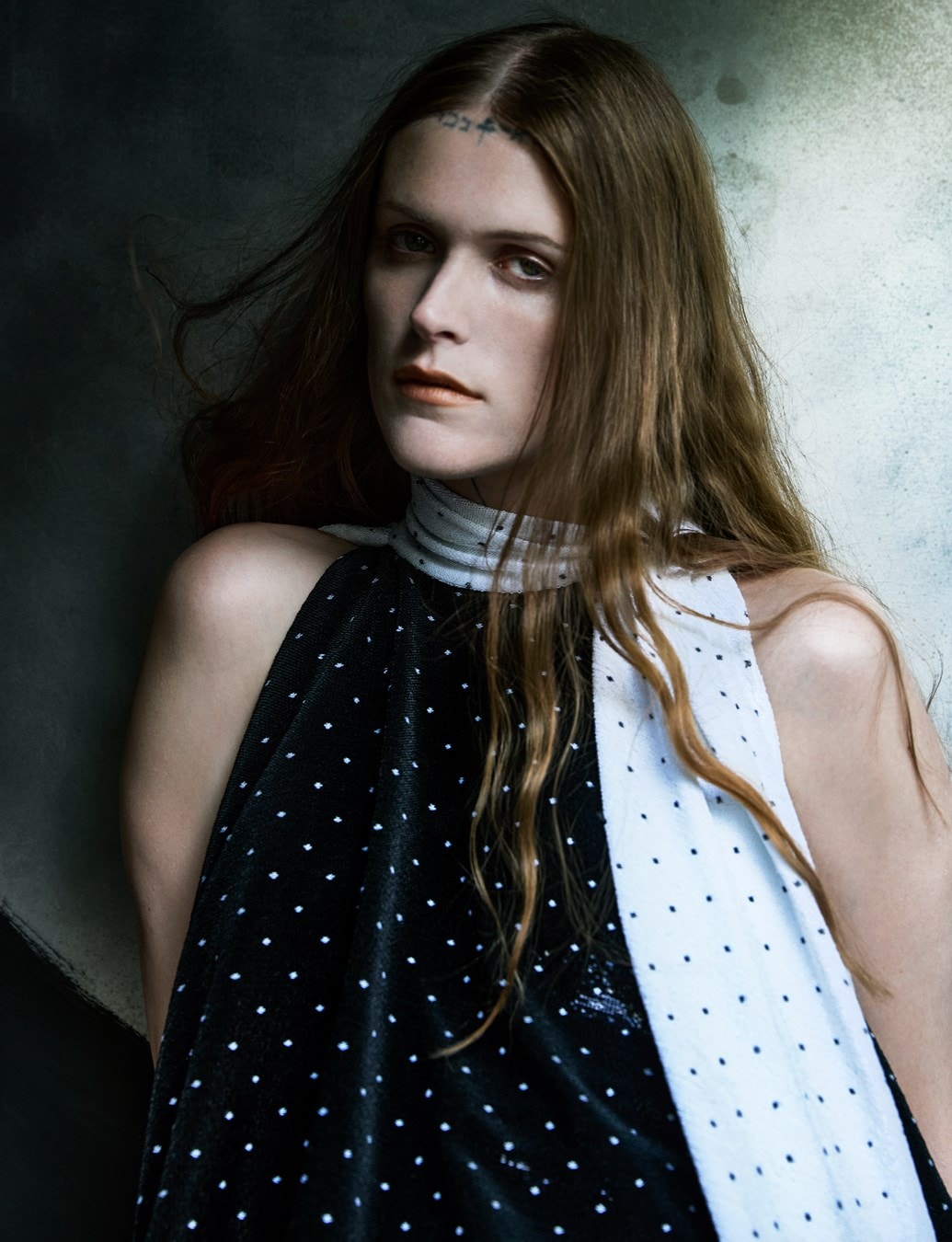
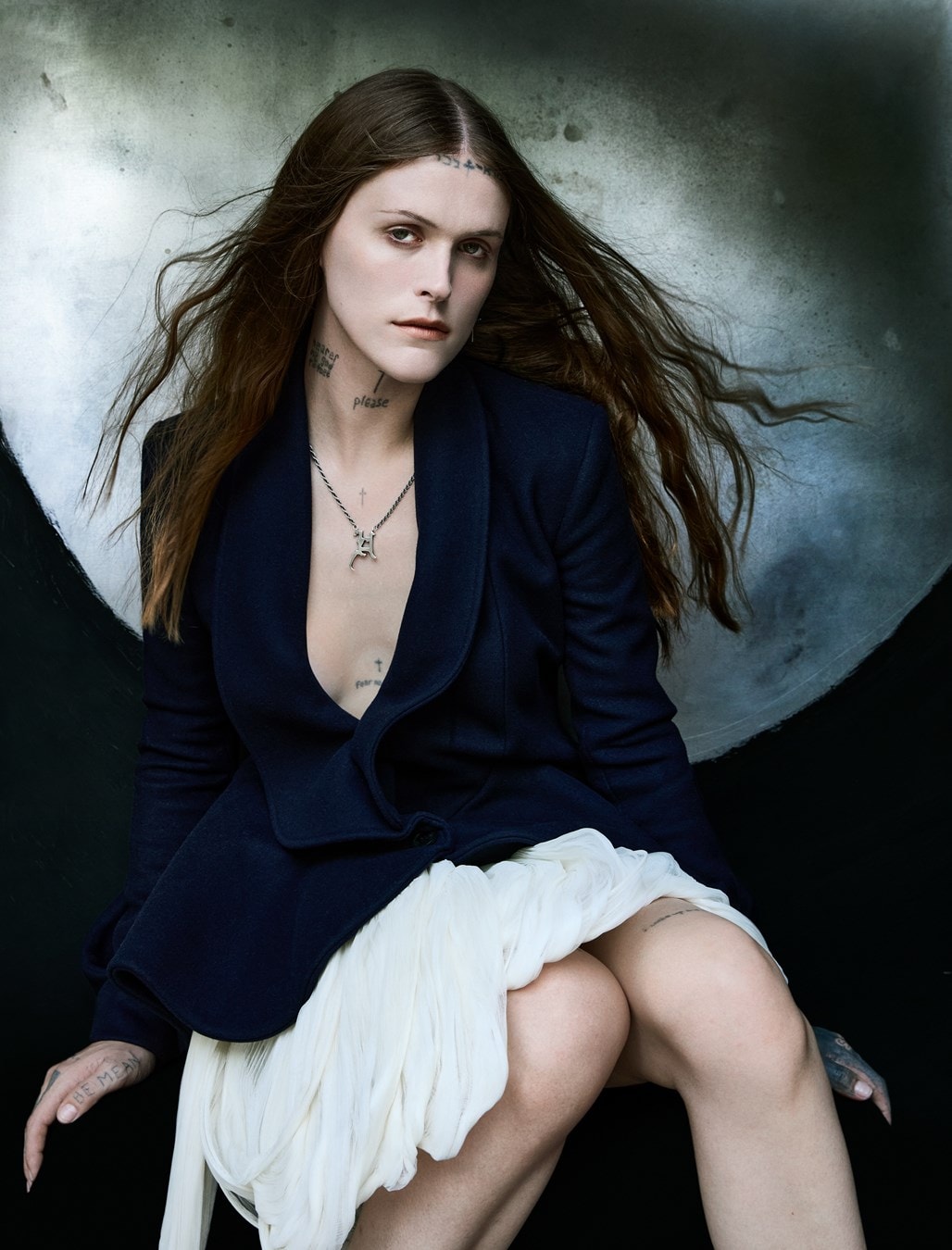
EC: I know what you mean. I’ve struggled with that my entire life. You know the [internalised male gaze]; the idea that every woman has a man inside her brain, watching her? This is an even more twisted version, where there is a me in my head watching me, but it’s not me. It’s so specific to when I’m crying. Within minutes, I’m like, ‘You look ridiculous. You’re crying too hard.’ That’s probably also a byproduct of the digital age, where we have a mirror held up to ourselves everywhere. You are constantly analysing the way you move because everyone else is, and everyone else is doing it to themselves.
My biggest gripe with my own psyche is that I can’t just do something normal. Can I act or feel a certain way without immediately anticipating how it will look or how other people will perceive it? Nothing comes naturally, and then I feel insane and much more calculated than I actually am. It’s distressing, and I also ask myself all the time, ‘Am I a psychopath?’
IN: Yeah, the number of times my search history has been ‘signs of borderline personality disorder or CPTSD [complex post-traumatic stress disorder]’, with me trying to psychoanalyse it… I love psychiatry, but I want to be self-accepting without blaming it on something else.
EC: Of course. There’s the [balance] of understanding the cause, without making excuses and saying, ‘This happened to me, and I am this way now, so I can be this way forever.’ At the end of the day, we’re still in control of our actions, and we can act accordingly. For a long time, I thought, ‘Well, this happened to me so it’s fine that I’m a hot mess.’ Then I realised being a hot mess wasn’t benefiting me or anyone else.
IN: I’m going to bring this back to video games. In life, you get all this XP, all this knowledge, but you can’t go back in time. Sometimes that weirdly gives me grief, because in a video game you can. But in life, you truly can’t.
“Even though I’m growing up and out, I still need to stay low. I like to stay close to the ground”
EC: Yeah. I struggle with nostalgia, too. I moved back to Florida because I was getting older – it was getting weird. I thought maybe I could crawl back into a time when it was safer, I was younger and there was less responsibility. But everything was different. You can never truly go back. I can walk into my kitchen today and it’s not even the same kitchen as yesterday. I struggle with moving forwards; it’s easier to want to live in the past. But a big lesson I’ve learned is to embrace life as it comes.
IN: Yeah, I want to get there. I’ll call you when I do.
EC: Hell yeah, we can chit-chat about it. Kind of on that tip, my other question was about [your process]. I describe my creative process as a turtle: if you make any loud, sudden movements, it goes back into its shell. You have to sit, without moving, for it to slowly poke its head back out. I can’t work on tour; I can’t work after hanging out with people; I can’t work while travelling. I have to sit at home in complete silence, go nowhere and do nothing for it to come back out. When the maelstrom of work quietens down, and you’re able to sit with your thoughts, do you ever get scared [by what’s in there]?
IN: Yeah. I think that’s why I understood Nikki. Nobody [apart from director Curry Barker] knew the pain coming out of me on set was real – the wails, screams and cries. It felt cathartic. I would go home after releasing all of that, after so many years putting it down. It was nice to go home and actually watch the blood wash off my body because I’d been covered in it all day.
[The period] after Obsession was strange because I wasn’t working. I’ve always had a hard time making friends, not for lack of trying. There’s this meme of Cillian Murphy that’s like, ‘Me when I’m having a great time’, and it’s him [pulling a blank expression]. That’s how I feel when I’m safe with my friends. It looks like I’m not having fun, but I am. I’m just sitting there, existing, comfortable enough to rest every aspect of my body. After Obsession, I had no energy for [performance or fakeness], so I found myself actually making friends, because I didn’t have any energy [left to perform with people]. Lately, the friends that I want to make are also scared of their own brains. Do you think Nikki and Preacher’s Daughter would be friends?
EC: Yeah. I think they would have gotten along because they’re both very obviously going through something desperate and brutal while everyone around them – even the people who claim to love them – does nothing to help. I think it would have been really bad for everyone else around them if they had gotten along. It’s like the two craziest bitches you know telling each other, ‘Exactly.’
IN: [laughs] Fuck yeah! And then the whole town’s burning.


EC: Do you have anywhere that is sacred to you? Anywhere you revisit when you’re feeling lost?
IN: Not to sound woe-is-me, but every place I found safe as a kid no longer exists. My grandma’s house is gone. My Australian grandmother lived in a trailer on an orchard; that’s gone, too. My childhood home technically was never a home because we moved around so much. I don’t consider myself super religious, [but] whenever the wind kicks in, I feel like it’s the world’s way of reminding me that everything’s OK, like a hug. I get the most validation not from people, therapy, music or movies, but from the wind, which sounds insane to say.
My family and I used to go on long road trips and pick out questions for each other. One was about what tree we would be. I’ve always said I’m a willow because of my love for wind, and obviously that was a big part of Obsession [with the One Wish Willow]. So what kind of tree are you?
EC: I would love to say I’m a live oak because roots are so important to me. Even though they grow upwards and outwards, they have such a complex, deep, strong root structure. Grounding myself and holding on to things is so important to me. Live oaks grow up, but then they grow back down, and they can be super low to the ground. Even though I’m growing up and out, I still need to stay low. I don’t need to get that high. I like to stay close to the source.
IN: Period.
“I bought this handmade linen prairie dress on Etsy… That’s where Ethel Cain was born”
EC: And [my last question]: what is your favourite aspect of human nature? Mine is that we can change our minds as much as we want. A lot of people hang on to the idea that, if you believe something once, you believe it forever. But our mindsets, opinions and everything about us are constantly evolving. While that’s a little frightening, it’s my favourite thing. We’re always able to change.
IN: Mine is that, even if you grow up being shown all the darkness in the world, there can come a time when someone is there for you unconditionally. I think that’s beautiful. If you find that when you’re young, with your parents or family, it’s great. But it’s also beautiful that you can find it when you’re older. An example that comes to mind is a woman giving birth, surrounded by women, and it’s an experience that happens together. People go through emotional births, and they can have their people around them. You don’t have to be family to have that understanding.
EC: Oh, absolutely. At the end of the day, that’s one of the only things we really do have, that we can lean on. I love that.
IN: Period. Thank you so much.
This story is taken from the autumn 2026 issue of Dazed, which is on sale internationally from September 10. Pre-order a copy of the magazine here.
Hair Anthony Turner at Jolly Collective, make-up Anthony Preel at MA+ Group using Byredo, nails Anatole Rainey at Premier Hair and Make-up, set design Christian Feltham, photographic assistants Pierre Nowak, Adrian Martin, styling assistants Charlie Edwards, Cari Lima, hair assistants John Allan, Sam Elliot, make-up assistant Gabrielle Cairoche, set design assistants Romane Huber, Heyder Naqfi, digital operator Florent Brunel, production Margaux Godeau Canac and Suzi Simms at Holmes Production, production coordinators Fanny Ladame, Ley Lalanne, production assistants Caitlin Leach, Lea Dupeyron, post-production Imagine, casting Greg Krelenstein at gk-ld.
