
Hope might be the wildest South Korean film of all time

Hope is reportedly the most expensive South Korean film of all time. It might also be the wildest. Nearly three hours of sci-fi mayhem, Na Hong-jin’s exhilaratingly bonkers blockbuster mostly does away with backstory and delivers what everyone wants: an onslaught of kinetic action set-pieces, hilarious star performances from actors leaning into the story’s absurdity, and blue, lanky, spindly aliens played through mo-cap by Michael Fassbender, Alicia Vikander, and Taylor Russell.
Na, a 52-year-old Korean writer and director, was already a genre specialist whose three previous films premiered at Cannes: The Chaser, The Yellow Sea, and, most famously, The Wailing. Hope, a few months ago, went further by competing for the Palme d’Or, making it an arthouse Avatar but way more fun. At the festival, Variety raved it for having “some of the most breathtakingly elegant action moviemaking” of all time but noted its “janky VFX”. The CGI has since been rejigged, and is best viewed on the biggest screen possible, even if just to take in the anatomical designs of extraterrestrials that look like a cross between a spiky oak tree and a Xenomorph with a gym membership.
Crucially, the aliens have identifiably human facial expressions, right down to gasping jaws and wide-open eyes that could be from the silent era of filmmaking. So much so, the Korean characters occasionally question whether they should point weapons at an organism with visible tears running down its cheek. “There’s a backstory that’s not really in the film, because I’m saving it for a later stage,” says Na in late September through an interpreter. “These aliens – or otherworldly beings – have fear in meeting homo sapiens, and then also disappointment.”
Humans are startled when they recognise themselves in the aliens. Does that mean aliens see a mirror image of themselves in the people, too? “That’s an underlying factor. They view things from a different position. The problem is that they have a different language and can’t communicate.” He corrected my use of the word “aliens”. Is that because to the visiting creatures, it’s the humans that are aliens, and therefore the word is irrelevant? “That’s right.”
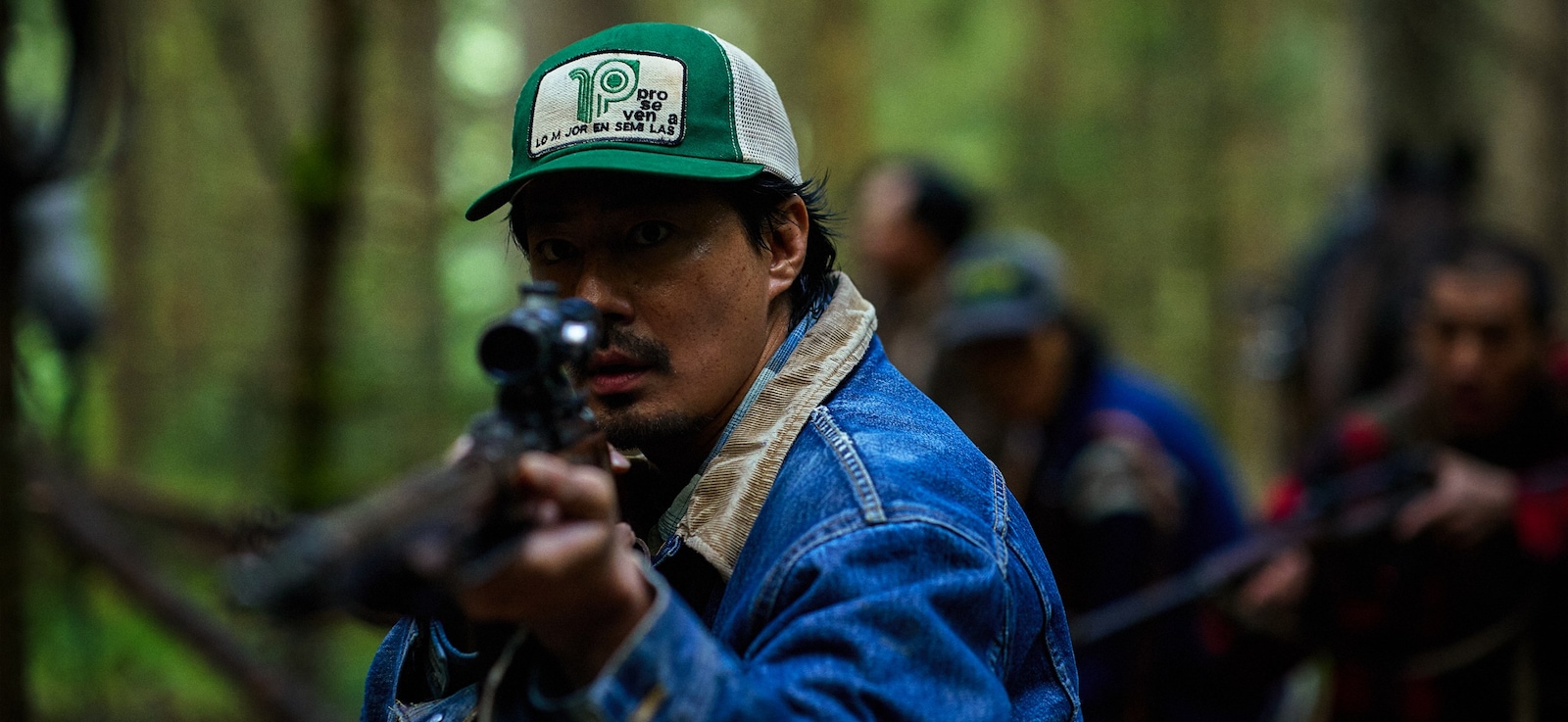
In Hope Harbour, an isolated town close to the Korean Demilitarised Zone, concerned locals inspect a series of dead animals, ripped-up fences, and a human arm hanging off a branch. Once shapeshifting creatures from outer space leap into the frame, using trucks to swat at humans like they’re pesky flies, the film unabashedly morphs into an ultra-violent shoot ’em up with speeding car chases, horse-riding heroes, and one climactic sequence on an empty motorway combining the two. If the CGI looks imperfect, it’s mainly because the surrounding environments are staggeringly real, as are practical stunts that make you wonder how the cameraperson didn’t crash into a tree or wayward vehicle.
It’s also very funny. When policewoman Sung-ae (Jung Ho-yeon from Squid Game) witnesses an amateur gunman, Sung-ki (Zo In-sung from Possible Love), slaughter an alien, she yells, “Are you a movie star? So damn hot!” The ultimate scene-stealer, though, is 80-year-old Im Hyun-sik as an elderly local who delivers a monologue about spicy food, diarrhoea, and how a middle finger saved his life.
“The sequel is a tragedy that goes into more theories, twists, and aggressions”
Lensed by Hong Kyung-pyo, the cinematographer of Parasite and Burning, Hope takes place entirely during daytime. (Imagine the iconic sunset scene in Burning but with a monster running through it.) It’s in stark contrast to Na’s previous work: The Chaser and The Yellow Sea are primarily cat-and-mouse pursuits that unfold when everyone’s asleep; the horror of The Wailing relies so much on darkness, its most iconic image involves glowing red eyes in the shadows.
“It was easier not doing night-time scenes, because there’s no lighting needed, only the daylight,” says Na. “However, I used the forest to give the feel of night-time. The next half of the story will go into actual night-time.” He wanted the forest to be scary? “It’s more to add different colours and density. The village is the area for humans, and the forest is for aliens. However, they go beyond their boundaries and attack each other. I wanted to show those boundaries being torn.”
Just as Na’s second feature, The Yellow Sea, reverses the actors who played the protagonist and villain in The Chaser, his planned sequel to Hope will focus more on the aliens’ perspective. In fact, Hope is only the first half of the script he originally wrote, meaning a draft for a follow-up already exists. “The sequel is a tragedy that goes into more theories, twists, and aggressions. I’m writing it at the moment, and trying to organise my thoughts. It might turn into something very different. I don’t find it fun to do the same thing again and again.”
Despite being a splatter-fest, Hope is a film with brains – and not just the ones scattered on the pavement. Its setting by the DMZ adds a political subtext, especially with visiting aliens played by westerners who speak a different language. Moreover, in the final moments, Vikander’s character, J’aur, reveals that the emperor passed on a message in a dream: “Faith is evidence of what we do not see.” It’s actually a quote from the Book of Hebrews.
As a Christian, Na has touched on religion in his previous work, most notably by opening The Wailing with a line from the Gospel of Luke. “I wanted to subtly have this religious philosophy in Hope,” he says. “I will talk about having faith in a god in the next chapter.” Is it a comment on how even aliens need a religion? “It’s more about maybe believing things exist. We couldn’t see the aliens before, but now we can actually physically see them. I want to subtly imply that there might be these beings.”
If J’aur knows the Bible, does that mean the aliens and humans might share a religion, if not an actual god, without realising it? “That’s right. At the end, you see a spaceship falling. If you look closely in the sequel, the design of the spaceship is very ancient. Within it, there is an emperor. From our human point of view, it could be a god that’s fallen in that spaceship. To the aliens, it might be their king, who they consider a god, whose duty is not continuing. I wanted to ask a question: when that disappears, how will the cosmic world go on?”
Hope is out in UK cinemas on September 25
