
Severe flooding in the Four Corners region prompts evacuations and rooftop rescues

Want to bookmark your favourite articles and stories to read or reference later? Start your Independent Membership today.
Already a member?
Log in
Severe flooding across Colorado and New Mexico left hundreds without power and forced evacuations, with emergency crews carrying out overnight rescues and key roads and bridges remaining closed on Saturday across the Four Corners region.
Officials anticipated further precipitation on Saturday where the borders of Arizona, Colorado, New Mexico, and Utah meet.
Two months of heavy rains had already broken a summer drought, delivering 4 inches (10 centimeters) of rain from Wednesday through Friday onto saturated soil, with an additional 1 inch (2.5 centimeters) possible on Saturday.
“We may see some floodwaters receding, but there will be more rain, and the rivers are expected to rise again,” San Juan County, New Mexico, Emergency Management warned in a Facebook post Saturday.
Emergency responders staged 20 rescues near Farmington and Shiprock, New Mexico.
Officials advised residents of 600 homes to evacuate, while local power companies reported around 1,500 people were left without electricity.
The New Mexico Department of Transportation closed a 2-mile (3.2-kilometer) section of U.S. Highway 64 west of Shiprock due to water on the road.
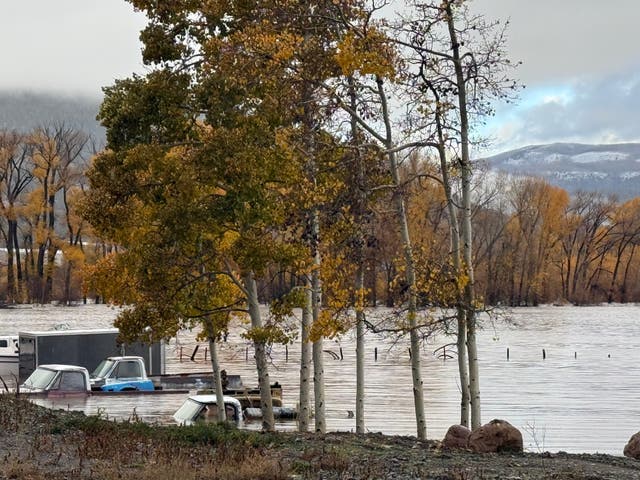
Flooding over a bridge on the San Juan River also shut down a four-mile stretch of New Mexico 371 south of Farmington, the region’s main population center with approximately 46,000 residents.
The inundation follows a week of stormy weather across the region.
Heavy rain flooded dozens of homes in Utah, while tornadoes in Arizona tore off roofs, knocked trees onto structures, and brought down power lines.
During a Friday news conference, Farmington Police Chief Steve Hebbe referred to the flooding as a “once in a generation” event.
In southern Colorado, flood levels exceeded predictions, cresting 3 feet (1 meter) higher than a 100-year flood event on the San Juan River just a year ago.
While parts of the Southwest are rocky, sparsely vegetated, and naturally prone to flash flooding, recent rainfall had thoroughly soaked the ground, making widespread flooding far more likely.
Forecasters attributed the intense moisture to the remnants of Pacific tropical weather systems pushing inland.
