
Stanford University used AI to replace Hispanic student with Black woman in promotional photo

Want to bookmark your favourite articles and stories to read or reference later? Start your Independent Membership today.
Already a member?
Log in
Stanford University has removed campus promotional banners after acknowledging that artificial intelligence was used to alter a photograph of students, replacing a Hispanic senior with an image of a Black woman and slimming the appearances of two others.
The original photograph was taken during a 2024 Lunar New Year event by a university photographer and originally published online by the school’s dining service. However, when the image resurfaced this fall on campus “Welcome Home” banners, senior Billy Ramirez discovered he had been removed entirely.
“I was driving to school from my hometown when my friend sent me the images comparing the banner to the original photos, and I was immediately baffled,” Ramirez, a human biology major, told The Stanford Review, the student-run publication that first reported the story. “At first, I found it hilarious that they had used AI to completely change our appearances, including my race and gender. But after looking at the comparison, I was also upset because I don’t agree with Stanford making those choices about how we were represented.
“Seeing my identity changed and being left out of the picture made me feel, in a way, silenced and erased from a representation that was supposed to include me.”
Ramirez, a first-generation Hispanic student, noted that public speculation on social media misidentified him as a white man, which added to his frustration.
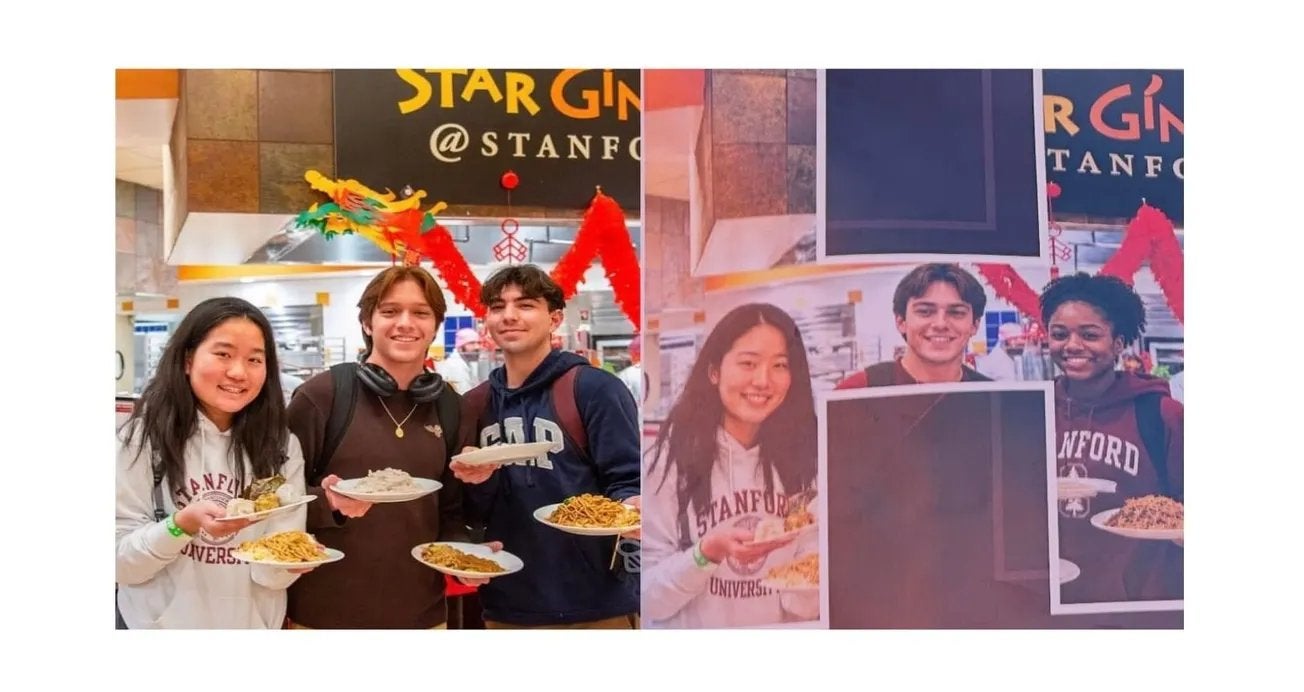
“I was replaced,” Ramirez later told The Washington Post. “And that to me is very upsetting.”
In a Substack post verified by The Stanford Daily, the two other students pictured, who remained anonymous, confirmed that one of them filed a formal discrimination claim with the university. They called for an apology, an investigation into how the banner was created, a ban on AI-generated student photos, and increased efforts to reinstate diversity, equity, and inclusion initiatives.
Stanford acknowledged the violation, confirming the image was modified using AI tools.

“Stanford’s A.I. policy is clear: The use of A.I. in producing or altering images of Stanford people, events, research, facilities or achievements is strictly prohibited,” the university said in a statement. “Both the alteration and lack of disclosure in this case violate that policy. We are working to provide additional training for all staff and ensure proper review of all materials.”
The university later removed the banners.
The incident occurs amid heightened focus on race and admissions in higher education. Under the Trump administration, federal officials have pushed universities to comply with strict interpretations of civil rights law following the 2023 Supreme Court ruling against race-conscious admissions.

The Justice Department is investigating Stanford’s medical school admissions practices, as reported in March by The New York Times, and the Department of Education opened an inquiry into potential race-based discrimination in a teacher training program.
According to the university’s Common Data Set from October 2025, approximately 16 percent of Stanford undergraduates identified as Hispanic or Latino, 6.5 percent as Black and 9 percent as two or more races. Out of 17,314 total enrolled students last fall, 3,406 U.S. citizens and permanent residents were categorized as underrepresented minorities.

“If you’re trying to use years-old photos that aren’t even accurate of the student body, then it just shows that Stanford needs to increase the enrollment of students from historically underrepresented backgrounds like Black and Hispanic students,” Ramirez told The Washington Post.
For Ramirez, who has interned on Capitol Hill and plans to pursue a master’s degree in public health to serve marginalized communities, the misuse of technology remains the central concern.
“It’s kind of like how some parts of history could be erased with AI,” Ramirez said. “It’s scary.”
