
The 9/11 images that still haunt journalists who witnessed the tragedy 25 years later

On Sept. 11, 2001, Karen Matthews was inside her Manhattan apartment preparing her three-year-old daughter for preschool when an unfamiliar, thunderous boom echoed outside.
Clutching her young child, she stepped onto the street. Onlookers were gazing upward at a gaping hole in the World Trade Center’s north tower, where dark smoke poured into the sky only a short distance from her residence.
“What did you see? What did you see?” members of the crowd asked each other. Matthews, a reporter for the Associated Press, instinctively began posing the same inquiry, reaching for her notepad to write down eyewitness accounts while still balancing her daughter in her arms.
Her original schedule called for taking her child to school before heading out to report on New York’s primary election later that day. Instead, she joined a team of AP journalists tasked with recording the unfolding Sept. 11 terror attacks as firsthand witnesses.
A quarter-century later, those journalists recall the moments they witnessed.
Initial confusion surrounded the tragedy
As she made her way through her building’s entrance earlier, Matthews had noticed a crying woman. At that moment, many onlookers believed an errant light aircraft had inadvertently hit the skyscraper.
Shortly after, she observed a “big fireball” burst from the south tower when a second hijacked airliner slammed into it.
“‘I want to go to school, I want to go to school,’” her young daughter began to weep.
“That’s when we all knew that we were under attack,” Matthews said.
Matthews initially continued walking toward the preschool, but turned back after spotting weeping teachers rushing children northward. Seeking safety, she returned to her apartment with her daughter and switched on the television show Barney.
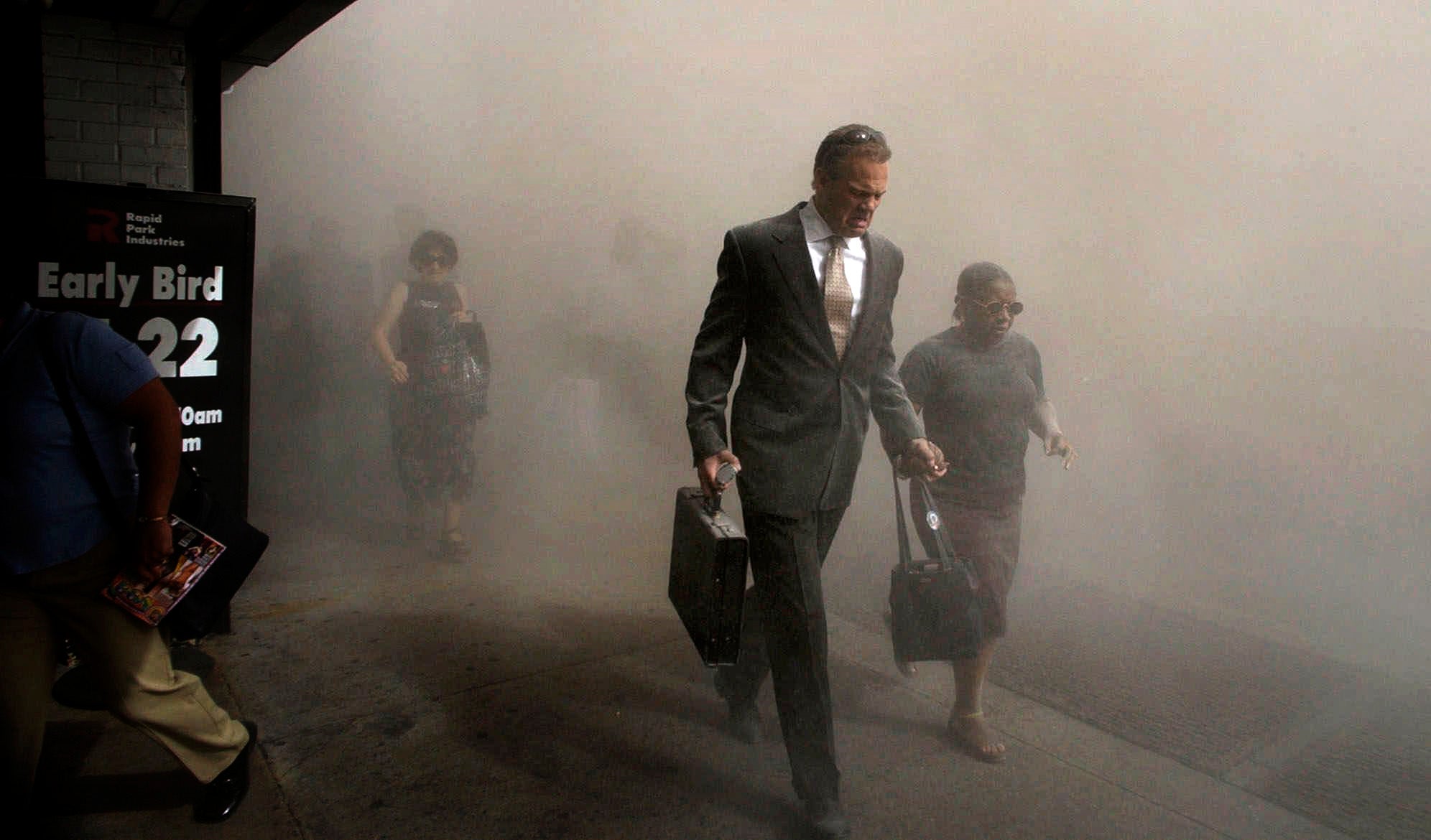
Moments later, two immense crashes shook the neighborhood as each tower fell in turn. Almost 3,000 victims lost their lives at the World Trade Center, the Pentagon, and aboard four commercial aircraft seized by al-Qaida terrorists.
Now retired, Matthews continues to view her lifetime through the distinct divide of before and after Sept. 11.
“I’m not a really fearful person,” she said. “But you lose a sense of security when something like that happens.”
“I do think it helped to be part of telling the story of what happened,” Matthews said.
Using a lens as a shield
Thick smoke and dust blanketed the streets of Lower Manhattan as Richard Drew emerged from the Chambers Street subway station to see both towers ablaze.
His day had been scheduled around photographing the launch of Fashion Week, an event typically defined by high fashion, runway presentations, and models.
He started capturing images while fine gray ash quickly coated his clothing, face, and photographic gear.
A paramedic gestured upward, calling out, “Look at that.” Figures were falling from the engulfed upper floors.
“I don’t know whether they were jumping or they got forced out by the fire,” Drew said.
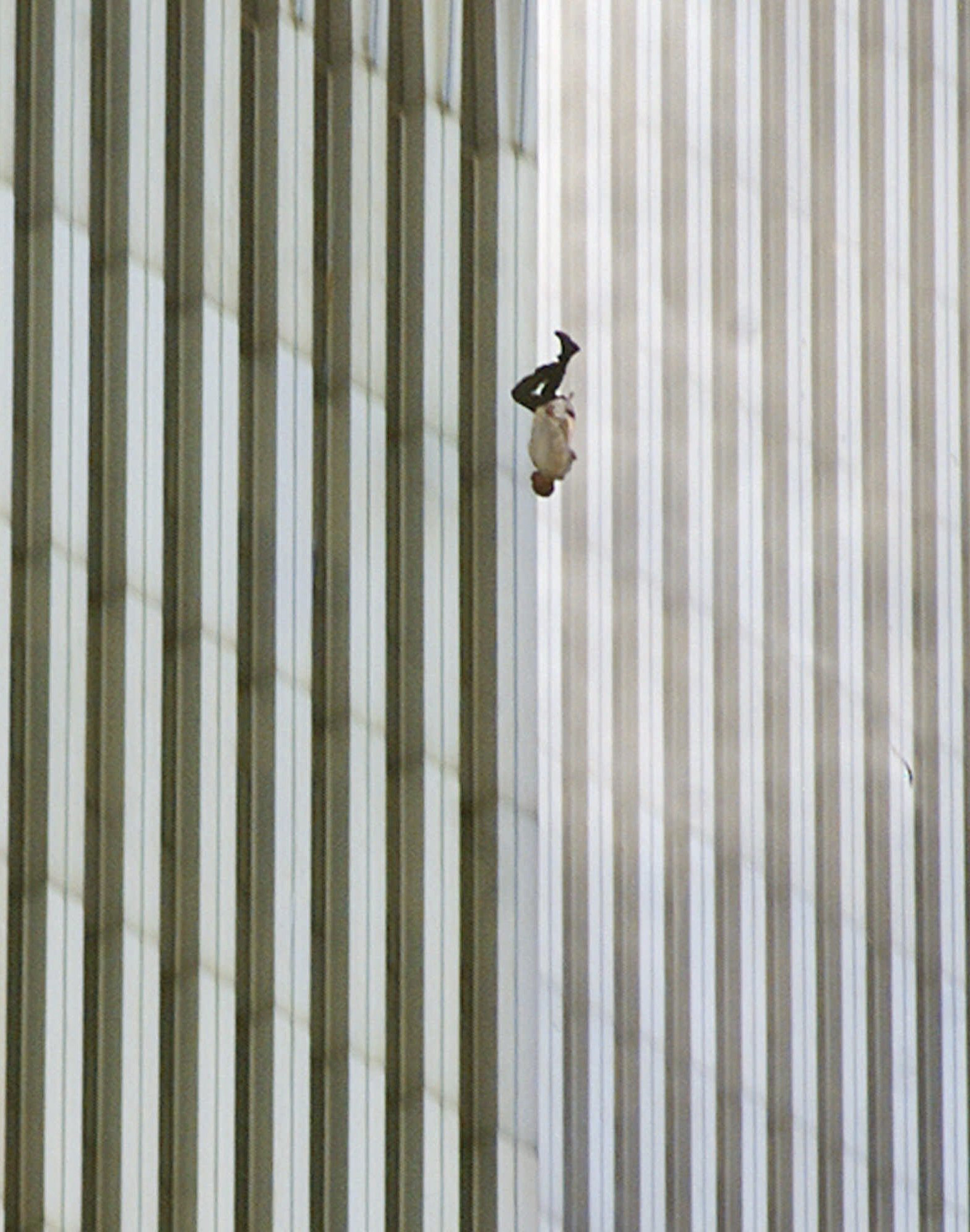
Drew continued capturing photographs of the falling figures. One frame, later titled “The Falling Man,” depicted a person dropping headfirst in near-perfect alignment with the architectural lines of the skyscraper. While a selection of newspapers published the image the following morning, numerous outlets refused to print it out of concern for reader distress.
To this day, Drew reflects on that iconic picture and the nameless individual captured within it at least weekly.
“When I’m in a situation like September 11th, I go into professional photographer mode and I concentrate on whatever’s happening in front of me,” said Drew, who also covered the 1968 shooting of Robert F. Kennedy.
He noted that his wife describes his camera as a wall, functioning as a barrier separating the photojournalist from the horrors occurring before them.
“I guess I’m in denial about whether those things really affected me,” he said.
Unused medical equipment lined streets
Debris from the destroyed skyscrapers fell “like a snowstorm” by the time AP journalist Larry Neumeister reached a medical facility close to ground zero that afternoon.
Medical teams assembled outside the entrance alongside rows of empty gurneys and wheelchairs. Hospital personnel were braced to receive a relentless influx of casualties that could reach into the thousands, according to Neumeister.
Yet hours went by.
“It became clear nobody else was being brought in,” Neumeister said.
Near midnight, Neumeister surveyed the perimeter of the collapsed complex. A physician remarked to him: “You either walked away from the site or ran away from the World Trade Center buildings when they fell, or you were gone. There was no in-between.”
Professional instinct guided a photojournalist
Amy Sancetta had originally scheduled Sept. 11 as a day off.
Operating out of Ohio at the time, the AP photographer had been in New York on assignment to cover the U.S. Open tennis tournament. With the matches concluded, she had personal time planned until an editor phoned to report that a small aircraft had struck a tower, instructing her to head downtown immediately.
While grabbing her equipment, Sancetta realized she was uncertain of the twin towers’ exact location. She hailed a taxi, telling the driver to navigate as close to the site as possible.
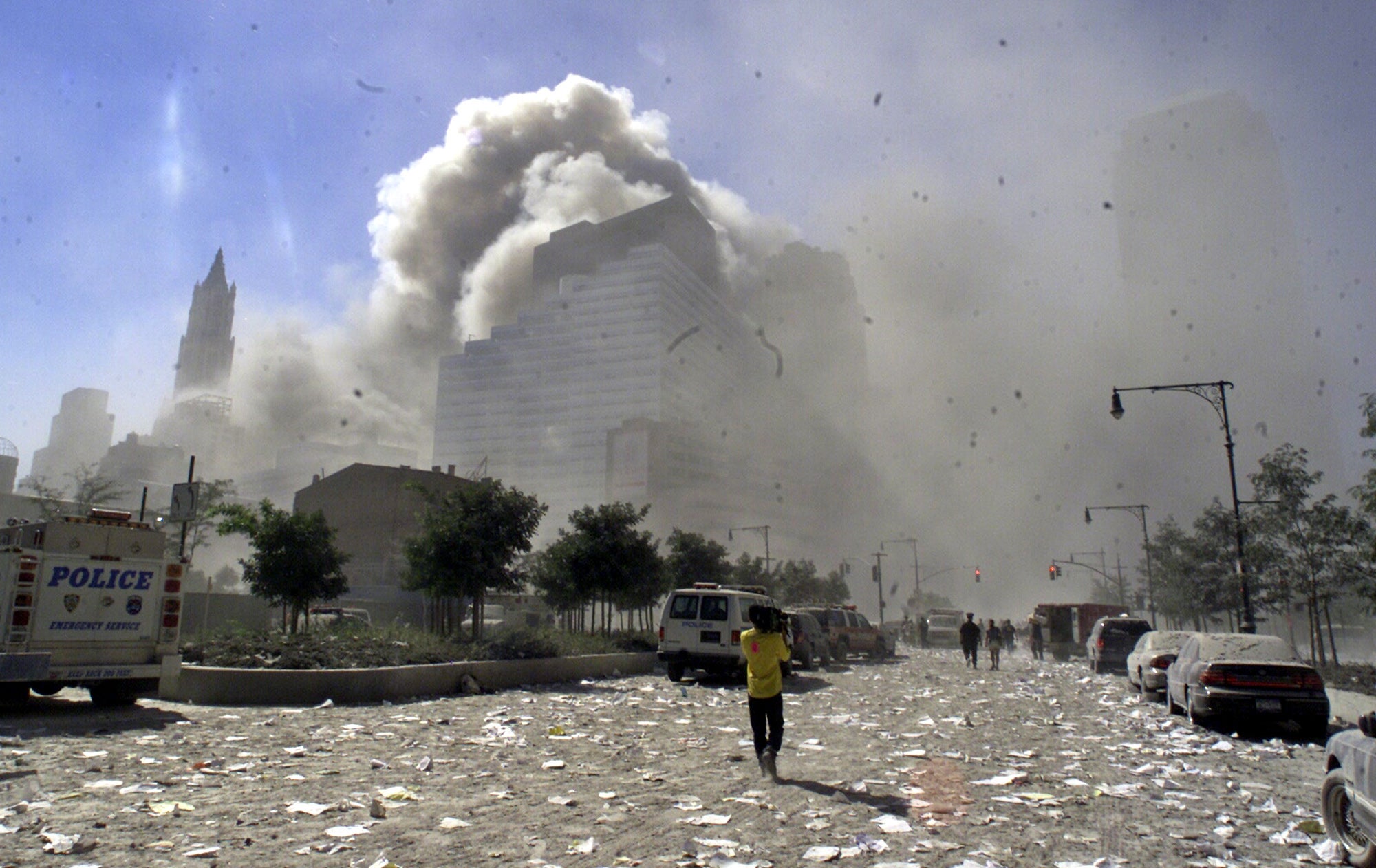
Standing roughly a block and a half away, Sancetta was actively documenting the south tower when its structure gave way.
“The weirdest thing that went through my head at the time was, it was kind of muscle memory, like shooting a basketball game,” she said.
As an advancing dust cloud approached, Sancetta took refuge inside a parking facility. Within a stairwell, she encountered a distressed survivor from the towers hoping to contact her son. Sancetta embraced her and pulled out her mobile phone with a trembling hand, but found no cellular service. She noted down the phone number and pledged to reach the woman’s son later.
Stepping back outside, she found the environment coated in white, “like covered with snow, but not snow.” The initial panic and running had turned to quiet weeping, while stray office documents drifted through the air “like birds.”
“I wish I’d shot that,” Sancetta said. “I didn’t, but I can see it — I see it right now.”
A quarter-century later, Sancetta displayed a Sept. 12 front page featuring her photograph of the blazing towers.
“NIGHTMARE,” read the prominent headline.
Today, peaceful woodland surrounds her home, yet the memory of the tower’s collapse remains clear — “just unearthly.”
“As a journalist, I’m glad I was there,” Sancetta said. “But as a human being, I wish I’d gone home on Monday.”
