
These photos offer a rare glimpse into grime’s early days

Hate Is a Strong Word, Jamie-James Medina (2026)
Gallery / 20 images
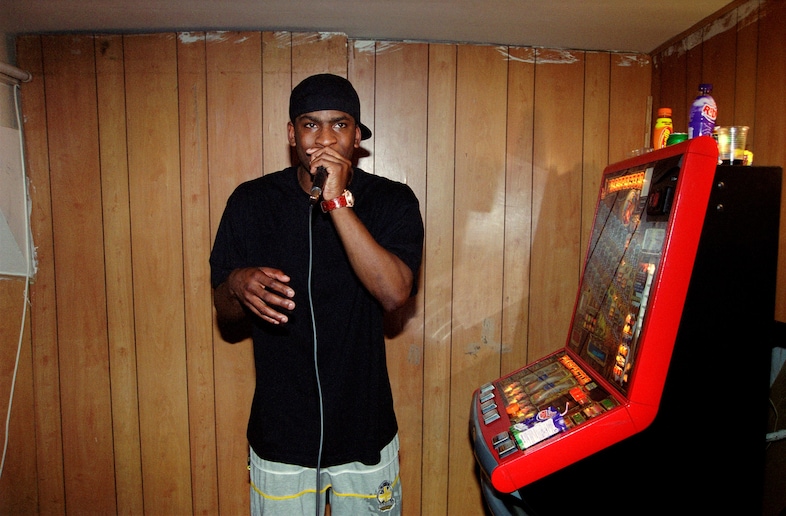
Nowadays, grime is all grown up. 25-odd years on from its formation, the genre’s aggressively British lyricism and driving electronic production have attracted acolytes all over the globe, and its imprint can be found on practically every British music scene that has come after it. Rewind the clock back to the early 2000s, however, and grime was concentrated in just a few tower blocks in East London. In those pokey council flats, pirate radio stations like Rinse FM and Deja Vu would broadcast, MCs like Wiley, Dizzee Rascal and Crazy Titch would clash (read: grime’s version of rap battles’), and photojournalist Jamie-James Medina would shoot his camera.
It is these early images that form the focus of Medina’s new photobook, Hate is a Strong Word, released as a digital download with WePresent today (September 22). The book takes its name from a lyric in Wiley’s 2004 track “Reasons”, in which he addresses his then-genre-dividing feud with Dizzee Rascal over icy, eskibeat synths: “Hate is a strong word / Think, why do you hate me? / I’m not against you / If it happens, then it happens for a reason.” “There’s just something about how Wiley delivers the line – his cadence, and how vulnerable he sounds,” Medina explains. “He’s talking to Dizzee, but he could be talking to himself. There were so many forces that stood in grime’s way – the music industry, the police, etc. This struck me as a positive message and one to build the book around.”
The intimacy with which Medina talks about the genre is well-founded – in many ways, his own life story is inextricably intertwined with grime’s. In 2001, an aspiring 19-year-old Medina found himself in East London attempting to report on the rise of gun violence in the UK. His photos from that time, the photojournalist writes in the book’s introduction, won a “very minor photography award… but what stays with me longest from those months is the sound blasting out of the radio […] A future sound, Black and British and broadcasting through an illegal frequency, in a car with no MOT. I had found my story.” He never looked back.

Over the following years, Medina became a fly on grime’s walls. He listened to reggae with Jammer’s postman father; his family cat, Jinx, was acquired when MC Scorcher had been sent to jail for driving offences and his cat had just given birth; and he recalls in our interview how D Double E’s voicemail in the early 00s was a recording of the iconic MC teaching his daughter his signature vocal style. His photos, meanwhile, reveal the overflowing emotions that characterised this period, from high-octane ‘clashes’ (read: grime’s version of rap battles) that were broadcast on pirate radio, to reloads on East London dancefloors heralded by gunfingers and lighters from the crowd, and, sometimes, to quiet moments of reflection both after the chaos – and before the global success the genre would later achieve.
One particularly striking image depicts Dizzee Rascal, soon to become grime’s golden Boy in Da Corner – the album widely recognised as bringing grime into the mainstream – peeking through a broken door in his Bermondsey studio in early 2003, a confronting determination in his eyes. “We went onto the roof, and someone had smashed the lock off the door,” Medina recalls. “This was before Boy In Da Corner came out, so I wouldn’t have known that yellow would become his colour. I look at it now, and it makes me think about him breaking through, blowing the doors open for the scene.”

It was also around this time that Dizzee Rascal was filmed in his now-iconic clash with fellow nascent grime MC Crazy Titch – a video whose heated exchange of lyrics and subsequent fight are transcribed in the final pages of the book, etched into history with all the weight and gravitas of a Shakespeare play. “That clash during a 2003 set on Deja 92.3 FM has been called grime’s ‘100 Club Moment’,” says Medina, describing every aspect of the video with vivid recollection – from the way Wiley’s hair is only partially braided (“as if he dashed out of the barber’s chair and started rapping”) to the names of everyone in the room. “Everything felt so charged back then. I wanted to bring people into that feeling, so I spent many, many hours transcribing the clash, rewinding and reviewing every syllable and burst of static. I spoke to Maxwell D and Sharky Major, making sure every lyric was accurate. Once I finished that, I started writing out all of the stage directions, following the different storylines in the room. At that point, you’re not simply listening to a set, but watching a drama, which may or may not end well. That is what grime felt like from 2003 to 2006.”
Indeed, this footage has since gone on to become so legendary online that one aspect of the clash has become endlessly discussed and debated in comment sections – one of grime’s great unanswered questions… until now. As the video devolves into a near-fight on a tower block rooftop, Dizzee repeatedly spits “I’m not a moot” at Titch. What does ‘moot’ actually mean? “Let me answer that question definitively,” responds Medina. “We spoke to Crazy Titch about this and he explained that ‘moot’ was regional slang, specific to Stratford and Plaistow. He said, ‘It means dickhead or mug. It means everything disrespectful’.” The question of moot’s meaning, it seems, is finally no longer a moot point.
Hate is a Strong Word was produced in partnership with WePresent and is available for digital download here, including exclusive essays from Wiley, Slimzee, Lethal B, and Crazy Titch.
Catch a closer look at the images in the gallery above.
