
Willem Dafoe on Gen Z, memes and staying young: ‘I’m a kid’

Willem Dafoe — winter 2017
Gallery / 4 images
Halfway through At Eternity’s Gate, Vincent van Gogh, as played by Willem Dafoe, screams at the sky in utter despair before cutting off his ear. The scene – or, rather, a GIF of Dafoe staring up with a pained expression – is now the go-to meme on social media, Reddit, and geeky forums for what it’s like to sit too near the front of a cinema. When The Odyssey came out in IMAX, the gag was everywhere.
In fact, images of Dafoe go viral so often, the website KnowYourMeme.com has an index page just for the 71-year-old American actor; examples range from “I’m Something of a Scientist Myself” from Spider-Man 2 to the self-explanatory “Willem Dafoe Smoking Cigarette with Two Oranges One of Them Mouldy”. While Dafoe is technological enough to log onto a Zoom call from New York in late July, he avoids social media as much as possible. “I’m not good with devices,” he says. “I still type on the phone with my index finger.”
Why is he so meme-able? “I generate a lot of work and I’m not bound by just naturalism. I sometimes do very abstract, theatrical performances. I like doing photoshoots. You get clothes you sometimes would never be caught dead wearing, and if the photographer’s good, it’s fun and instant. You have to find shapes and perform.” Young artists educate themselves on Godard and Bergman. Does he do the reverse with TikTok and Instagram? “I don’t have to seek it out. It’s in the culture. So much of it is in your face.” He knows the memes? “People send me weird stuff, yeah. I enjoy it sometimes.”
Despite his age, Dafoe is hugely popular with Gen Z. A co-founder of the Wooster Group in 1975, Dafoe spent the next few decades acting for all-time greats like Martin Scorsese, David Cronenberg, Wim Wenders, John Waters, Spike Lee, Kathryn Bigelow, and Lars von Trier; in recent years, he’s been a regular for Wes Anderson, Yorgos Lanthimos, and Robert Eggers. Fittingly, Dafoe’s newest film – and his 159th time on screen – is a sly, nuanced drama that mirrors the actor’s own affinity with young cinephiles.
Late Fame was adapted by director Kent Jones (the former director of the New York Film Festival) and screenwriter Samy Burch (May December) from an 1895-written Arthur Schnitzler novella of the same name about a 69-year-old Austrian civil servant, Ed Saxberger, whose old poetry becomes unexpectedly popular. (Schnitzler also wrote Dream Story, which Kubrick turned into Eyes Wide Shut.) Jones’s film updates the story to the present: Ed Saxberger (Dafoe) is a New York postman who hasn’t written in decades. A secret rich kid, Meyers (Edmund Donovan), informs Ed that his old poetry has been rediscovered; a lively gang of young artists encourage him to create new material. It’s like a Whit Stillman comedy set in the age of smartphones – except the Enthusiasm Society, as they call themselves, are defiantly anti-technology.
Put on the spot, Ed struggles to summon up new verses. Is the film suggesting that great art can’t be forced? “I think he’s traumatised by the identity of it all,” says Dafoe. “He was supported by his youthful ambition, and he left that world. He doesn’t know if he can do it anymore.” Is that because he’s self-conscious that he’s older than the Enthusiasm Society? “If he was the same age, he’d be writing poetry. He’s able to project onto them, but they’re different than he was.”
“I’m always trying to figure out what young people are up to, because they have an energy I respect and want to tap into”
As in The Florida Project, Dafoe delivers an unshowy performance that’s full of soul: Ed’s dismay at his writer’s block; his fury that co-workers ridicule his former literary ambitions; his affection and lust towards Gloria (Greta Lee), a flirtatious actor half his age. Also believable as a postman who’s been street-cast for his first-ever acting role, he’s comparable to Adam Driver taking bus-driving lessons to play an amateur poet in Paterson.
Another core element is Ed’s disconnect with Meyers, a youthful sycophant more invested in the romantic idea of rediscovered poetry than Ed’s words themselves. When Meyers offers feedback, Ed refuses to take it seriously. It makes me wonder if Dafoe would work with a Gen Z director as young as 21-year-old Kane Parsons. “I have, I have,” he says. “Maybe not 21, but I’ve worked with a lot of young directors. Many years ago, Gene Hackman’s biggest advice to me was: ‘Whatever you do, never work with a first-time director.’ I obviously didn’t follow his advice.”
But would he take instructions from a director as young as 21? “I would if there was something for me to contribute. Listen, I’m always trying to figure out what young people are up to, because they have an energy I respect and want to tap into. They have their lives ahead of them, and a desire to make something. When you need to make something, and the world drops away, and you have this single purpose – that’s attractive to me. How they think might be different to me – I’m not a kid – but I can learn from them. What I want to avoid is people who are stuck and don’t have that desire. Sometimes people lose that over time. I haven’t lost it. Maybe I’m a little bit of a bloodsucker, but I turn very much to the younger generation to put me in places where I’m not comfortable.”
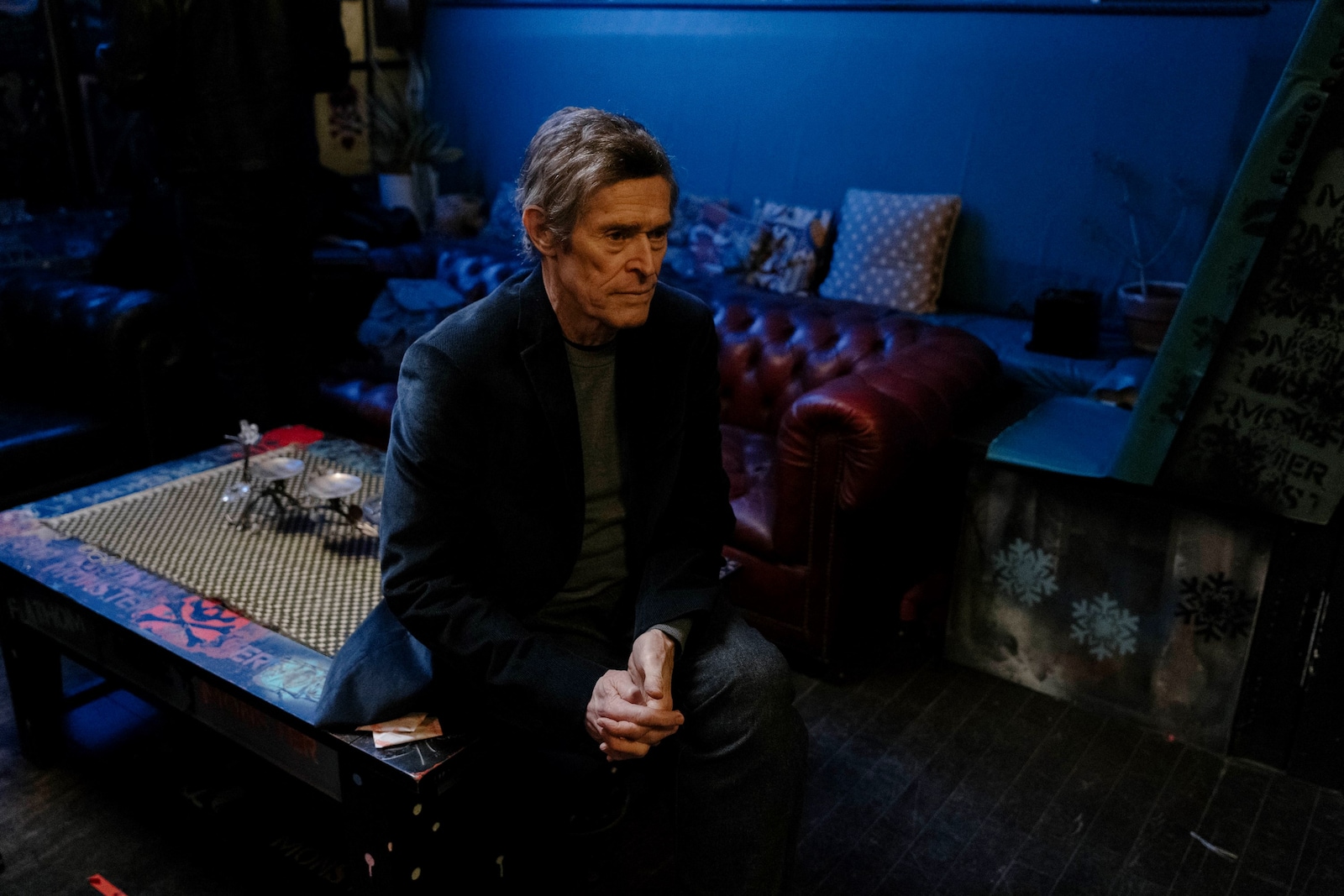
Talking to Dafoe, it’s apparent that Late Fame isn’t merely another acting gig. Prior to Burch writing the screenplay, Dafoe had already read Schnitzler’s Late Fame and asked Abel Ferrara to consider an adaptation. A line in the film was added by Dafoe himself, drawing from the actor’s own life. “I put it in there because I’ve said it in interviews,” he says. “I used to be the youngest in every group, and then one day – it’s not a gradual thing – I woke up and I was the oldest one. I’m dealing with that.”
Dafoe also acknowledges the meta element of being surrounded by younger artists. “Between shots, we take shelter in restaurants and coffee shops. They ask me to tell war stories of making films; stories of when I was young, poor, and idealistic; stories of who I knew. You get sucked in. I felt rooted in doing the movie because of that parallel experience. If the feeling of shooting the movie is captured in the movie itself, then it’s usually a good movie. If there’s a big disconnect, then it’s usually not a good movie.”
But, I say, that’s why it’d be fascinating to see Dafoe directed by a 21-year-old, just to see if there’s still that connection. “I’m working with a lot of people who are a lot younger than me,” he says. “When I’m put in that position of an older actor and people ask me things, it’s confusing. My identity is that I’m a young guy. I’m a kid.”
Late Fame is out in UK cinemas on September 4
