
New CDC data shows young Americans still make up most urgent care visits. Doctors say forgoing primary care could be risky

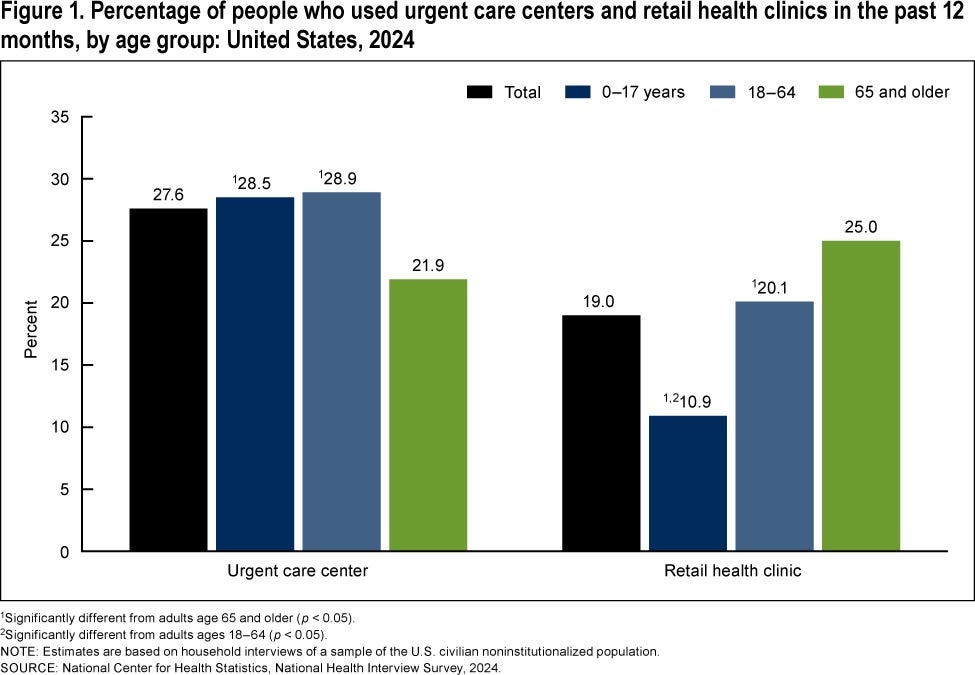
Younger American adults are still turning to urgent care centers more than their older counterparts, newly released federal data shows.
Nearly a third of Americans visited an urgent center at least once in 2024, the majority of whom were under the age of 64. That’s a trend also seen in 2021 data from the U.S. Centers for Disease Control and Prevention.
The findings support continued observations over the last decade: more young Americans have been opting for urgent care centers over primary care physicians, as the number of U.S. urgent care centers has doubled.
Many young adults in good health might not think they need longer term or preventative care until they are older or have a more obvious health condition. Going to urgent care is also pretty convenient and often less costly than an emergency room visit.
But doctors caution that sole reliance on these care centers could lead to missed or incorrect diagnoses, potentially leading to greater issues down the line.
Part of that is due to the nature of urgent care, Dr. Sarah Nosal, president of the American Academy of Family Physicians, recently told The New York Times.
Clinicians at urgent care centers are likely meeting patients for the first time and typically don’t have access to medical records that could provide a wider understanding of a person’s overall health.
Urgent care centers aren’t really places that manage longer term health problems, but they may provide a bridge to that kind of care.
“Urgent care isn’t bad medicine; it’s episodic medicine,” Dr. Howard Willson, a Washington-based emergency medicine doctor who works in urgent care, told The NYT. “Nobody’s watching the long arc of your health.”
Primary care physicians work to help you stay healthy, detect problems with symptoms that aren’t noticeable or determine risk for cancer and other genetic conditions.
“You have even more of a reason to get a primary care physician and regular checkup if you have a biological relative with a strongly genetic illness like colon cancer. That changes our medical decision-making because you may qualify for a colonoscopy at 25 years old,” Dr. Edward Kim, a primary care specialist at UChicago Medicine Medical Group, explained in a 2022 statement.
Some diseases, such as colorectal cancer, are rising in younger Americans, according to the American Cancer Society.
Still, more than 40 percent of adults aged 18-29 do not have a primary care physician, according to a 2019 poll from the Kaiser Family Foundation. Over half of Gen Z and Millennial Americans primarily use urgent care and the ER for their health needs, a survey conducted by Aflac insurance found last year.
Cost, location and complacency are barriers to access, the medical publication Physician’s Weekly notes.
It can also be hard to know who to turn to and doctor burnout is reducing the number of available physicians.
All of these issues suggest that fix will need to be multi-pronged.
One suggestion to entice millennial patients is online marketing, allowing doctors to display their expertise.
Another is for physicians to expand options for scheduling and telehealth.
“Convenience and access, for patients, trump continuity,” family physician Natasha Bhuyan previously told the American Academy of Family Physicians. “We need to get comfortable with transitional care, but still show patients the value of continuity in the process.”
And, doctor burnout can be addressed by training and financially supporting more primary care physicians, eliminating pay gaps between them and specialists, Dr. Peter Grinspoon, a primary care physician at Massachusetts General Hospital, wrote in a 2022 blog.
“We need to buttress those doctors who are currently trying to stick it out as primary care doctors, so they don’t cut down hours or quit. These doctors urgently need emotional, financial, logistical and psychological support,” he said.


