
Inflation to surge beyond forecasts as UK economy set for growth slowdown

Want to bookmark your favourite articles and stories to read or reference later? Start your Independent Membership today.
Already a member?
Log in
Households are set to face significantly higher-than-expected inflation and a slowdown in economic growth next year due to pressure on energy prices, the Government’s official forecaster has said.
It came as Chancellor John Healey warned the economy had been impacted by “global economic storms” in his first autumn Budget.
Official forecasts also show national debt levels, compared to the size of the wider economy, are set to swell over the next three years amid higher-than-expected state borrowing.
The Office for Budget Responsibility (OBR) said UK inflation is set to rise to a peak of around 3.75% by the start of next year, particularly driven by a jump in household energy bills in January.
It is then expected to steadily decline but only reach the Government and Bank of England’s 2% inflation target in 2028.
The OBR said inflation would average at 3.1% this year and then 3.4% in 2027, in a significant hike to previous forecasts of 2.3% in 2026 and 2% in 2027.
The jump in inflation will also come despite a number of measures from the Chancellor aimed at reducing the cost of living, such as removing VAT from electricity bills and the standing charge from gas bills.
The economy is also now expected to see growth slow next year as accelerating inflation puts pressure on households and businesses.
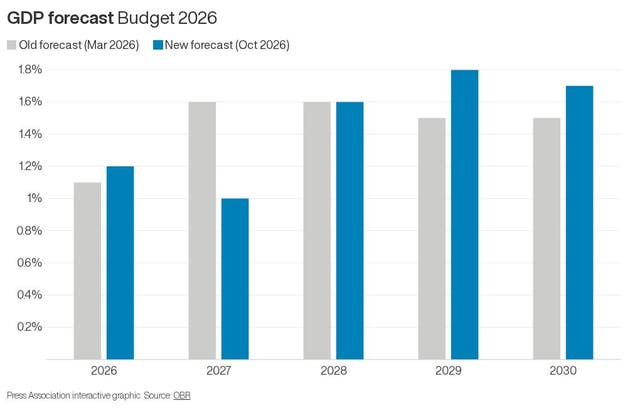
The OBR said UK gross domestic product (GDP) is set to improve by 1.2% this year, up from a previous estimate of 1.1%.
However, the watchdog said the economy is then expected to see growth slow to 1% next year.
It represents a significant cut to the growth outlook, with the watchdog having previously predicted the economy would grow by 1.6% for the year.
Growth is expected to lift back to 1.6% in 2028, followed by rises of 1.8% in 2029, 1.7% in 2030 and 1.6% in 2031, pointing to a slightly stronger outlook for the final years of the forecast period than previously expected.

Mr Healey also confirmed on Wednesday that he will reduce the UK’s fiscal headroom to £15 billion in 2029/30, from a previous prediction of £26 billion, after witnessing a jump in borrowing costs.
The weaker headroom, which will improve to £22 billion by 2031, was linked to a £15 billion jump in debt interest costs for the current year.
The yield on UK 10-year gilts – government bonds – eased back two basis points after the Budget despite the reduced headroom.
Government borrowing is expected to be higher than expected in every year of the latest forecast compared with previous predictions from March, the OBR said.
The OBR said it is expected to surpass previous forecasts by around £18 billion this year, £16 billion in 2027/28, and an average of £11 billion a year after that.
Mr Healey stressed however that borrowing as a proportion to GDP is set to decline 4.2% this year, dipping each year until 1.8% in 2030/31.
Meanwhile, the UK’s national debt – public sector net debt – is set to rise from 96% of GDP this year to 97% in 2028/29, before falling back to 96% in 2031.
Elsewhere, unemployment is set to be lower this year than previously expected.
The forecasts indicated the unemployment rate will strike 5% for this year, before rising to 5.1% for 2027 and easing back to 4.9% in 2028 and 4.5% in 2029.
The OBR had previously predicted unemployment of 5.3% for 2026, although it had originally forecast this would ease to 4.9% next year.
