
In photos: The secret history of Ibiza’s wildest 90s club night

Manumission: 90s Ibiza
Gallery / 24 images
The most surreal moments in The Motel: High Times in 90s Ibiza, a new memoir about the legendary Ibiza club night Manumission, are not when a performer called Otter shoots fire from her flame-tattooed vagina. Or when the club’s owner gets his fingers broken by a couple of large Italians, upset about Naples being labelled a “city of thieves” on promotional posters. It’s not when co-founders Claire Davies and Mike McKay fear they are about to get shot by an investor they owe money to while he racks them up lines. It‘s not the live sex shows (including someone sucking his own cock, a dancer pulling out her tampon and throwing it into the crowd, before being fucked by a strap-on). Or when a Radio 1 DJ fails to show up on air after a night of partying and the BBC are given the cover story that she has been kidnapped.
The most surreal moments come when, every Thursday morning, Davies and McKay have their weekly business meetings. After becoming fully immersed in the debauched Manumission world – a reality with no rules, no real sense of time or geography – they would suddenly find themselves dropped back into real life and all its mundane admin: suppliers, bar bills, bar takings, staff wages, operating hours, roof build, licenses. Of course, the book doesn‘t dwell too long on these meetings and before long it’s back to regular programming. “Drip, drip, drip went the liquid acid. Dab, dab, dab went the powdered MDMA, chop, chop, chop went the rock of cocaine, the mescaline, the ketamine… Puff, puff, puff went the magic dragon, whose wings flapped and we soared up, up…” as Davies writes.
Manumission started as a night in Manchester’s Gay Village before making its way to Ibiza in 1994 where it found a home at Ku (which later became Privilege and is now UNVRS). Imagined by McKay as a place of “magic, drag queens, sex, dwarfs and art”, Manumission aimed to create an environment where anything went. “It was kicking against the prudishness of British society at the time,” McKay tells me over the phone from mainland Spain, where he now lives with Davies, who wrote the memoir, and their three children. “We were always kicking against something. That was our driving force,” Davies adds. “There were no boundaries. There was no VIP. It was all ages, sexualities, spiritualities. We always had really high artistic standards ourselves. But at the end of the day, we wanted people to have the best time of their lives.”
Rankin x Manumission, Dazed April 1996
Gallery / 6 images
Every week, 10,000 deliriously happy clubbers filled Ku’s famous rooms to dance until dawn and experience a night (often stretching well into the following day) of theatricality, spectacle and transgression. Artistic concepts for the shows ranged from murderous femme fatales to celebrating cities around the world. “My philosophy was about creation rather than destruction,” says McKay, who drew from philosophers and writers like Alan Watts and Paulo Coelho when conceptualising his vision for Manumission. “In life, you can be so worried about what other people think of you – with good reason in lots of places. We tried to create an environment where you didn’t have to worry like that. People could let their guard down.” “And that’s where the wild sex shows came in,” adds Davies. “People would watch the performance and think, ‘I can do anything’. It was supposed to make you talk to the person next to you, even if it’s just to say, ‘Oh my god.’”
To write the book, Davies and McKay looked back through their archives of diaries, design notes, posters, flyers, tapes. They also interviewed people who were there at the time, gathering recollections (sometimes hazy) and favourite memories, before compiling it altogether in a process that took around 10 years. “We tried to tell the story as honestly, openly and fearlessly as we possibly could. It was a huge endeavour. Every day we would write another story until we amassed this huge body of writing. And then, well, we kept getting drawn back to the motel.”
In the summer of 1998, Davies and McKay took over a disused pink brothel by a roundabout near Ibiza Town and opened the Manumission Motel. Described by Davies in the book as a “labyrinth of freedom”, the motel acted as an HQ for the couple and as a place for DJs, music producers and performers to stay and keep the party going. Press and photographers were banned, a posse of New York strippers (known as the Pink Pussies) were residents, and everyone from Jade Jagger and Kate Moss to author Irvine Welsh and notorious international cannabis smuggler Howard Marks passed through. It was a hotbed of artistic sensibilities, fuelled by a seemingly endless supply of drugs. It only lasted for two years.
Davies’ writing matches the kinetic energy of those days with a breathless, breakneck speed. “We really wanted the book to capture the late-night conversations you have when your boundaries and your barriers are down,” she says. “We just wanted people to really feel like you’re there. That was a big point. Can you feel it, can you smell it, can you taste it?” Of course, the highs are followed by the inevitable comedown – both personal and professionally. The party can‘t last forever. “We also wanted to include the downsides, the warnings, the trouble that does come with the drugs and the lack of sleep and the lack of food,” says Davies.
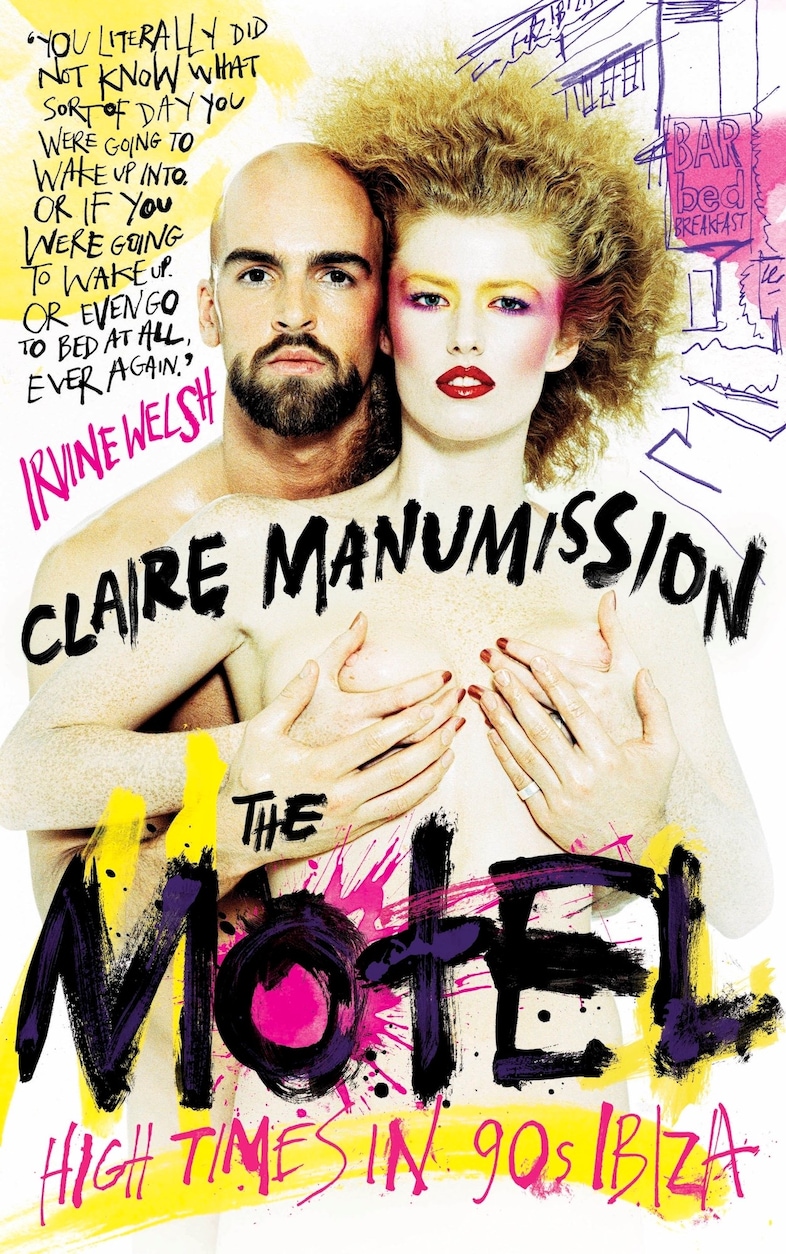
A certain kind of Ibiza club experience began its long decline in the early 2000s, even though Manumission soldiered on until 2008. The intrusion of sensationalist tabloids and reality TV broke the spell, as did money troubles and burnout. During one scene in the book, Davies and McKay come back from a trip to neighbouring island Formentera to find that the DJ booth has been moved into the centre of the stage, bringing everyone’s attention to a focal point. It signals the start of what Davies describes in the book as a “predictable and monotonous scene”, one dominated by mega-clubs, VIP bottle service and oligarchical DJ residencies.
This formulaic approach towards club nights might guarantee ticket sales, but, the pair argues, it takes away the possibility for magic. When the DJ became the show, people stopped dancing and talking to each other, disrupting the rhythm of the experience. “The DJ is not meant to be looked at. The DJ is meant to soundtrack the night. They watch the dance floor. They respond. It’s a beautiful, alive relationship with a good DJ, with the dancers, the people on the dance floor. But when the DJ was put in the middle and stared at…”
“It created a different type of person that can thrive in that position,” McKay finishes the thought, adding that when DJs earn half a million for a set of two hours, there’s no money left for the party. “There used to be a huge culture around nightlife – the drag queens who did the decor in the day and performed at night, the drummers, the dancers, the artists, the designs. That’s all been taken away because of the greed of the management and the agents,” agrees Claire.
For anyone feeling nostalgic for those hedonistic heydays, McKay and Davies are bringing back Manumission – and the 90s – later this month. Held at the sprawling open-air venue 528, across multiple stages and performances, the pair will recreate the year 1998, with replicas of the motel and (in)famous Ku rooms like the Hong Kong Hot Tub. Phones will, of course, be banned. “Our belief is that it can feel the same as it did in our time if you take the phones away. Human beings haven’t changed and if you can train people to not, in a moment of awkwardness, look at their phone screens and be present in the moment, they’ll have a lot more fun,” says McKay.
The Motel: High Times in 90s Ibiza is available from Velocity Press and tickets for Manumission: Le Weekend on Saturday 26 September are available at 528.
