
Kembra Pfahler’s guide to becoming an artist

When legendary rockstar and performance artist Kembra Pfahler walks into a room – these days, often wearing a balaclava, sunglasses and dark lipstick – people take notice. Few artists have commanded such a lasting legacy. As a key figure in the Lower East Side’s underground scene, Pfahler’s performances have influenced New York culture for more than four decades. On stage, Pfahler, who is the high priestess of The Voluptuous Horror of Karen Black, became known for getting naked and covering herself in head-to-toe single-colour body paint (even blacking out her teeth), wearing her signature three-tiered black wig and stiletto boots. Who better, then, to teach a performance art 101 class? In late July, I woke up bright and early to head to Art Omi in Ghent, New York, for exactly that.
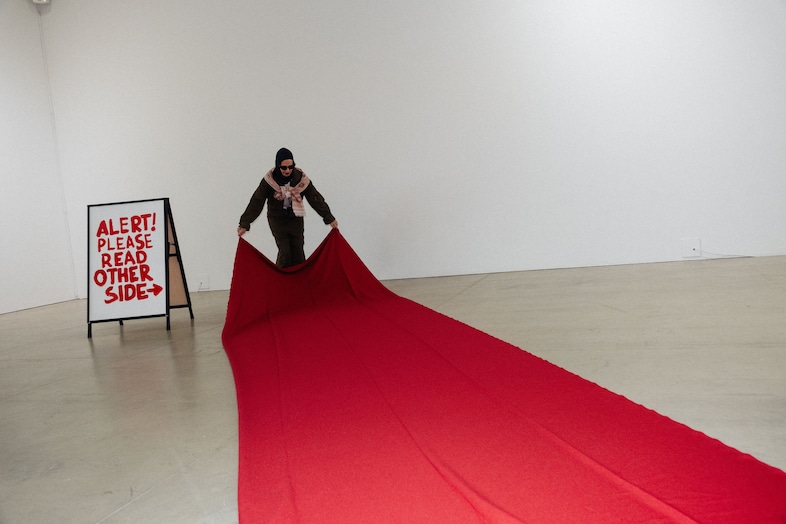
Pfahler arrived at the not-for-profit arts centre and 120-acre sculpture and architecture park in a green jumpsuit, ringing a large gnome-shaped bell to say that class is in session. On a whiteboard, she wrote the word “AVAILABISM” in big letters – an artistic practice she came up with centred on making use of what is readily available. On stage, availabism can look like showing up with a large cut-out sheet wrapped around you, rather than any expensive stage clothes, but the philosophy also extends to every corner of life. For example, during introductions, when someone mentioned they were shy, Pfahler told them to “hold onto” their shyness. “Being shy is a good thing,” she said, before explaining how she’s less inclined to work with people who crave the spotlight. Availabism, then, in that context, is about leaning into what comes naturally to you. “You don’t have to be the performer; you could be the director, you could be the costume maker, or you could be the person that’s filming your friend,” Pfahler told me when I caught up with her after class.
Perhaps even more impressive than Pfahler’s fierce and wild performances over the years – all documented in her new Rizzoli book, which she says she worked with senior editor Loren Olsen on for about 7 years – is her commitment to shape the next generation of artists. “My desire has always been to create things from nothing,” she says. And Pfahler is a natural teacher. She invited everyone to join her on stage at her next show, and put her number on the whiteboard at the end of class – when she said to call her “anytime”, she actually meant it.
Below, we asked her for her takeaways from decades of availabism, in her own words.
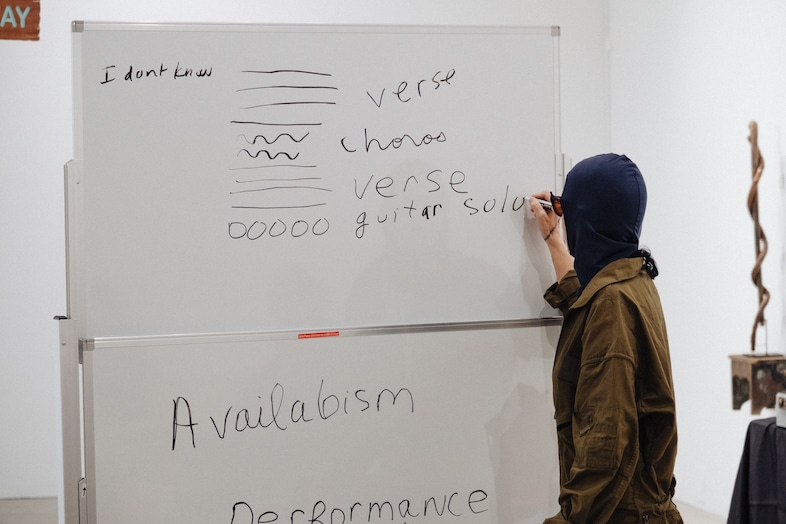
That’s the sentence that started it all – Pfahler recounts saying it to her teacher, artist Joseph Kosuth, at the School of Visual Arts, when he asked her what she was. “I took great offence because I didn’t know what I was when I was a 17-year-old,” she says. Shortly after, she quit school. Thankfully, she found her community in New York “right away”.
Shortly after moving to New York, she organised “The Extremist Show”, a nine-day event that mixed performance and music with drawings, paintings, and sculpture at ABC No Rio arts space. “ABC No Rio has been given to the younger generation to take over as a free space to use and curate shows,” she says. “I was very fortunate because I found that in New York – not only did I have this idea, but I had a community of people to help me understand what I was doing.” According to Pfahler, it took her another decade to understand “what it meant”.
When Pfahler was just getting started, she says performance art was not taken seriously and performance people were “the devalued clowns of the art world”. This, of course, didn’t stop her from creating her own subversive visual language, exploring themes of horror, sex and feminism. In the 1980s, Pfahler funded her underground film projects with work at an independent porn studio. She says she was “angry” when she first started, but encourages emerging artist to think “very seriously” about using their nakedness in public. “You always have to be prepared to talk about your performance at the dinner table with your grandmother at a Jewish, Buddhist or Muslim holiday,” she says. “It’s impossible to do things in secret.”
This, says Pfahler, was a lesson she learned especially during her more extreme performances, like when she sewed her vagina shut for Richard Kern’s Sewing Circle (1992), and then had to explain that to her 11-year-old nephew at the time. “I never thought that being naked was sexual because it wasn’t about adult sexuality,” she says. “It was about beauty, power and not having – coming from extreme body shame and dysmorphia.” Throughout the 1990s, Pfahler continued to explore how physical transformations could challenge conventions around aesthetics, gender and performance art, including in her performances in The Voluptuous Horror of Karen Black.

Pfahler says she always suggests people don’t do a performance just because they want the accolades. “You’re doing a performance to share new ideas,” she says. “I think I learned from the punk generation in the early 70s in Los Angeles that you are going to give yourself a nervous breakdown if every time you do something, you want to go straight to the top.” In fact, in the beginning, people in America didn’t understand The Voluptuous Horror of Karen Black. This didn’t deter them from doing a cross-country tour in the 90s anyway.
“I never toured in Europe with my band because Europeans always treated New Yorkers so openly and positively,” she says. “I thought to myself, ‘I have to tour in the US where they hate my guts because they don’t have anything like us’.” This was before Marilyn Manson rose to popularity, and Pfahler says New Yorkers would say they were “homosexual heroin addicts” who wore too much makeup. The entire purpose for touring in places where you didn’t receive a warm welcome, according to Pfahler, was that they’d end up playing in cities where there were “three punk rock gay kids” who would always be waiting for them during soundcheck.
Pfahler developed a couple of hard rules over her years of experimental performance. One is to always pay people. The other is to do no harm (including to herself). “In the beginning, I used house paints that put me in the hospital and glitter made of glass that can cut your eyes,” she says. “I had to learn the hard way about materials. A breakthrough came to her during a conversation with Sharon Stone, who said something along the lines of “We all have to be careful”. “I was like, ‘Jesus Christ, you’re absolutely right’.”
Other than those simple rules, Pfahler encourages everyone to experience the freedom of embarrassing themselves in public. “We don’t know who is going to save the world or change the world,” she says. “I think all of us do in our own little ways just by showing up.” With this in mind, Pfahler says it’s never too late to start a band or schedule a solo performance – which she recommends just picking a date for, making a flyer and then “figuring it all out later”. Availabism includes inventing performance spaces out of nowhere and having the courage to ask questions like, “What are you doing with all this fabric after your wedding?”.
During the performance 101 class, Pfahler emphasised the importance of reaching out to artists you admire and doing studio visits. Or, as she put it, “pursuing people who are alive”. In an age where it’s easy to hide behind a screen, it’s sobering advice. “Availabism can be confusing if there’s an excess of apligants [Pfahler’s made-up word for application-driven intelligence], but if you ask AI how to build a lemonade stand, it‘s going to give you 50 thousand different ways to build it, and that can be confusing,” she says. “The internet is a handful of rich white guys’ opinions”.
