
Sayonara summer. US daylight is fading fast again

Daylight is dwindling across the United States as the season shifts from summer to fall.
Some northern states could lose over an hour and a half of daylight over the month of September, according to a new assessment from forecaster AccuWeather.
Southern states lose fewer minutes but even the coasts of Texas and Florida will see daylight dwindle by 40 minutes.
Why is this happening? Summer-lovers can blame our Blue Marble.
“Days become dramatically shorter throughout September, faster than any other month, all due to the tilt of the Earth,” AccuWeather says.
What this means for you
On a practical level, this means that there’s less daylight in your day. There is more daylight lost in September than in any other month of the year, according to AccuWeather.
Cities from San Diego, California, to Charleston, South Carolina, are slated to lose 50 minutes of daylight. Those between Los Angeles and Raleigh, North Carolina, will lose an hour.
Residents living between Eureka, California and New York City are set to lose 70 minutes. Those around and below Portland, Oregon, and Boston, Massachusetts, will lose around 80 minutes.
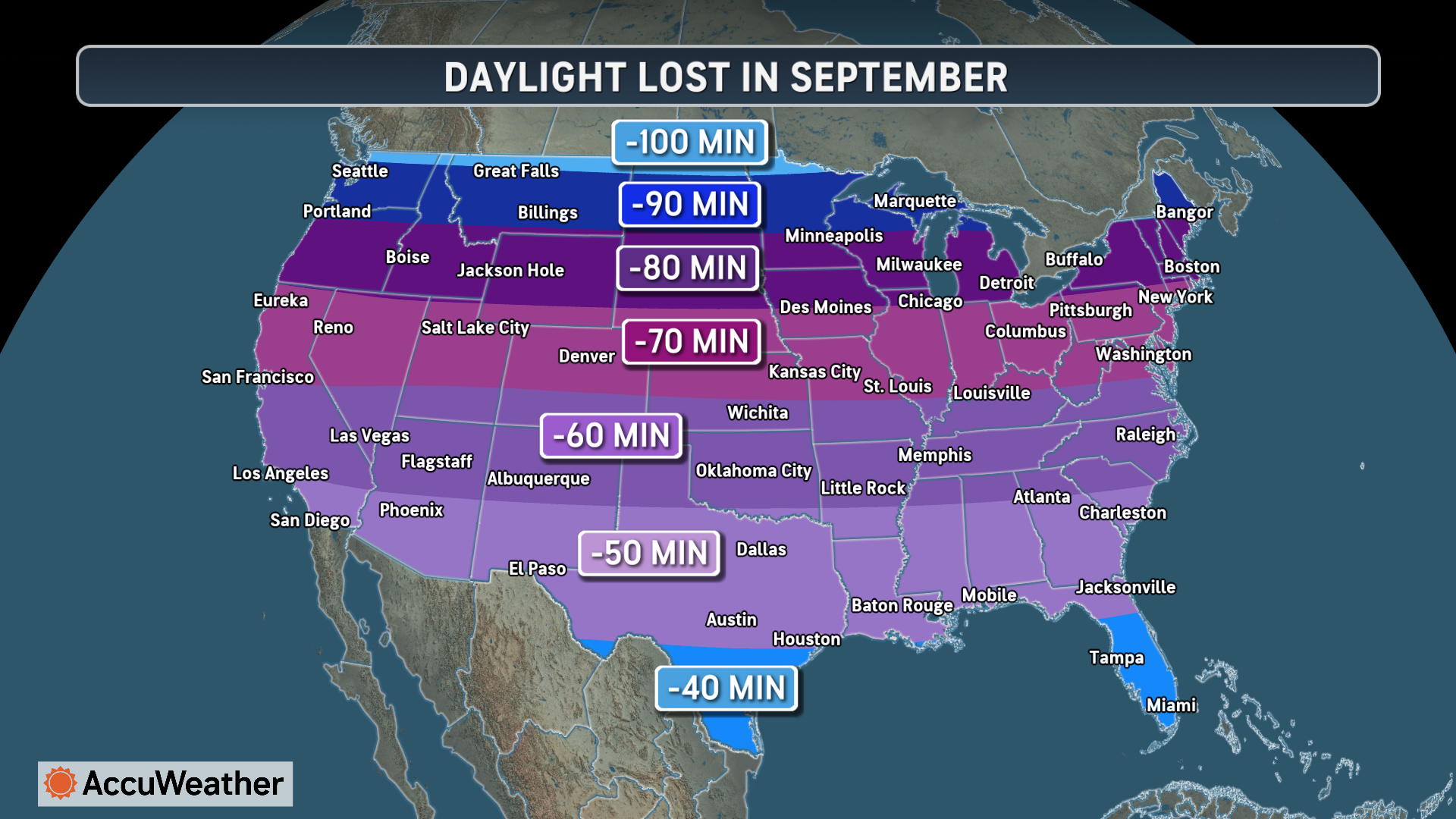
Only the northernmost reaches of the contiguous U.S. will lose between 90-100 minutes. That includes Seattle, Washington, the majority of the Great Lakes region and Bangor, Maine.
What causes the light to fade?
The Earth is at a fixed tilt of 23 degrees thanks to an impact from the ancient planet Theia 4.5 billion years ago, according to NASA, leading to the formation of our moon.
It’s the orientation of Earth’s tilt relative to the sun that causes the seasons.
The northern hemisphere leans away from the sun during winter and toward it during the summer, which changes how much daylight we receive.
This gradual shift starts after the summer solstice on June 21, according to The Farmer’s Almanac, which is the longest day of the year.
“The sun follows a lower path through our sky, sunrises become later, sunsets become earlier and our total hours of daylight decline,” the Almanac explains.
The days will continue to grow dark until the winter solstice on December 21 winter solstice, when the cycle reverses.
