
The story behind this artist’s aborted trip to the moon

Rhiannon Adam, Rhi-Entry
Gallery / 33 images
“They should have sent a poet.” Those are the words uttered by Jodie Foster’s character in 1997’s Contact! after travelling through a wormhole and emerging on an alien beach, under a sky filled with glittering stars. And the real Japanese billionaire Yusaku Maezawa took that literally. In 2018, just over 20 years after Contact!, Maezawa announced that he was set to command eight creatives on a SpaceX rocket destined for the moon – all experiencing spaceflight for the first time, and all making the journey free of charge in the name of illustrating the majesty of space. Among them was the Irish photographer Rhiannon Adam. She was to have been the only female member of the crew, and the first openly queer woman to venture beyond Earth’s atmosphere.
“It was the middle of the pandemic,” Adam tells Dazed, setting the scene. “I mainly make work about humans, and I was in the midst of a bit of a life crisis thinking, ‘My god, I’m never going to be allowed near another human again.’ So everything ground to a horrible standstill.” Then, a friend who followed Elon Musk on Twitter – pre-DOGE and right-wing meltdowns – told her about a callout for Maezawa’s so-called dearMoon project. “I thought it was a bit of a joke at first,” she adds. “I mean, who gets to apply to go to space? That’s just not a real thing. So I applied, but I didn’t really think too much of it.”
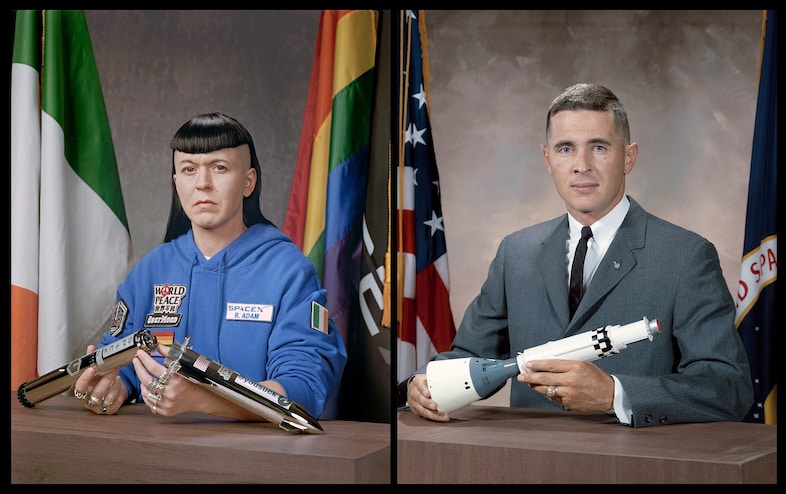
Then, Adam got an email back asking for more information. This was followed by a round of Zoom calls, team-building exercises, and self-tape videos requested at 2am (SpaceX is based in Texas – Adam was in a “terrible B&B” in Great Yarmouth). Eventually, she completed a medical survey, and was finally invited for an in-person interview in Houston. In 2022, she was officially announced as one of eight mission participants, also including the Korean rapper T.O.P. (Choi Seung-hyun), DJ Steve Aoki, and YouTuber Tim Dodd.
The following months were spent working with SpaceX to figure out the unique requirements of the mission, which would have involved circling the moon in one of the private company’s Starship rockets. (NASA’s Artemis II mission completed this journey in April 2026, although its Orion spacecraft was piloted by trained astronauts.). The preparations also saw the mission team form close bonds from all corners of the Earth, as well as coming to terms with the potential aftermath if the mission went badly wrong. Suddenly, though, everything stopped. In 2024, Maezawa made an announcement that the mission wouldn’t go ahead due to delays in the development of the Starship spacecraft.

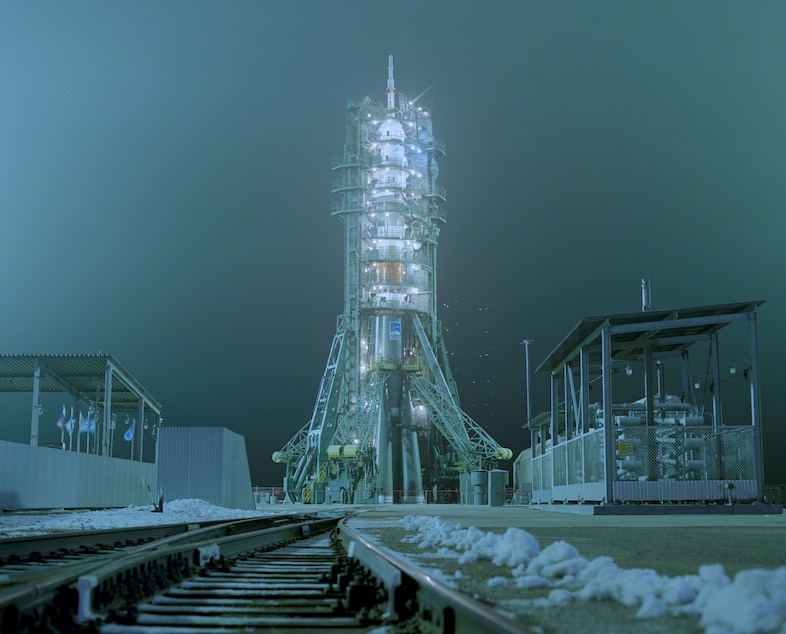
“He basically got bored of waiting,” says Adam, whose photographic project Rhi-Entry explores the journey and its deep disappointments, alongside the history of human spaceflight and its prevalence in our culture. “My suspicion is that, ultimately, he knows it’s a bit like an airline… you can just buy another ticket later on. For him, there wasn’t any great loss.” For the crew, of course, it was a different story. Publicly, the billionaire stated that he didn’t want to keep them waiting, saying: “I can’t plan my future in this situation, and I feel terrible making the crew members wait longer, hence the difficult decision to cancel at this point in time.” However, Adam claims that Maezawa never discussed the cancellation with the crew ahead of time. “All of us were super aware that the original timeline that was set out was completely impossible,” she says. After all, there’s a common tendency to be over-ambitious among companies like SpaceX, especially when combined with the production and manufacturing delays caused by the pandemic.
“It’s a strange thing to contemplate your own mortality, and make quite important decisions based on that, and then for it all to fizzle into nothing” – Rhiannon Adam
“If we thought for one second that it was either that timeline or nothing, none of us would have agreed to being trawled through the media,” she adds. “We were in it for the long haul. All of us had decided that this was going to be our life’s mission, so we planned our lives accordingly.” And, in some cases, they even planned beyond that. “It’s a strange thing to contemplate your own mortality, and make quite important decisions based on that, and then for it all to fizzle into nothing. It’s quite a thing to say that you’re willing to die for something, and then for it to be treated as something disposable… God, what a thing to commit to, when people don’t commit back.”
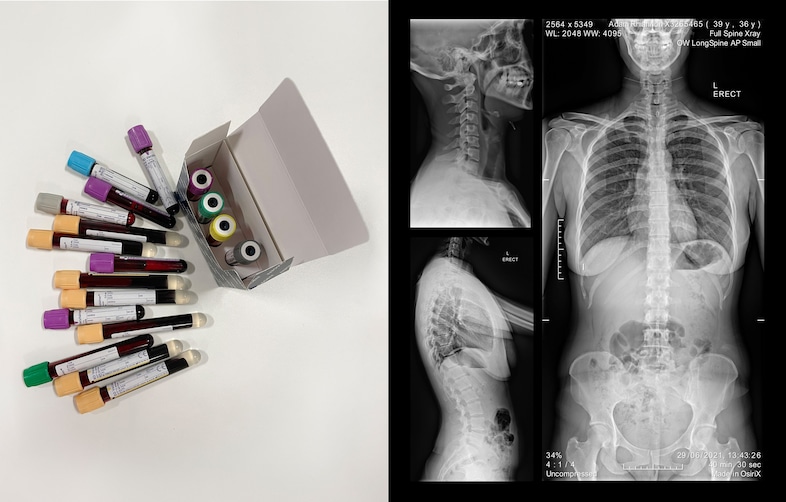
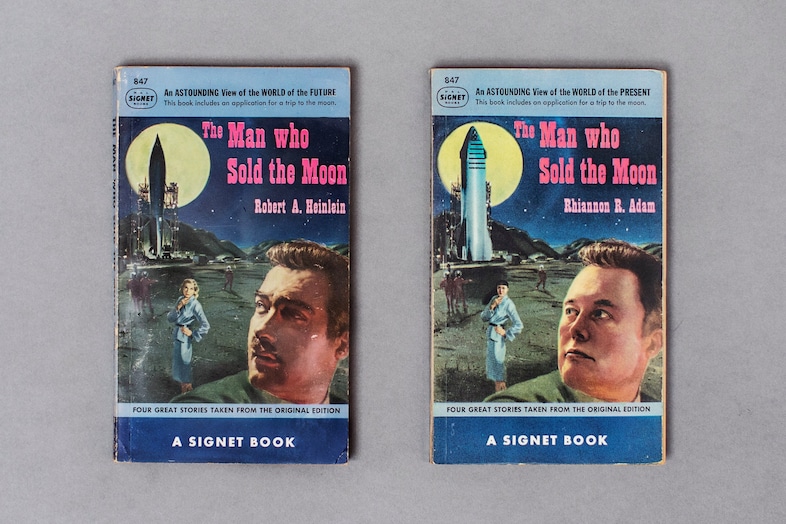
Following exhibitions in cities such as Milan and Copenhagen, Rhi-Entry is now set to go on show at the International Centre for the Image in Dublin. Using photographs and moving image, but also archival materials, installations, floating basketballs and more, it tells a vulnerable story about Adam’s dashed dreams and her struggle with returning to “normal” life. You might not be surprised to hear that there’s also a healthy dose of critique on the private space industry, including phallic rockets and a reimagining of The Man Who Sold the Moon – a 1950 book about a super rich businessman who exploits the moon for profit – with the face of Elon Musk as the titular billionaire. A janky AI artwork also shows Musk as the same character in Destination Moon.
Adam didn’t start out so sceptical, necessarily. She says of the dearMoon project: “I did feel like it was a way of reigniting an interest in space in a way we could all get behind. SpaceX, at that time, hadn’t become so entrenched with the government, so Elon hadn’t been meddling in US politics. There was this moment… where it felt like we could do the things that NASA would have loved to have done, and say the things that others couldn’t, because we didn’t have a party line to tow. We didn’t have to just uphold this idea of American supremacy, and use the imperialist and colonial words that are so often thrown around in space circles.”
In fact, the “conservative-coded” space industry proved much less conservative than it might first appear, she adds, even in the majority-Republican Texas. “As an out queer person, I felt like a Trojan horse in that environment,” she says. “But what’s kind of weird is that when you’re really in it, people don’t care about what colour your skin is, or where you came from. They feel like if you’re there, you deserve to be. Everyone has respect for each other, like, ‘We’re all nerds together.’” Of course, no woman or Black astronaut has set foot on the moon yet, but they got close during NASA’s lunar flyby in 2026.
Ultimately, Adam adds, dearMoon was an “egalitarian” project, even though it was funded by a billionaire and enabled by one of the flagship companies of the world’s richest man. Not only did it aim to put people in space who wouldn’t otherwise get the chance – photographers, performers, musicians, and educators alike – but it also promised to revolutionise the way we communicate back on Earth. “It felt like a way to change things, to fund communicators who can spread a message, and give them a really epic platform.” For Adam, this came with a heavy sense of responsibility, and a desire to make the most of such a rare opportunity. “It was liberating in one sense, because we didn’t have to tow a party line,” she says. “But there was also this intense sense of, ‘Don’t screw it up.’”
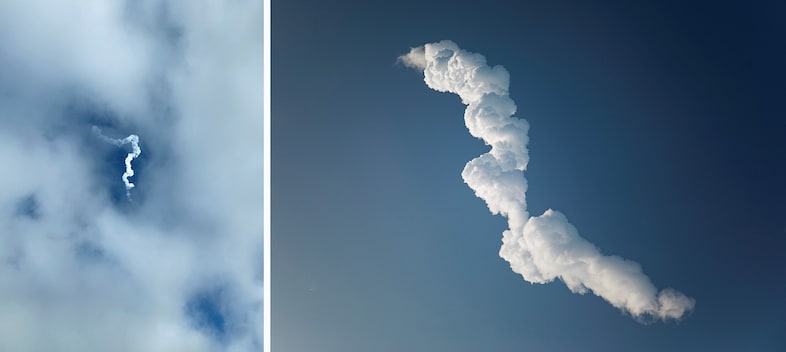
In a film exhibited alongside Rhi-Entry, Adam talks candidly about feeling “like an idiot” after the project was cancelled, and all of this pressure came to nothing. Elsewhere, we see hints of what could have been, including photos of staggering rocket launches and footage of the now-iconic “chopsticks” manoeuvre pulled off by SpaceX in 2024. Unnervingly, though, the film ends with the voice of Donald Trump. He’s talking about space being the next warfighting domain for humanity.
“Ultimately, Elon Musk spent a whole load of money on an election to get Trump elected because he really wanted some red tape cut with the FAA [Federal Aviation Administration] so that he can get to Mars faster and launch more Starship rockets,” Adam says. “People don’t think space relates to them… but USAID is cut because Trump is in power, people are dying of HIV because Elon Musk helped win an election because he wants more rockets in space.” That’s not to mention the wildly influential space infrastructure that’s physically controlled by people like Musk, such as Starlink, which plays a decisive role in Earthly issues like the Ukraine war. Ultimately, says Adam: “We should really care.” And one way to do that is by putting artists back in positions where they can communicate what’s really going on – not just for a publicity stunt, but to illuminate where our collective future is headed.
Rhi-Entry is on show at the International Centre for the Image in Dublin, from September 11 to December 23, 2026.
