
This new zine is challenging big tech’s fear of sex

Flip Flop: Slava Mogutin x Oli Raptor
Gallery / 12 images
We are in a strange cultural moment when it comes to representations of gay sex. On the one hand, steamy “MLM” erotica is a booming genre, with Heated Rivalry becoming a mainstream phenomenon and other adaptations sure to follow. On the other, gay artists are facing a wave of censorship, whether through social media guidelines or ideologically motivated funding cuts and institutional collusion with repressive governments. When I put this disparity to photographer Slava Mogutin, he baulks at the term “erotica”. “I hate that word”, he says. “I would rather be called a pornographer than an erotic artist.”
Whatever you call him, Mogutin, along with his friend and collaborator Oli Raptor, is among the most prolific contemporary photographers whose work concerns queer sexuality. This week, the pair have launched Flip Flop, a limited-edition zine which brings together their – similar but distinct – sensibilities and shared preoccupations. Longtime admirers of each other’s work, Mogutin and Raptor have previously collaborated on a group show in New York titled The Violators, and have appeared together at several events, including the Tom of Finland festival in London last year. “I just love the fact that Oli’s work is very punchy and sexy and exquisite and sex-positive, and I’m so fed up with social media and all the censorship we experience,” says Mogutin. “We both wanted to do something uncensored and personal and not controlled by ‘the community guidelines’, or whatever the fuck they call them.”
Both artists have repeatedly run into the problem of online censorship, on platforms where the content guidelines are often opaque and inscrutable. One can safely assume that images of erect penises are out, but there is a vast grey area: it’s anyone’s guess whether, say, the hint of a butt crack or a flash of pubic hair will get slapped down. “Sometimes it feels like they don’t know what their own rules are,” says Raptor, who recently requested a review after having around 20 images flagged. While each of these images was then approved, he says he remains shadow-banned. This makes it significantly harder to find an audience, subjects and other artists to collaborate with, although making his own website has gone some way to redressing that.
Mogutin, who claimed asylum in the US in the 90s after experiencing persecution in his native Russia, says he has been dealing with censorship all his life, and that the modern, tech-enabled face of it is fundamentally nothing new. “I see all this resurgence of homophobia and anti-gay censorship, and it’s just the continuation of American gangster capitalism. It’s all brought about by American bigots and conservatives. They are in control, and it’s no surprise that they go after artists like us – it’s just the way it is. [But] it’s ironic when they talk about ‘community guidelines’. These people don’t give two shits about ‘community’ or anything else. They just stuff their pockets. That’s all.”
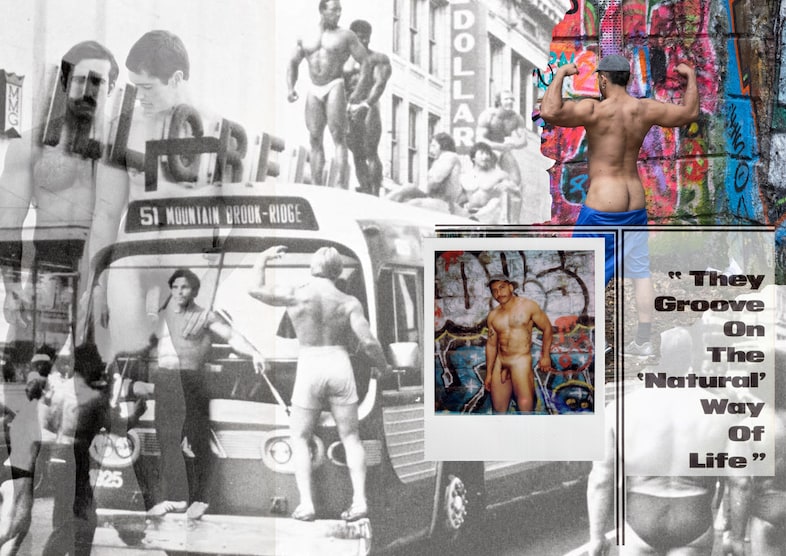
As well as photography, Flip Flop makes extensive use of collage, weaving in an intricate assemblage of symbols and images throughout: a still from Derek Jarman’s Carravagio, for example, along with old stickers, text fragments and scans of vintage gay magazines. “There’s a lot of fun things hidden in the background,” says Raptor. The work feels, on the one hand, rich in meaning and conceptually considered, and on the other hand, spontaneous, DIY and a little haphazard. After its inception, it only took a week to come together. “It was really fun because it was like playing ping pong. We were just bouncing ideas and images off each other,’ says Mogutin.
One of the recurring themes is outdoor sexuality, something which has characterised much of their respective work. “At a time when everyone is on the apps and social media, I feel like it’s really cool to do something that is like the opposite of what you see on your phone or online,” says Mogutin. Raptor mostly shot in London’s Hackney Marshes and Hampstead Heath, and Paris’s parc de buttes chamont (“which is kind of like Disney world – nothing’s real,” he says, referring to the park’s follies, sculptures and fake stalactites. Some of his subjects are, like Mogutin, asylum seekers, which he says “was another way to connect with his work.”


Mogutin, meanwhile, shot in locations all over the world, including LA’s Ranion canyon; San Francisco’s Marshall beach, one of the world’s most historic cruising spots; Berlin, and Mexico City. His boyfriend is a recurring subject. “He’s such an exhibitionist, so he’s kind of the perfect muse. And it makes it personal for me – it’s basically a diary of the relationship,” Mogutin says. The images capture a communal kind of intimacy, far from the insular and domestic. “There were quite a few spectators around, so at some points I had to ask people to back off a bit so I could make a shot. It’s a very quiet moment, but in fact we were surrounded by guys of all shapes and ages.”
Flip Flop is a riposte to that idea that gay sex must be represented, if at all, with polite ambiguity. It features full-frontal nudity, non-simulated fellatio, and a sense of erotic charge running through it, as though the subjects, as curator Dominic Johnson writes in the blurb, have either just had sex or are just about to. In fact, it prompted a spirited debate in the Dazed office about just what, exactly, we could get away with publishing on site (if you want to see erect penises or gaping holes, I’m afraid you’ll have to buy the zine). The project can’t be reduced to titillation or X-rated shock value, but it’s bold and unabashedly sexy. This is a side of gay life the big tech censors don’t want you to see.
Flip Flop is published by Bona Varda, and is available to purchase now


