
Women around the world call on UK to protect mothers and babies from deadly infections during childbirth

Want to bookmark your favourite articles and stories to read or reference later? Start your Independent Membership today.
Already a member?
Log in
A global coalition of midwives and mothers is calling on the UK government to “champion clean water in healthcare”, to protect women and their babies from deadly infections in childbirth.
The network of eight “Women Champions” supported by the charity WaterAid, are delivering an open letter to No 10 Downing Street on Wednesday – as well as the government in Zambia – ahead of the 2026 UN water conference in December.
As co-chair of the conference’s Water for Cooperation dialogue, Zambia has an important role in shaping discussions and commitments. The hand-in comes ahead of a high-level dialogue in Lusaka, bringing together women leaders and policymakers to discuss practical solutions for safer childbirth and stronger health systems. Meanwhile, the UK has historically been a major force in pushing for better sanitation globally, but is one of a number of nations to have cut its international aid spending – from 0.5 per cent of Gross national income (GNI) to 0.3 per cent.
Their demands have been backed by 70,000 people worldwide in the form of petition signatures and demonstrations.
Speaking about the challenges facing women across the world, Liberian midwife Shawnette Kula Sherman – one of the eight Women Champions – said: “If the patient is brought here in labour, in the time it takes me to go and look for water, she might deliver and she would need my attention immediately. But I’m not around because I am looking for water. That could cause significant harm to either the mom or the baby. She might have postpartum haemorrhaging in the process, and I am looking for water, so she could even bleed to death.”
The letter being handed in by the Women Champions – which can be read in full here – says: “Mothers arrive at maternity wards carrying their own buckets of water. Midwives can’t wash their hands between deliveries. Women and newborns lose their lives to infections that are entirely preventable.
“Every day, more than 2,700 mothers and newborns die from preventable infections due to unclean births.
“These are not just statistics. These are women we meet, the families we work alongside and the realities we see first-hand.”
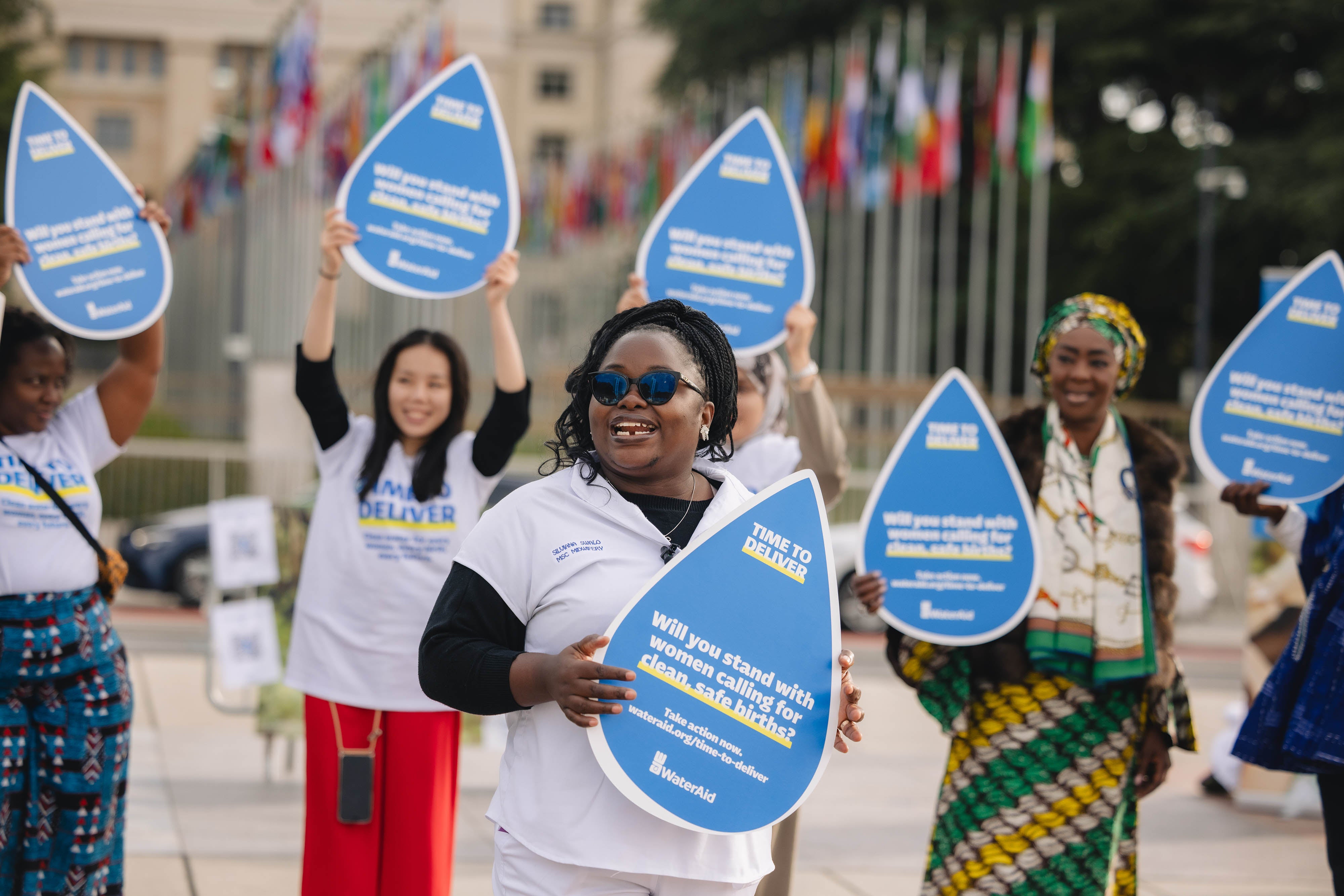
The demands in the letter include treating water and healthcare as related, not separate, issues and ensuring that clean water, decent toilets and safe medical waste disposal are requirements in every healthcare facility through national maternal, newborn and child health plans that are adequately funded. In addition, the letter calls for guarantees of equal and meaningful representation for women and women-led organisations, from global decision-making bodies to local healthcare facility governance boards, including real roles in planning, budgeting and oversight. This is to be backed by public reports to ensure accountability, published every two years.
The letter goes on: “As women, we do not lack the knowledge to help solve these problems. We lack equality of opportunity to shape the healthcare we use and deliver every day. Women hold just 25 per cent of senior leadership roles in global health, despite making up almost the entire frontline workforce.”
Annie Msosa, senior campaigner on health at WaterAid, said: “Women know what is needed to make pregnancy and childbirth safer because they live these realities every day. They are mothers, caregivers and make up almost the entire healthcare frontline. As climate shocks and disease outbreaks place increasing pressure on health services worldwide, listening to them has never been more important.
“We need women’s frontline experience and expertise to make childbirth safer for women – and healthcare safer for all of us,” she added
Almost one billion people around the world rely on healthcare facilities without water, leaving patients and health workers without one of the most fundamental requirements for safe care.
Some 907 million people used healthcare facilities without water in 2025, while 936 million were treated in facilities without sanitation and 652 million in places without basic hygiene services, according to new research by the World Health Organisation (WHO) and the UN Children’s Fund (UNICEF).
The problem is particularly important in maternity care. Women giving birth and newborn babies are vulnerable to infections, while midwives and other health workers need clean water and hygienic conditions to provide safe care.
Every two seconds, a woman gives birth in a health facility without clean water, a functioning toilet or basic hygiene – conditions that WaterAid’s research links to 36 deaths from sepsis a day across sub-Saharan Africa. Women who develop the condition are 144 times more likely to die than those in Britain, Europe or North America.
Brian Mathew MP, chair of the Water, Sanitation & Hygiene All-Party Parliamentary Group (APPG) in the UK parliament, said:
“Today’s joint hand-in in the UK and Zambia is a significant moment, uniting voices across the world to call for urgent action ahead of the UN Water Conference. Having visited WaterAid Zambia myself last month, it’s particularly meaningful to be in Westminster alongside healthcare workers from Africa, bringing this important message directly to the heart of UK government.”
“We must all continue to work together to make safe, dignified childbirth a reality for every woman,” he added.
To sign the WaterAid “Time to Deliver” maternal health petition please click here
This article has been produced as part of The Independent’s Rethinking Global Aid project
