
Artist Chloe Wise asks: are UFOs actually angels?

Chloe Wise, PsyFi*
Gallery / 10 images
In 1566, there were mass reports of a “fight” between mysterious red and black spheres in the sky over Basel, Switzerland. At the time, many interpreted the battle as a religious miracle; more recently, ufologists have recast the celestial phenomenon as an alien battle. Both explanations might sound farfetched, but this kind of encounter has been more common throughout human history than you might think. Close encounters with unexplainable objects or beings from the sky – bright lights, humanlike figures, mysterious voices – have shaped myths and folklore from ancient Egypt to fourth-century China, and the canonical texts of Christianity are filled with similar accounts. Today, we call them something different: UFOs. But are we actually talking about the same thing?
This is where we return to Basel: the Canadian artist Chloe Wise is pondering the question over coffee, close to the gallery that hosts her latest show, Extrasensory. “It’s not the experience that changes,” Wise suggests. “It’s the words we use to describe it, and to make sense of it, that change over time.”
“In a religious paradigm, governed by Christianity, you’re met with something ineffable and you call it an angel. But now, we’re in a technological, post-nuclear [age]. We sent Katy Perry to space. So the way that we make sense of something unfathomable would be through a more technological lens.”
In Extrasensory, you enter through the gift shop: that is, the lobby of the Kulturstiftung Basel H. Geiger (KBH.G) has been filled with the kind of quasi-spiritual and pseudoscientific merchandise you might find on the roads around Area 51, or similar UFO hotspots across the globe. There are Himalayan sea salt lamps, keychains, discount CDs, prayer candles featuring Jesus surrounded by Zeta Reticulans, and packets of glowing green alien toys. In truth, each of these objects was painstakingly created and staged by Wise and her small team, down to the dust on the covers of the pulpy DVDs, and the black mould that grows out of sight behind the reception desk. To craft this hyperreal environment before the show’s opening, they worked until 2am every night for 12 days, which sounds like a biblical feat in itself.
“In a religious paradigm, you’re met with something ineffable and you call it an angel. But now… the way that we make sense of something unfathomable would be through a more technological lens” – Chloe Wise
It would be easy to dismiss the gift shop as a surface-level rendering of the concepts from science and spirituality that are tied together in ufology. “There’s an impulse, as humans, to create memorabilia,” Wise admits. But the t-shirts, crystals, and bumper stickers are just the beginning. In the show, as in real life, “the tackiness, the kitsch, the cheap objects serve as a starting point”. They represent a shallower “layer” of esoteric, religious, or otherwise revelatory experiences – a way in.
“At first, you interact with the commodified version of the experience, like tarot cards, rosary beads, or a prayer candle,” the artist adds. “And then something happens. You have an experience, and words don’t quite cut it.” Then, everything becomes imbued with a deeper meaning. “Suddenly you’re noticing these numbers everywhere, or a turn of phrase, or symbols like a heart in the clouds or Jesus’s face on a piece of toast. You start to look for these symbols and synchronicities.”

The focal point of the exhibition – after visitors have passed through an eerie, Lynchian “backstage” with a soundtrack by experimental composer Loke Rahbek – is the 30-minute film PsyFi*, which begins with one of these experiences that words can’t quite capture. Faced with an extraterrestrial light, a group of young people look to the sky and begin reciting poetic phrases and mantras that recur throughout the film. “An ideal pebble in a perfect pond.” “The planet is a mess, it deserves a rest.” “Science confesses her ignorance.” “The body is a situation.”
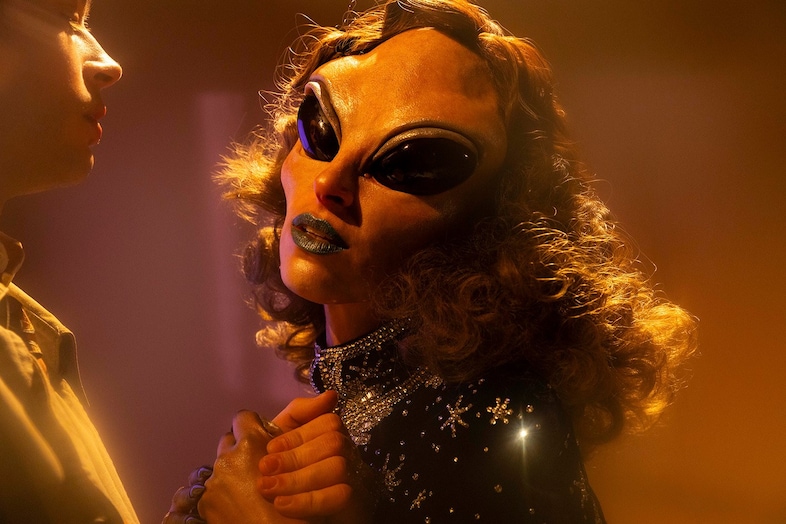
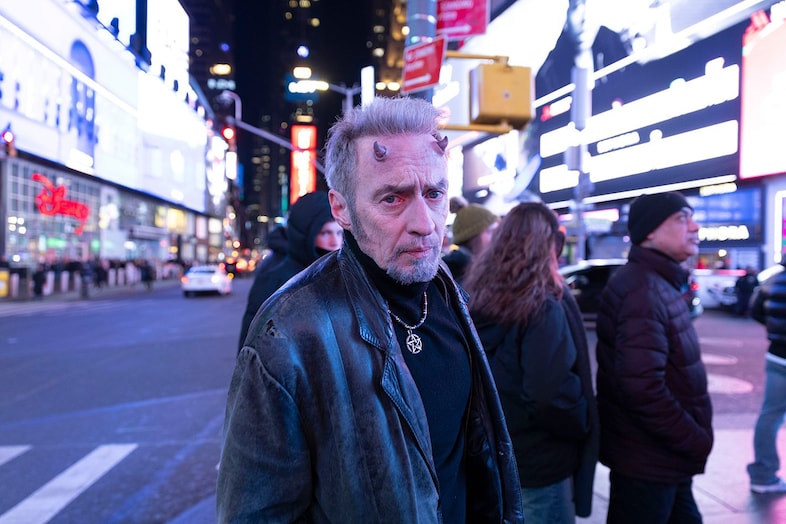
From there, PsyFi* plunges into a world (or series of worlds) featuring cults, angels and demons, a Victoria’s Secret-style fashion show, and a down-on-his-luck devil drowning his sorrows in New York. A highlight, within one of these nested realities, takes us inside a melodramatic TV show starring Wise as an alien who wants to return to her home system, and Ben Ahlers as her jilted lover. “There’s a better universe next door. Let’s go.” Once again, there are Lynchian overtones to the disconnected words and liminal backdrops – fitting, given that Lynch and Wise are both painters-turned-filmmakers, both drawn time and again to the mysterious and the ineffable. See: Wise’s 2025 show of paintings, Myth Information.

The sci-fi tropes and religious theatrics that appear in PsyFi* aren’t just empty images. In fact, says Wise, you can’t talk about faith without also talking about the fictions, films, and images that surround it: “You have to include the way the stories are disseminated and told.” Yes, in the 21st century this includes sci-fi films and shows like The X-Files, as well as holy texts like the Bible. “You have to include all of those elements in order to weave the whole tapestry, which includes all of these different threads that, alone, don’t speak to the true nature of the thing. The truth being, of course, that there is no absolute truth.”
In this spirit, Extrasensory is accompanied by a book of the same name, which sees the artist prompt writers, artists, scientists, and mystics to reflect on the unknowable phenomena that exist at the edges of “consensus reality”. The result is a blend of speculative research, philosophy, religious studies, psychoanalysis, fiction, and firsthand UFO accounts that expand – rather than seek to explain – the realities that proliferate in the film. “This book couldn’t have been, like, a textbook on UFOs,” she says. “It’s like a dream object that you just feel your way through. Everybody could find something different from it, but that’s what the phenomenon is. That was why I thought art is the place for this, the way that poetry is a good place to talk about love… We’re weighing, and playfully, poetically dancing around all these different possibilities.”
“We’re weighing, and playfully, poetically dancing around all these different possibilities” – Chloe Wise
Extrasensory the show is structured like a bracelet, Wise says: after the film ends, with real footage of orbs and UFOs from the US government’s declassified files, viewers return to the mirrored backstage and end up back in the gift shop. But things are different – at least, our perception of them has changed. We recognise images, characters, and fragments of language from the film on candlesticks, CD covers, and bumper stickers. “Suddenly, things are starting to make sense.”
Of course none of these trinkets can contain, in its totality, the PsyFi* universe – much less a real extraterrestrial encounter. (I saw a UFO and all I got was this lousy t-shirt?) Like all souvenirs, they represent an attempt to hold onto some memory of the thing you witnessed, or some feeling you felt, but can only gesture at the much broader scope of the realities we inhabit. Then again, maybe this disconnect is the whole point; that’s where the faith gets in, whether we’re talking about religious miracles or physics-defying flying saucers. “Belief persists,” says Wise. “Maybe it’s a biological need that we don’t understand. Maybe the mystery is inherently necessary. We want to be reenchanted.”
Extrasensory is on show at Kulturstiftung Basel H. Geiger until September 6.


