
Extra Geography: A teen comedy about the messiness of female friendship

Extra Geography
Gallery / 7 images
When you think of iconic English-language teen comedies about female friendship, they tend to be American: Lady Bird, Mean Girls, The Edge of Seventeen, Ghost World, Clueless, and so on. The British equivalents, with some notable exceptions, skew towards drama (Rocks, My Summer of Love, Me Without You).
Even more reason to celebrate Extra Geography, a sharp, hilarious coming-of-age comedy about the friction between two best friends at an all-girls boarding school in North Yorkshire. Set in 2003, the directorial debut by Molly Manners (One Day) is adapted by Miriam Battye (Succession) from a 2007 short story by Rose Tremain. Above all, though, it’s an acting showcase for its two excellent leads, Galaxie Clear, 18, and Marni Duggan, 19, both of whom nail the comic timing of the deadpan dialogue, the extreme mood swings of adolescence, and the emotional beats of falling out with your best bud.
“I can’t get over how young we look in the film,” says Duggan, laughing. “We were 17 and 16, but we look like we’re 12.”
Before Extra Geography, Clear and Duggan, based respectively in Manchester and Liverpool, had no prior TV or film credits. Speaking to Dazed in September, the duo still find the experience surreal: since its Sundance premiere, the rapturously received film has maintained a 100% Rotten Tomatoes score, suggesting there’s a gap in the market.
“It gets compared to Booksmart, which is American,” says Duggan. “But the humour is so British. The language, vocabulary, and everything about it is so British.”
“I hope that Extra Geography becomes a comparison point of its own down the line,” says Clear. “There’s so much going on underneath these teen girls that doesn’t often get the spotlight. The film gives space for teen girls to be arrogant and annoying, but also wonderful and charming. All these different layers have to exist.”
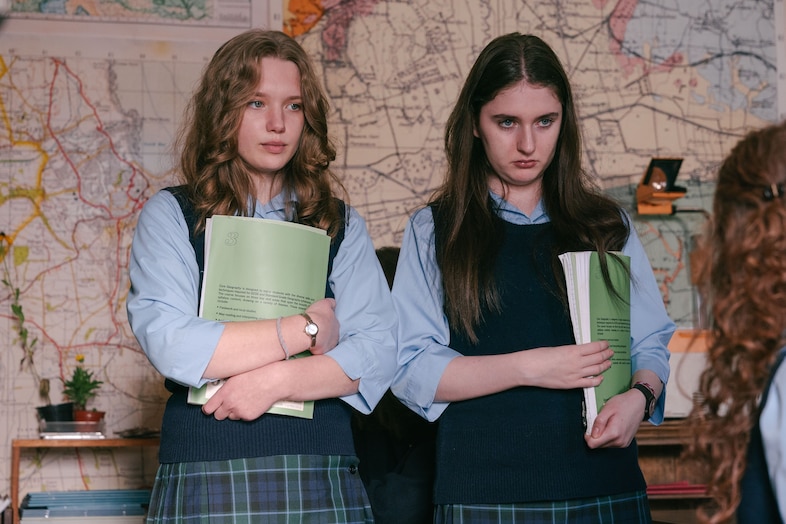
Academically excellent but inexperienced when it comes to dating, Flic (Duggan) and Minna (Clear) are such close companions that it verges on co-dependency. Challenging themselves to become more “worldly”, they make a pact to fall in love with the next human that crosses their path. When that turns out to be their geography teacher Miss Delavigne (Alice Englert), the duo attempt to woo an authority figure twice their age – and Miss Delavigne doesn’t discourage it.
Elsewhere, the two girls find further competition in the school’s production of A Midsummer Night’s Dream. Not only does self-assured Minna nab the role of Titania, a literal queen, she also proves popular with the male actors. In contrast, Flic, the more fretful of the two, is cast as a tree, and is agonisingly aware that boys view her as someone they’re forced to interact with when trying to date Minna. Whereas they once finished each other’s sentences, they later turn their attempted seduction of Miss Delavigne into a pseudo-love triangle.
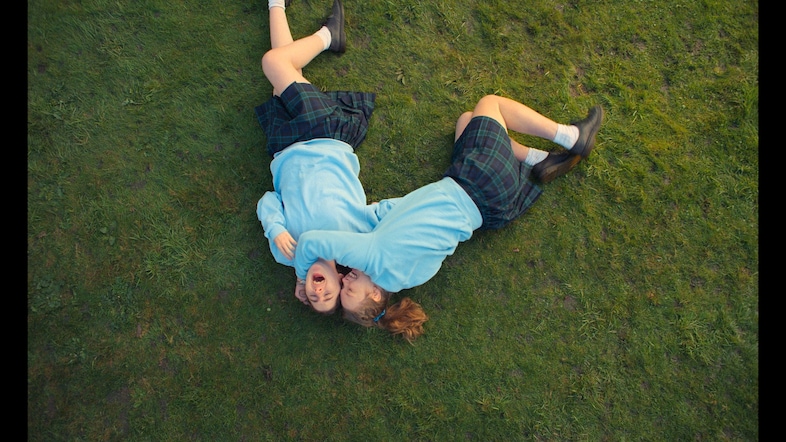
Both characters, then, are distinct, and the actors were specifically asked to read for their roles. For Clear, it was her first-ever audition. Attending Saturday acting classes, she was discovered by Lucy Pardee, the casting director responsible for the young leads of Aftersun, American Honey, and Rocks. “Minna has that outward ‘queen of school’ energy,” says Clear. “It allows those moments of insecurity to really hit home, because it’s something she suppresses. That’s so accurate for teen girls. You have to exude this confidence to survive in an all-girl environment. It doesn’t mean those insecurities don’t exist.” She recalls a memorable acting note on set. “If Molly wanted ‘I don’t care, I’m amazing’ energy for Minna, she’d go, ‘Be brat!’ As in ‘brat summer’, because it was 2024.”
Before Extra Geography, Duggan, who had an agent, was met with “rejection after rejection after rejection” when it came to submitting self-tapes. “But they kept asking me to read for Flic,” says Duggan. “On the way to auditions, I’d listen to a playlist of songs that reminded me of her. Already, I was thinking, ‘Would she wear perfume?’ Little things like that. I was so attached to the part, I was like, ‘I’m not going to watch this film if anyone else is in it.’”
The film gives space for teen girls to be arrogant and annoying, but also wonderful and charming
What was on the playlist? “‘Oh No!’ by Marina and the Diamonds and ‘The Archer’ by Taylor Swift reminded me of Flic,” says Duggan. “These songs about internal pressure. Flic tries to exude superiority, but she’s so insecure and feels so out of place no matter where she is.”
“I listened to a lot of Camera Obscura, which captures this very adorkable, lovable, cinematic vibe,” says Clear. “‘I Wanna Be Adored’ by The Stone Roses is a very Minna-coded song.”
When they hang out, do they hate each other’s music?
“No!” they both exclaim in unison.
“If we’re going somewhere and getting ready, we blend the playlists,” says Duggan.
“We might not have the same taste, but we can appreciate good music,” says Clear. “It goes from Megan the Stallion to The Sundays, and that encapsulates our vibes.”

The genuine friendship is apparent in the film’s preoccupation with hands: the value of uniting through touching palms or interlocking pinkies; the way Flic later stares at Miss Delavigne’s fingers.
“I think it’s a byproduct of us naturally synchronising,” says Clear. “At the start, they depend on each other, so their hand movements always mirror one another. But as boys interrupt this world, they lose that, and Miss Delavigne is thrust into that mix where we start holding her hand, and she physically comes between us.”
Already cast as Pandora in a new TV adaptation of Adrian Mole, Clear names Emma Stone and Yorgos Lanthimos as dream collaborators. Duggan shouts out Mikey Madison, explaining, “I noticed her posture is so different in interviews to how she is in Anora. Flic has good posture, but in between takes I’d go back to my bad posture. Whenever Flic is stressed, she makes a fist like this.” She demonstrates it for me. “I adopted this tension that wasn’t scripted. My body genuinely transformed into her.”
Friendship breakups are so much worse than romantic breakups, because if you break up with your romantic partner, you can talk to your friends about it. But if you’ve broken up with your best friend, who do you talk to about that?
In Tremain’s short story, Flic’s narration suggests she’s secretly in love with Minna. In the film, any romantic overtones are less obvious. “I spoke to Molly about it,” says Duggan. “We came to the conclusion it’s more like maternal feelings; this instinct to protect each other. I’ve definitely had intense friendships where, on the outside, they might look romantic to other people. Ours is up for interpretation.”
“It’s so malleable,” says Clear. “You can see almost any relationship you’ve had in this dynamic.”
That includes friendship breakups, another cruel part of life that’s rarely depicted in British female-led teen films. Or in films, full stop. When Flic and Minna drift apart, the gag-heavy scenes shift more towards pathos.
“Friendship breakups are so much worse than romantic breakups, because if you break up with your romantic partner, you can talk to your friends about it,” says Duggan. “But if you’ve broken up with your best friend, who do you talk to about that?”
“Female friendships are so formative,” says Clear. “At that age, you don’t fully understand what they are. When it breaks, you don’t fully understand what kind of relationship is breaking down.”
Extra Geography is out in UK cinemas on October 2.
