
Hannah Einbinder: ‘I think shame around sex is universal’

Hannah Einbinder is very relaxed. Stretched out on a chair like she’s at home, not a corporate meeting room in King’s Cross, the 31-year-old American comedian and actor balances a glass of water on a slim arm rest without looking. Cheery without overdoing it, she overrides the stereotype of a stand-up who’s neurotic when away from the stage. “As a person sitting across from you today, I feel the most comfortable in myself now,” she says serenely. “It took me a long time to feel comfortable and good in myself.”
I shouldn’t be surprised. After all, on screen, Einbinder oozes confidence. At 23, she was the youngest comic to ever perform on Stephen Colbert’s late-night talk show, and last year she won an Emmy for playing the supremely outspoken Ava Daniels in the sitcom Hacks. (In her televised speech, Einbinder declared, “Go Birds, fuck ICE, and free Palestine.”) However, Einbinder’s in London for the UK premiere of Jane Schoenbrun’s Teenage Sex and Death at Camp Miasma, a meta comedy-horror in which she depicts a nervous wreck named Kris. She’s so convincing, I wondered if Einbinder herself is more Kris than Ava.
“Kris is, physically in her body, completely the opposite of me,” says Einbinder. “Ava in Hacks walks into a room dick first. But Kris is more insecure, subdued, and kind of nerdy. My awareness of my physical instrument helped determine how Kris walked, her twitchiness, and the way she shrinks. I cut little bangs for myself and wore glasses. There are outfits modelled on Maggie Gyllenhaal in Secretary with the tall socks, the long skirt, the Mary Janes. It’s so different from the way I present in the world.”
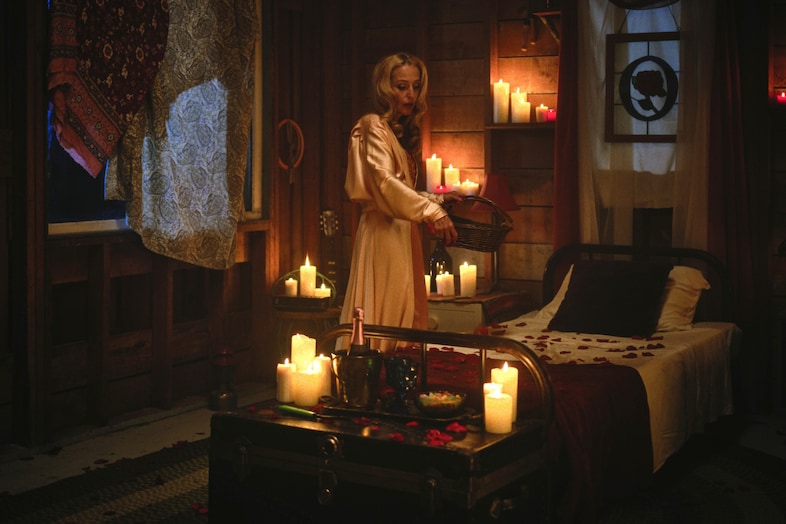
Written and directed by Schoenbrun, Teenage Sex and Death at Camp Miasma dips in and out of reality and often resembles a blood-splattered fever dream. Ostensibly, the story follows a filmmaker, Kris (Einbinder), who after scoring a Sundance indie hit is tasked with rebooting the Camp Miasma slasher series – an affectionate parody of Friday the 13th. The studio openly admits the appeal: Kris is queer, and thus ticks a box for them. Kris, though, doesn’t want to discover the next Inde Navarrette. Instead, she tracks down Billy Preston (Gillian Anderson), the Final Girl from the original Camp Miasma. Now a loner who lives in an isolated cabin where the film was shot, Billy forms a psychosexual relationship with Kris that bends time, physics, and gender norms.
“I stole some mannerisms from Jane,” says Einbinder. “They bottle up their sweatshirt, and pick at their hands.” We realise that Einbinder coincidentally describes my body language. “I won’t lie: if I’d met you before the part, I’d be stealing some stuff! Physicality communicates so much. I grew to love Jane so instantly. Representing them felt fun, endearing, and like, ‘This is my little impression of my friend.’”
Schoenbrun is the gifted trans director behind We’re All Going to the World’s Fair and I Saw the TV Glow – both Sundance premieres, if anyone wants to draw parallels to Kris. Whereas those two films reflected Schoenbrun’s experiences while transitioning, Teenage Sex and Death is the filmmaker’s first feature post-transition. Although Kris isn’t trans, she‘s unhappy in her body, troubled by feelings of dissociation and has never experienced an orgasm. It’s through Billy and re-enacting scenes from Camp Miasma that Kris eases into their skin.
“I tend not to speak explicitly about Jane’s experience in ways they haven’t spoken about, because the film is representative of the journey they’ve been on,” says Einbinder. “It’s also something we can all relate to. I think shame around sex, and discomfort in one’s body, is incredibly universal. I feel so lucky to work with Jane. When you’ve done so much work to meet yourself deeply, it’s hard to conceal all of that. Jane being candid makes space for all of us to be candid. It’s the greatest offering an artist can make, being like, ‘Here’s everything I’m going through.’ I’m a pretty open person, and Jane has inspired me to be honest and say, ‘Yeah, I relate to Kris’s experience.’ I think pretty much fucking everybody on Earth does in some way, or at some time.”
Where Einbinder’s honesty also materialises is through politics. A few hours before our interview, she posted, as she regularly does, several Instagram stories in support of Palestine. I realise during the conversation it’s why she’s so relaxed: she has nothing to hide. “When it comes to Palestine, I’m so sure of my views on this issue, and that what I’m seeing before my eyes is a genocide, that it doesn’t make me nervous at all,” she says. “You have to take that leap initially to start speaking about it at a certain point. But for me, it’s just become very clear that I can’t be concerned with the repercussions.”
As Einbinder has been in therapy since 15, I correctly guess she knows her enneagram number. So much so, it leads to a five-minute digression. “I’m a 3,” she says immediately. “‘The Achiever’.” The Enneagram system – a fascination to some, completely baffling to others – divides everyone into one of nine types. Einbinder’s publicist, who enters the room at this point, admits he’s never heard of it before. “It’s like if astrology was real,” she tells him. “You have to take the test.”
Before the interview, though, I searched online for Einbinder’s enneagram, and the Google AI Overview – the irritating summary that appears at the top of Google searches – claims Einbinder is a 7: “The Enthusiast”. Einbinder screams with laughter. “That’s so funny! Hello? They don’t think I’m ‘The Achiever’?” She’s so baffled, we double-check on our phones: yes, the internet believes Einbinder is a 7. For context: a 7 will run from their pain, or not even acknowledge its existence. “Girl. I’m pretty real in my public persona! I’m a 3! I’ve talked a lot about how, when I started, stand-up was my way of feeling good when I felt bad all the time. But that’s not all there is.”
Notably, Schoenbrun didn’t cast Einbinder because of Hacks – it was due to the playfulness of Einbinder’s 2024 stand-up special Everything Must Go. The set’s opening sequence – under a blue spotlight, she swoons to slow jazz in front of a red curtain – feels positively Twin Peaks. However, she tells me, “I’m an open book, and I don’t hide what I think – ever. But when it comes to stand-up, I never talk about sex or dating. I think I still won’t, but that’s because it’s kind of hack.”
Stand-ups regularly use their sex life for material, whereas filmmakers tend to be more private? “Well, comedians aren’t talking about their sex life negatively. It’s overdone as a topic. Even when I was starting stand-up at 20, I was like, ‘OK, what else?’ It’s not the topic, but how you discuss it. This film discusses sex in a new way. There are tons of films about sex, but not many about how hard, unglamorous, painful, and not sexy it can be. To me, this film is incredibly radical and brave.”
Teenage Sex and Death at Camp Miasma is out in UK & Irish cinemas on August 21
