
In Pretty Babies, Hollywood glamour collides with the realities of sex work

When Tyler-Marie Evans was a young adult, she swapped Christianity for cinema, and encountered a different, more flickering kind of light. “I was in this cult-y church,” she recalls. “I wasn’t allowed to talk to people outside the church. My sense of life was restricted.” Such was the severity of her upbringing in Texas, she wasn’t allowed to watch movies made after 1960. “I left the church when I was 19 and decided that every Sunday I’d go to the movies. The Angelika Theatre in Dallas became my salvation.”
Evans, now 31, is speaking to me during the Edinburgh International Film Festival, two days after the world premiere of her debut feature, Pretty Babies. Like Evans did as a child, the film’s leads, Marie (Emily Alyn Lind) and Luna (Sadie Stanley), lounge around after school in a living room studying Rita Hayworth in Gilda. After Marie is raped and Luna sticks a glass bottle through the man’s face, the pair escape on a road trip to Hollywood where, instead of acting gigs, they’re introduced to sex work by two strangers, Gemma (Madelaine Petsch) and Sapphire (Ashley Benson). Regardless of the situation, the duo never give up on their fantasy of becoming the next Joan Crawford and Bette Davis.
A hypnotic, Malick-ian drama about toxic friendships, cinephilia, and the everyday threat of violence against women (especially sex workers), Pretty Babies was pitched by Evans in 2023 as Spring Breakers meets The Virgin Suicides. “Spring Breakers had this great, satirical, but also philosophical, sense to it,” she says. “That phone call Selena Gomez gives is very much my voice. The Virgin Suicides was my number-one movie. But now I would say Pretty Babies leans more Thirteen meets The Virgin Suicides.”
Firmly placed inside Marie’s brain, Pretty Babies jumps backwards and forwards in time, often oscillating between film styles, colour palettes, traumatic memories, glitzy illusions, violent realities and even archive footage of black-and-white movie stars. When Marie flirts with a cute waiter, it flashes to a clip of Cary Grant; joyous hangouts are intercut with self-shot audition tapes comprising pure play. However, in a painful phone call, the camera remains fixed on Marie’s crying face; in a rape scene, instead of a cutaway, the viewer is directed towards a faded Gilda poster on the wall.
“Something I want to explore, not just in this movie but in my career in general, is how a character views their dream world through that lens, and then having a stark contrast with reality,” says Evans. “You show a character having these hopes and dreams, and then we feel that crash. In Atonement, [the author protagonist] gives these characters a world that never existed. In my editing, I linger for a few beats longer in the characters’ dreams, even though we have to come back to reality.” As for the overall POV, she refers to it as a “broken female gaze – it’s a young girl who’s lost her sense of self.”
In her 20s, Evans worked multiple jobs, some film-related, others not, while writing scripts and shooting shorts on the side. The inspiration for Pretty Babies came in 2020 when she was folding clothes during lockdown and a specific image came to her head: “In my mind, it was these two girls hitchhiking on the side of a dusty road, and they have this sweaty, gross hair with glitter stuck in it. And I was like, ‘They’re smiling with their little thumbs because they’re replaying an Old Hollywood movie in their head.’”
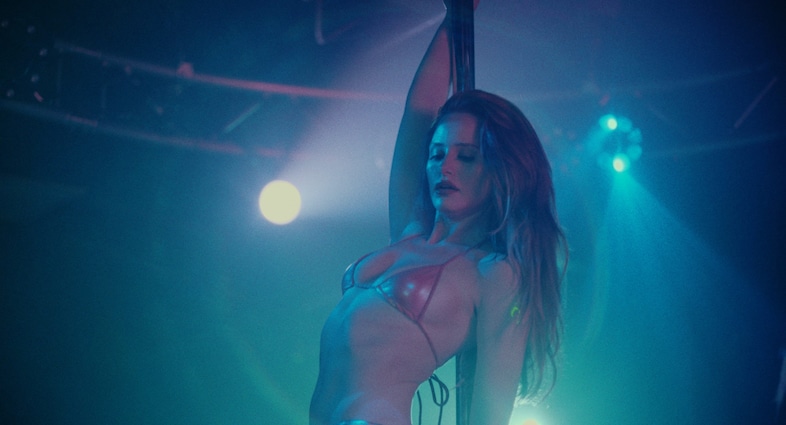
Evans also wanted to tackle sex work from a new point of view – though she is quick to note that she adores Sean Baker and Paris Is Burning. “I wanted to show the interiority of a woman in sex work, and also the interiority of a young girl in sex work,” she says. “I did research and found there’s a huge divide. There’s young girls who are underage, doing this as a means for survival, in an industry that targets those who would endure great violence and not speak up for themselves. That compelled me to write a film that deals with these innocent girls who romanticise life, yet find themselves down a dark hole in work that doesn’t acknowledge their voice.”
In researching the script, Evans met sex workers through friends, and asked around at strip clubs in New Mexico, Oklahoma, and Los Angeles. In the interviews, she learned from the “strength and courage” of women she encountered, as well as heartbreak. “I met someone in Tulsa, Oklahoma who’d been in the industry for 13 years. She said most women get into sex work because of rape or survival. That’s why the rape is such a specific moment in the film. I wanted audiences to understand that Marie is losing control of her body, and that propels her into losing control of her identity.”
Here’s where Pretty Babies might not be for everyone. Despite the film depicting the many highs (some of them cocaine-infused) of hanging out with your BFF in LA, it’s also a distressing drama with multiple scenes of sexual violence. Working with Jordan Wagner and Christine Vachon as producers, Evans felt empowered to stick to her vision. “Jordan pushed for the authenticity, and Christine made Boys Don’t Cry at a very unpopular time. It felt like confirmation that this film had to be made. People will shame and point their finger at sex work. I’m not saying that sex work is the issue; I’m saying that violence in and outside of the industry is the issue. Violence on women is the issue – and yet we try to blame it on an industry.”
Making up for lost time, Evans wrapped her second feature last week with I Wish I Never Had Sex with Him, another vehicle with Petsch. In March 2027, she hopes to shoot her third feature, Girls in London, 1999, a self-penned erotic thriller that she describes as “if Eyes Wide Shut was from Nicole Kidman’s perspective”. In the meantime, Pretty Babies is seeking international distribution, with Wagner Entertainment handling worldwide sales. “It’s playing with the specificity of these girls’ internal worlds, against the landscape of sex work,” she says. “It’s not a judgement on sex work at all. I love seeing the love for this movie. I think it’s going to find its audience.”
Evans is referring to the world premiere where, after the screening, a line of girls – she estimates they were between 14 and 17 years old – waited to speak to her. “This one girl came up to me, holding her mother’s jacket, and she goes, ‘This is my favourite film I’ve ever seen.’ It made me so happy. I’m so glad this film touches people. I want it to speak to these young girls. It starts a conversation about their own identities that I’m excited for them to have.”
Pretty Babies had its world premiere at the Edinburgh International Film Festival
