
How the Covid-era college experience shaped a generation

If there were two words to capture the global disruption and tragedy of the Covid-19 pandemic, they would be “unprecedented times”. At first, the term was an accurate acknowledgement of the new world we had all stepped into. Then, article after article, post after post, it became a memeified cliché. While writers and major television execs may have spent the years since trying (and failing) to present a unified and relatable portrait of the pandemic, the appetite for Covid-related storytelling has felt almost nonexistent, perhaps because it‘s still too close to home. No one, it seems, has been able to capture how living through lockdowns and losses felt for many young Americans at the time without conjuring up unwelcome memories of celebrities singing “Imagine” in their mansions. Who better, then, than a 25-year-old writer to tell the story of gen Z’s Covid college experience?
Malavika Kannan’s latest novel, Unprecedented Times, is a coming-of-age story following Rishi, a burnt-out Indian American youth climate activist, as she embarks on her first year at Stanford. The book starts with the ripe possibilities that many feel as they leave high school and their hometowns for college – Rishi is eager to free herself from her strict childhood in Florida, and particularly excited to have gay sex. While Kannan set out to write an in-depth character study of a queer gen Z person who came up under a specific set of circumstances she hopes that some of her experiences may ring universal for others, especially young people. “The pandemic was a huge radicalising experience for most Americans,” she says. “But it hit different for a generation of people who had not gotten a chance to see the American dream work as promised.”
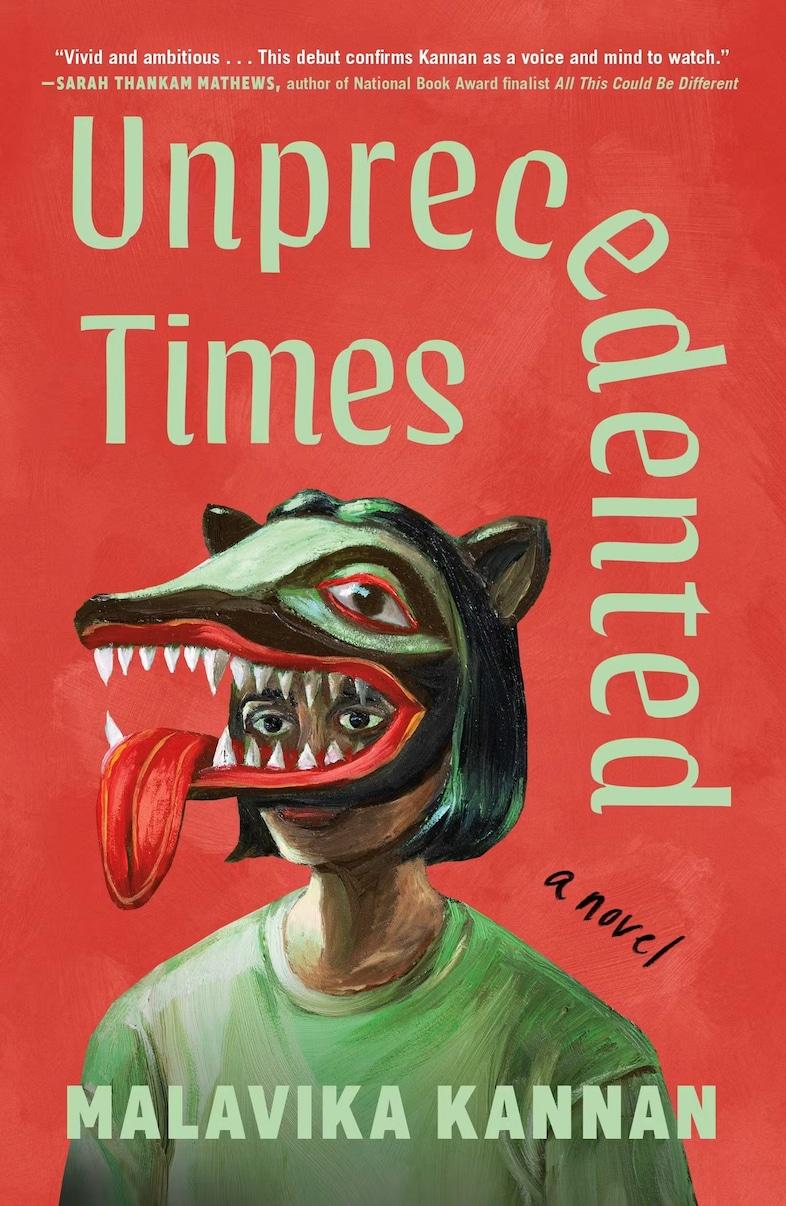
As you can probably guess, Rishi’s college experience is ripped away from her right when she is finding her footing. And, especially with the book’s immersive first-person narration, it’s impossible not to draw parallels between Rishi and Kannan’s life experiences – although Rishi and her classmates join a farm collective instead of doing virtual college. Like Rishi, Kannan was an activist, advocating for gun violence prevention in the face of the Pulse nightclub and Parkland shootings, who left Florida for Stanford in 2019. “Rishi has a really distinctive voice and is definitely someone that I relate to deeply,” says Kannan. “My goal was to write a protagonist [where] you feel immersed in her point of view, but you can also disagree with her.”
Rishi is a fully fleshed-out character whose frontal lobe is still fully developing – she’s flawed in ways that make for compelling reading, but not so insufferable that you don’t still root for her. All the characters in the book, from Rishi’s friends to family, feel whole and complicated – something that was important to Kannan, who says she felt tired of a certain genre of immigrant novel where “anyone but the first-generation American protagonist is a villain”. “I came up from a slightly earlier moral code of characters where anything done by a person who’s marginalised is inherently moral and worthy,” she says. “But that’s not true in this book – Rishi has a confidence very similar to that of white men.” Kannan, who finished Unprecedented Times while still in college, says she would have “unironically stood by Rishi” if it came out then. Now, she feels like her older sister.
When reading the whirlwind that is Unprecedented Times, one thing you can’t accuse Rishi of is not being self-aware. There’s an eye roll in Kannan’s writing that allows her to explore the topic of Covid without it feeling forced. It will be recognisable to many readers that Rishi, say, has empathy for the fact that people are notoriously too hard on their mothers, while she’s actively being nasty to her own. “In making her voice so self-aware, I was trying to say something about what selfhood is like in the age of the internet,” says Kannan. “A lot of us have so much information available at our disposal. We can identify dynamics and patterns, but that doesn’t necessarily empower us to do anything.” The fact that Rishi doesn’t have the bandwidth, within the scope of the book, to heal the relationship with her parents only makes it all the more relatable to the average 18-year-old experience.
“The pandemic was a huge radicalising experience for most Americans. But it hit different for a generation of people who had not gotten a chance to see the American dream work as promised”
Kannan loves the college campus novel because the characters are thrown into a new environment, allowing readers to learn the rules alongside them. And there was no doubt in her mind that Unprecedented Times had to take place during Covid, because she did not experience campus life without the pandemic looming over it. “As a metaphor, it just felt so unmistakably true,” she says. “The sense of systems collapse was just what I wanted to describe.” While she calls the first wave of pandemic novels “very naval-gazy autofiction” – then proceeds to admit that that’s what her book is too, albeit in a different setting – Unprecedented Times is one of the first pieces of pandemic literature that’s written by and for gen Z. Kannan guesses there will be a second wave of Covid depictions coming down the pipeline, too.
For a generation who feel robbed of a beginning, it may feel poignant to finally see a pandemic coming-of-age story on the page. But Unprecedented Times is also much more than just a Covid novel – it’s a 2020 period piece exploring the modern political and cultural landscape as much as the pandemic. Kannan weaves in topics from headlines usually written about gen Z, rather than by young people themselves, like entering a modern dating world shaped by #MeToo or coming of age on social media. “I joke that this book is the novelistic version of the lesbian master doc because a lot of the relationships that Rishi has with her female friends makes her ask very existential questions,” says Kannan, who admits she didn’t have the wisdom to attempt to answer them. “These questions probably take people a whole lifetime to sort out.”
