
Loving, lustful portraits from New York’s West Village

Stanley Stellar, Don’t Worry Boys
Gallery / 15 images
For photographer Stanley Stellar, a typical Sunday in New York in the 1970s involved walking the length of Christopher Street towards the West Side Highway, squeezing through a hole in the fence and descending into the crumbling piers along the Hudson River. Abandoned after the decline of maritime cargo transport in Manhattan and largely neglected by the authorities, this landscape of barbed wire and rotting wood offered the promise of freedom. Here, gay men came to cruise, sunbathe and doze in each other’s arms at the water’s edge.
“It was a total sexual world down there, a kind of gay playland. But it wasn’t all cruising – it became a way for us to know each other, a way for us to meet and see each other, out in the open, for the first time,” says Stellar, who captured gay life among the ruins. His pier scenes are among the electrifying West Village street portraits collected in his new photobook Don’t Worry Boys. Edited by Jordan Hancock, this loving reappraisal of Stellar’s archives from the 1970s to the 1990s documents a critical chapter of gay culture, when the rush of liberation was matched only by the weight of loss.
During his childhood in Brooklyn and even as an art student at Parsons, Stellar knew he was different but lacked the visual language to express it. “I knew what was ‘wrong’ with me and I didn’t think it was wrong, but I still couldn’t really talk about it,” he says. “I made sense of the world through images, and the only images of men in society were men in suits in GQ, or porn magazines.”
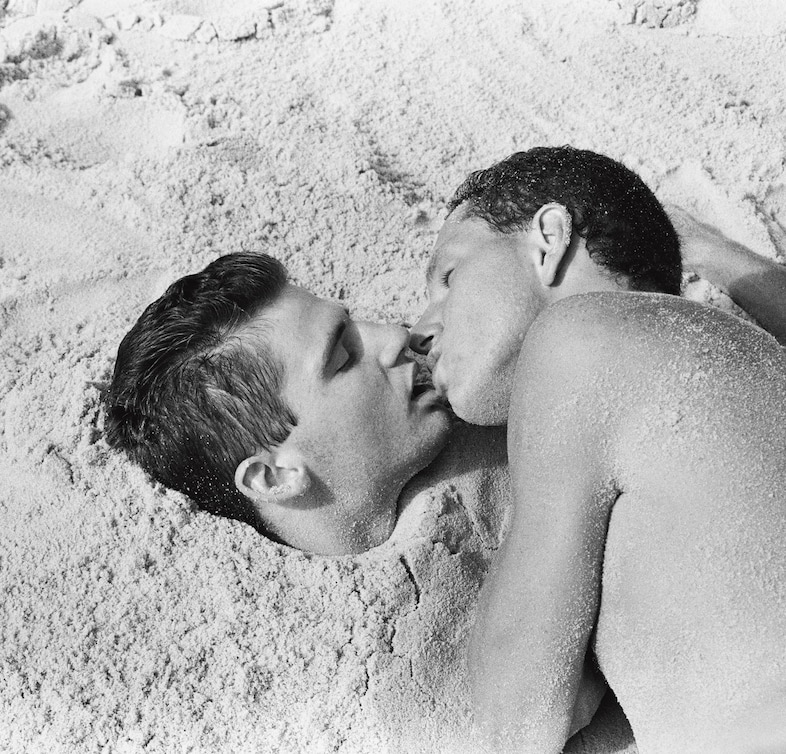
Everything changed when he was taken to Christopher Street for the first time on a date with an older man. “I’m going, ‘Oh, this is where it is!’” he recalls. “All of a sudden, for the first time in the history of homosexuality, as far as I knew, there were these five or six blocks of the West Village where we could actually go and be ourselves and walk around in the daylight.”
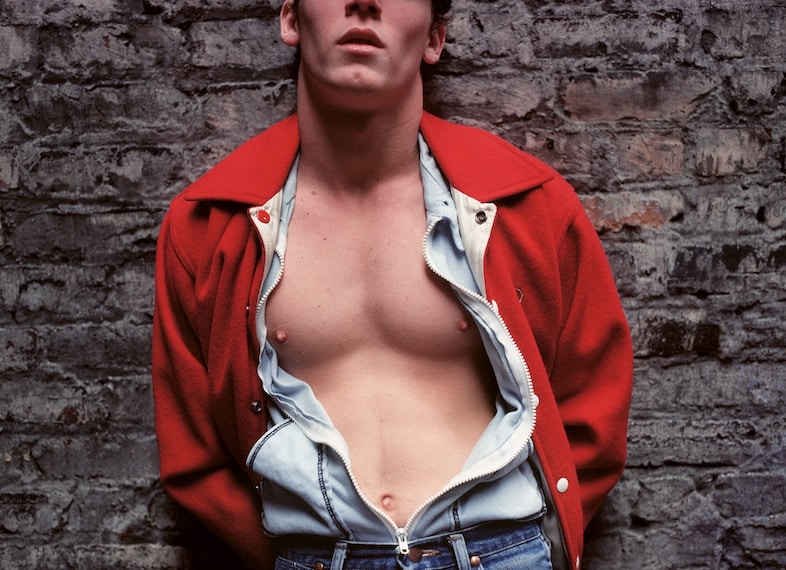
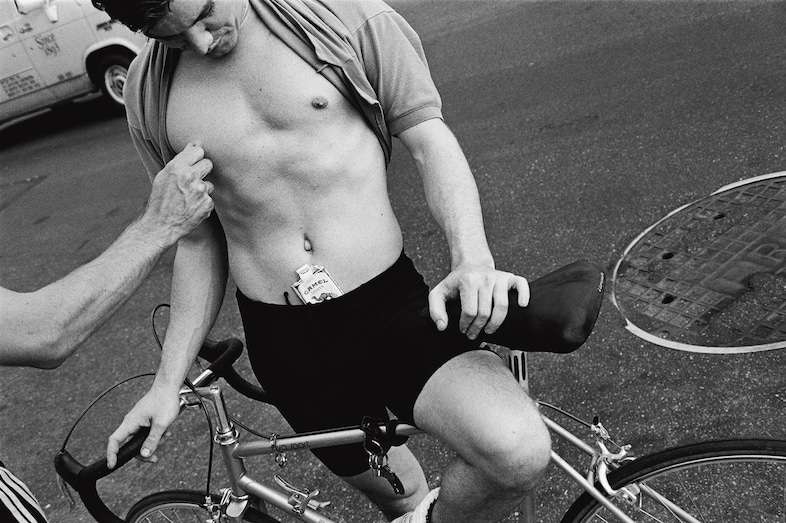
In 1976, Stellar purchased his first professional camera and began making the kind of work he was missing. His infectious candour and charisma infuse the images, whether capturing his community mid-stride on the sidewalk or pressed up against the peeling blue walls of the piers; fucking in dilapidated warehouses as stately as cathedrals or lounging naked by the Hudson, a geometry of limbs against the skyline. The pictures are erotic, some explicit, but always relaxed – sex a piece with the surroundings, and Stellar a part of the moment, effortlessly transporting you into it.
“I got really good at being able to see a potential photo in a human, and walking up to them and saying, ‘Hey, you’re such a character, can I look at you with my camera for five minutes?’” he says. “I didn’t think I was being a historian then, but I knew that I was among the first people on earth to ever witness gay men as a cohesive culture in the daylight, and I loved it.”

He credits this ease to being a “native New Yorker”. “We could talk to each other. We’re not driving to the mall in our automobiles. We’re sitting this close in the subway every day,” he says, gesturing to Hancock, who sits beside him. Growing up in the city also gave him a safety net that other queer photographers lacked. “I didn’t need the fashion editorial to survive. I could always go home to my family and they’d feed me. I could take risks.”
The gravitational pull of the West Village is most vivid in snapshots of Gay Pride Day, when “younger and older queers from the outer boroughs would come to sit together on the sidewalk, have a beer in the sunshine, and breathe”. Stellar remembers the “giddiness” that defined the end of the 70s, after all the sexual liberation that had transpired.
Then, around 1982, he found himself in a house on Fire Island reading about a mysterious and deadly disease in the newspaper. “We went from all that newfound freedom to ‘Oh, if I just kiss you does that mean I’m gonna die now?’ They didn’t even know what transmitted it.”
As the Aids crisis intensified, Stellar’s photography entered a new phase, moving off the street and into his studio, where he invited members of his community to sit for him with a newly purchased medium-format camera. “I was very aware that many of us could be sick and not know it, and I didn’t want to take sick photos of us. I wanted to see us in an affectionate, truthful way, to record that our lives are here, were here, and how strong and unique and beautiful we could be.”
Of the hundreds of men who passed through Stellar’s loft during that period – many of them couples, pictured holding tight to one another – only a handful are still here to tell it: “It materialised faster than anyone could imagine; I would shoot somebody, then be invited to his memorial service two months later.”
In their stillness, these exquisite portraits provide a counterpoint to his dynamic street scenes, but the joy is no less palpable. As Hancock attests: “It was important to me that this wasn’t a depressing book. There’s so much joy in everything that Stanley does and all of Stanley’s images. He was capturing the beauty of people, even during the grief. That is what makes his work revolutionary.”
Don’t Worry Boys by Stanley Stellar is published by Loose Joints and is available here now.
