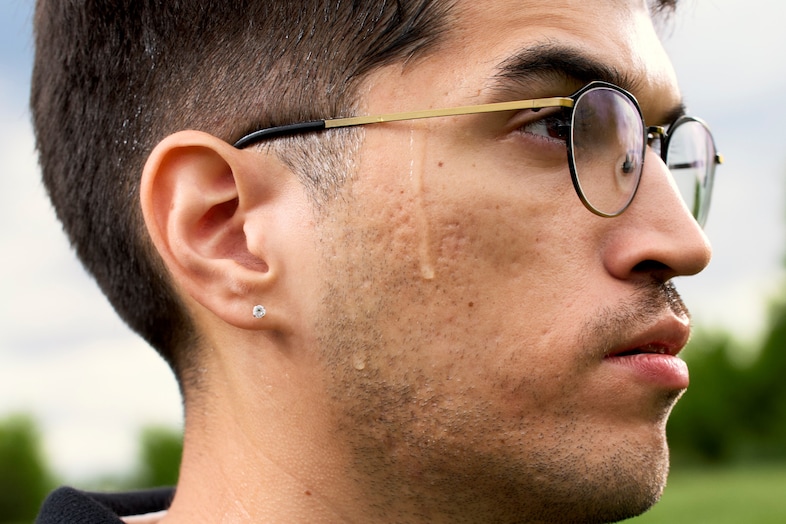
Raven Smith and Amelia Abraham on throwing out the dating rulebook

Raven Smith and Amelia Abraham have careers in saying (well, really, writing) the hard thing out loud. Smith’s latest book, Men, is an unabashed exploration of what it means to be a man in the modern day, sharing personal stories of the men who have influenced him, while also examining the patriarchy and his own identity. Abraham, author of Queer Intentions and Sex, Clubs, Dissent, explores LGBTQ culture and politics hroughout her work. With overlapping interests and a shared sense of humour, the writer duo couldn’t tell you how they first met, but can tell you about how they immediately hit it off. “We’ve known each other forever!” says Smith.
Abraham describes Smith as a “maestro of the romcom genre”. Most recently, you can hear his signature wit in action in his story for Hinge’s No Ordinary Love audiobook, Thou Shalt Play It Cool. In the story, Smith follows a real couple, Elena and Michael, through a series of honest early dating moments that inched them towards each other (like admitting the food on their first date was terrible). “There are ancient rules about this sort of thing: Thou Shalt Play it Cool,” writes Smith in the story. “There are entire ecosystems built around pretending you don’t care as much as you do.” Michael and Elena ignored it all.
The third edition of No Ordinary Love celebrates the risks – both big and small – we take in dating, and reinforces the importance of saying the hard thing out loud. Along with Thou Shalt Play It Cool, the new audiobook features four real Hinge love stories, written and read by Tembe Denton-Hurst, Nicola Dinan, Curtis Garner and Rufi Thorpe. You can listen to it now on Spotify or Substack.
Ahead of the campaign release, Smith and Abraham spoke about radical honesty, throwing out the dating rulebook and unpacking the fear of doing ‘too much’.
Amelia Abraham: This story is about emotional honesty, and it’s quite staggering that these people were so honest with one another when you think about the fact it was just the first two or three dates. Tell me more about that.
Raven Smith: Being a Brit, I think we’re naturally more guarded about how we feel about things. But there was just something very vulnerable: they went on their first date together, Michael spent a long time trying to pick the right place to take this wonderful woman that he’d just met online, and when the mushrooms came that they ordered, they were disgusting. For Elena and Michael, or anyone on a first date, there is a hesitation about being characterised as someone who is happy to complain about something. There’s that equilibrium, and it can go either way. But Michael was like, ‘These mushrooms are disgusting’, and it completely broke that sense of performance that can happen when you are meeting someone for the first time, and you feel like you are on show.
Amelia Abraham: And then, the mushrooms become a kind of extended metaphor, and in true life writing style, you are able to do quite a lot with those mushrooms, arguably more than the chef could. You cheffed up some good metaphors.
Raven Smith: I separated the wheat from the chaff.
Amelia Abraham: And the honesty continues when Michael says ‘I went on a date with someone else this morning’. Did you feel like you could still relate to things within their story as a gay man?
Raven Smith: Oh, absolutely. There’s something so universal and so delicious about falling in love. It’s such an improbable free fall. You have to take a lot of chances, and it’s magical, but it’s also really scary. That feeling of falling speaks beyond gendered lines. There’s so much luck and so much chance. You almost can’t believe that you’re falling in love while you’re falling in love.
I did want to ask you: what’s the bravest thing you’ve done for love?
Amelia Abraham: It depends how you define brave, but something instantly jumping to mind, which happens to be the opening of my first book, is when I matched with someone who had been in the UK but then was back in Iceland. We chatted for a couple of weeks, and then I decided to hop on a flight for our first date, having never been there. Instant vibes.
Is there a time that comes to mind that you’ve said the thing and been grateful that you did?
Raven Smith: I’m a creature of saying the thing. That desire or honesty in a relationship for me is really important. When I met my husband, there was a year when we were casual, and then we both just knew it was right.
Amelia Abraham: The social conditions and context of our time do not particularly encourage us to feel certain, and that’s why certainty to me is the most romantic thing because it feels quite radical sometimes.
Raven Smith: It is radical. You’re right. I’ve never had any fear of saying how I feel. It’s embarrassing, but I just always think that the truth sets you free.
Amelia Abraham: I think I’m also a person who generally says the thing, and I especially don’t feel nervous to say the thing when I’m in the early stages of dating. But as I’ve grown older, I do think I have this bad habit of sometimes not saying the thing ‘cause I just wanna have an easy life. I’ve started leaning towards, ‘Oh, I think I’ll have forgotten about that in three days so don’t say it now’. It doesn’t solve the problem in the long run, so I think saying the thing is an important thing to remember to do.
You’ve written a lot about queer love and dating. In what particular ways, specific to your experience, does emotional risk play into that, as a gay person?
Raven Smith: Despite the kind of modernity that we are enmeshed in, contemporary London and the coastal elites, there is also a risk to being queer. Every day a person I know has been through some kind of emotional reckoning in terms of realising that they are not the same as as their peers. There’s a level of self-understanding that you come to in any kind of gay relationship. You’ve committed to not being run-of-the-mill in some respects, because I think a lot of men can fall into the trap of ‘this is how men behave’ without really questioning it.

Amelia Abraham: Totally. And so many emotional risks that are universal. What makes a digital connection a compelling starting point?
Raven Smith: So many love stories begin online now. When I wanted to kiss a boy, I had to get out of bed, put some nice clothes on, go to the club and hope I met someone. Now, that spark happening digitally isn’t less romantic, but it is easier to perform behind a screen. Trying to cut to the chase and see what someone is about takes more effort. Intimacy now is 360. You need that person to be part of this digital life that you’re living alongside your life as well.
The crux of internet dating is that the early stages are quite uniform, where you’re both desperately trying to work out where the real person is. To find the space within the hotline of understanding for each other, where there’s room to like them more, that’s the trick. You look for those cracks, and they’re not bad things, but it’s a bit beyond what would normally be on your CV.
Amelia Abraham: I’ve been texting with someone recently who really likes to send 12 texts in a row, then two voice notes after, and it’s like that also in person. It matches up.
Raven Smith: Totally. And so, is that bad, or are the normal rules of dating telling you it’s bad?
Amelia Abraham: There’s no rule book!
Raven Smith: What worked for Elena and Michael is that it didn’t follow a traditional course. We’re so used to how you should be online: [you] shouldn’t really double text, shouldn’t send voice notes over a minute. It’s refreshing when people aren’t conditioned to that. We want to play it cool. We want to be the cool person that the other person’s obsessed with in a way. But playing it cool and aloof doesn’t necessarily serve you.
Amelia Abraham: For me, I think it’s always a good sign if someone responds well to my lack of aloofness, because we’re not playing games here. You literally wrote on a show called Too Much. So, what do you think makes people so afraid to be seen as ‘too much’ in dating today? Everything we’ve been talking about really, this idea of saying too much, or oversharing.
Raven Smith: I don’t think men are seen as too much or are necessarily seen as over-sharers either. It feels like quite a gendered term, and there’s an expectation to minimise yourself in some way in order to be more palatable. What Elena and Michael taught me is that’s not true. Them being fully themselves and not holding back served them both incredibly well in this relationship. The more of yourself you show, the more you open up to someone not liking something that’s real. The more of a facade you have, if someone doesn’t like it, it’s a type of armour. So it doesn’t hurt so much. Putting yourself out there, being ‘too much’ yourself, should eventually pay off.
Amelia Abraham: I’ve noticed this other thing happening, specifically for being queer: there’s this sense of a doomer outlook that’s going on in the background. This sort of ‘F it, the world is a scary place, so I might as well just lay my cards on the table’. I’m seeing more friends being less reserved, and this ‘what have I got to lose?’ mindset coming in a bit more.
Women have always been conditioned to diminish their needs. I think the reason this story is so refreshing is that Elena doesn’t do that, and he meets her where he’s at. Did you learn anything about your relationship [in writing this]?
Raven Smith: You can just go for it. If you throw the ball, you don’t know if that person’s gonna catch it, and on a really good day they do.
Amelia Abraham: I think there is understandably a lot of fear around embarrassment, rejection, being hurt, and the list goes on. But for me personally, getting over a lot of that has really helped in terms of dating life. Of course, we’re all scared of being embarrassed, rejected, or getting hurt. But they are also parts of life. How does one become less fearful? I guess also really unpacking where that shame or fear comes from.
Raven Smith: Therapy. And also is this the right person to put my fears aside for? That’s part of the chance of it, too.
Amelia Abraham: Or is this person going to hold my fears and embarrassment carefully and kindly? We never really know, but we can try.
Raven Smith: Take the leap.