
The four returning All Blacks stars England have to stop in crunch clash

Want to bookmark your favourite articles and stories to read or reference later? Start your Independent Membership today.
Already a member?
Log in
For New Zealand, the data was damning. In many ways, their 35-28 defeat to Wales was record-setting – the All Blacks had more rucks than ever before, and forced their opponents to make more tackles than just about any game on record. They created chances, too: 16 entries into the 22 would usually be ample for a team with their cutting edge. “There were bits of the game we were pleased with,” the attack coach Mike Blair insisted. “Our ability to create opportunity: we were held up over the line three times, we had four walk-ins.
“But it’s about exploiting those opportunities and coming away with points. We’ve talked about those last 20 minutes and getting a bit of a tunnel-vision, being a bit too focused on what was in front of us rather than our previous mindset about ball movement and making the defence make decisions. There is some learning there.”

How closely, then, have England studied New Zealand’s defeat? Not particularly, as it happens. “It is an anomaly,” senior assistant coach Richard Wigglesworth explained. “I love watching effort. You saw that from Wales. But they missed an incredible amount of chances. I don’t see this one being that.”
As Wigglesworth noted, England will face a very different All Blacks side this weekend. It should take nothing away from the Welsh performance but with Jordie Barrett and Will Jordan back fit, plus Cam Roigard and Damian McKenzie recalled, this All Blacks backline is back to its hydra-like full form. Much of their work starts in the accuracy and aggression of their carry and cleanout – but add in Beauden Barrett, on his 150th cap, they pose a unique threat in the ability to have four players comfortable stepping in to first receiver as a primary ball-handler.

England’s defence has gone well in the last two weeks, though not yet truly been tested. The nature of their fast starts have forced Australia and Japan to play plenty of rucks inside their own half as they chase scoreboard pressure, and, with Maro Itoje to the fore, England have done a good job trapping their opposition in. They have also prevented long phase counts in defensive passages, the sort of scenario from which much of their discipline problems stemmed earlier in the year. The jackalling threat posed by Ben Curry’s return at openside flanker will be seen as key to that.
New Zealand, though, will stress and strain with varied shapes and high ball movement. In the Nations Championship, the All Blacks average 239.4 passes per game – more than 50 more than second-ranked Scotland by that metric. They combine that with the best ruck success rate in the competition.
Having Jordan, who had been a doubt with a hamstring tear, back fit is a huge boost for Dave Rennie. Reared as a full-back, there is no wing in the world quite like the All Blacks’ record try-scorer. While those exploits draw the headlines, the 28-year-old’s playmaking threat makes him a unique proposition, with licence to roam and rotate in to different roles. For a sign of the difference between the usage of he and Tommy Freeman – another world-class wing with significant versatility – consider the statistics: Jordan has made 31 passes across his 293 minutes in the Nations Championship; Freeman just nine in 310.
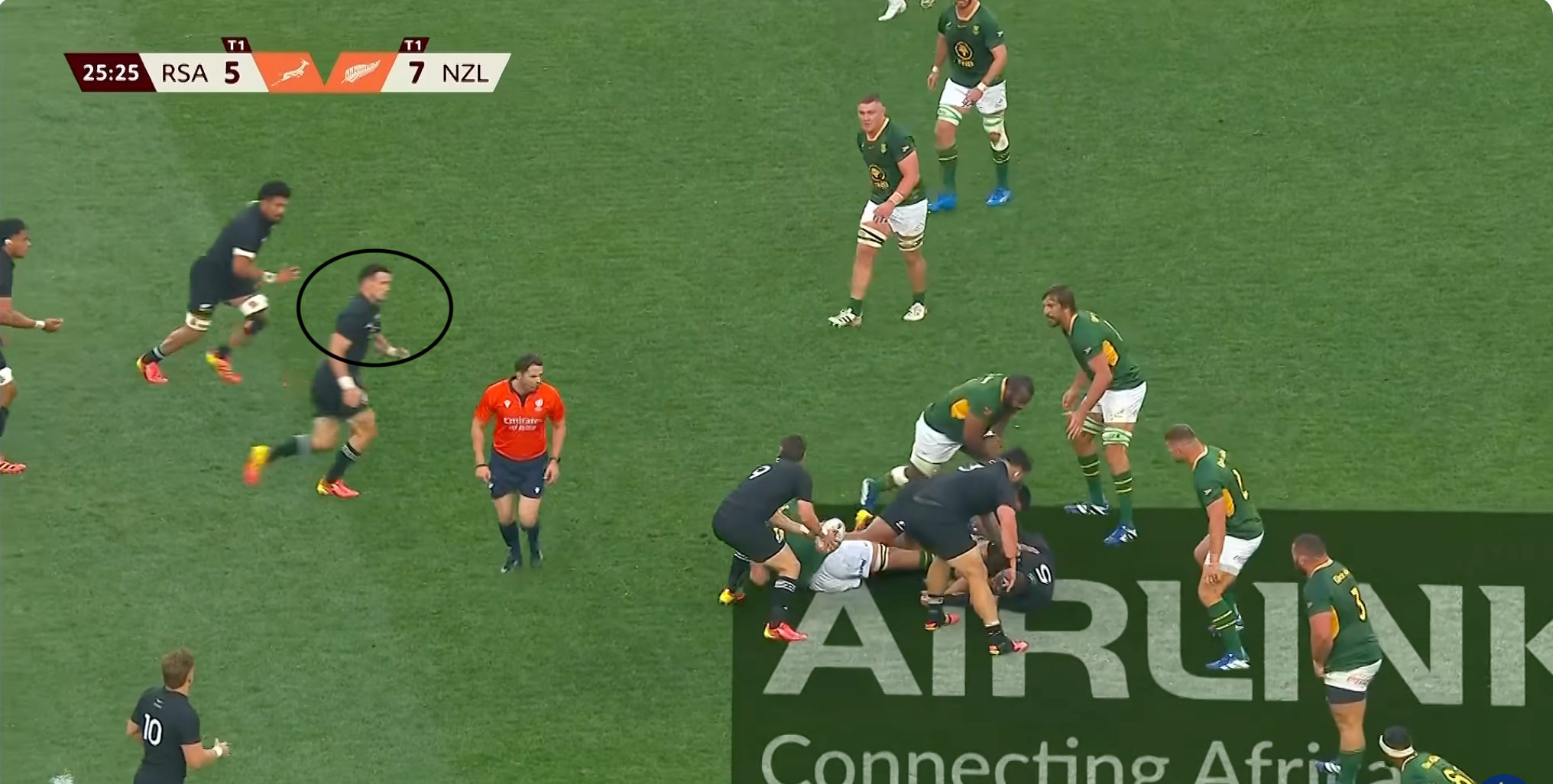
The pictures that can present to an opposition can be tricky to defend. Here is a great example from the third Test against South Africa: Jordan first presents himself as first receiver as a carry option, though goes unused. Recognising the opportunity, he steps in to scrum half at the next ruck, generating quick ball to exploit an overlap. Ardie Savea eventually scores in the left corner.
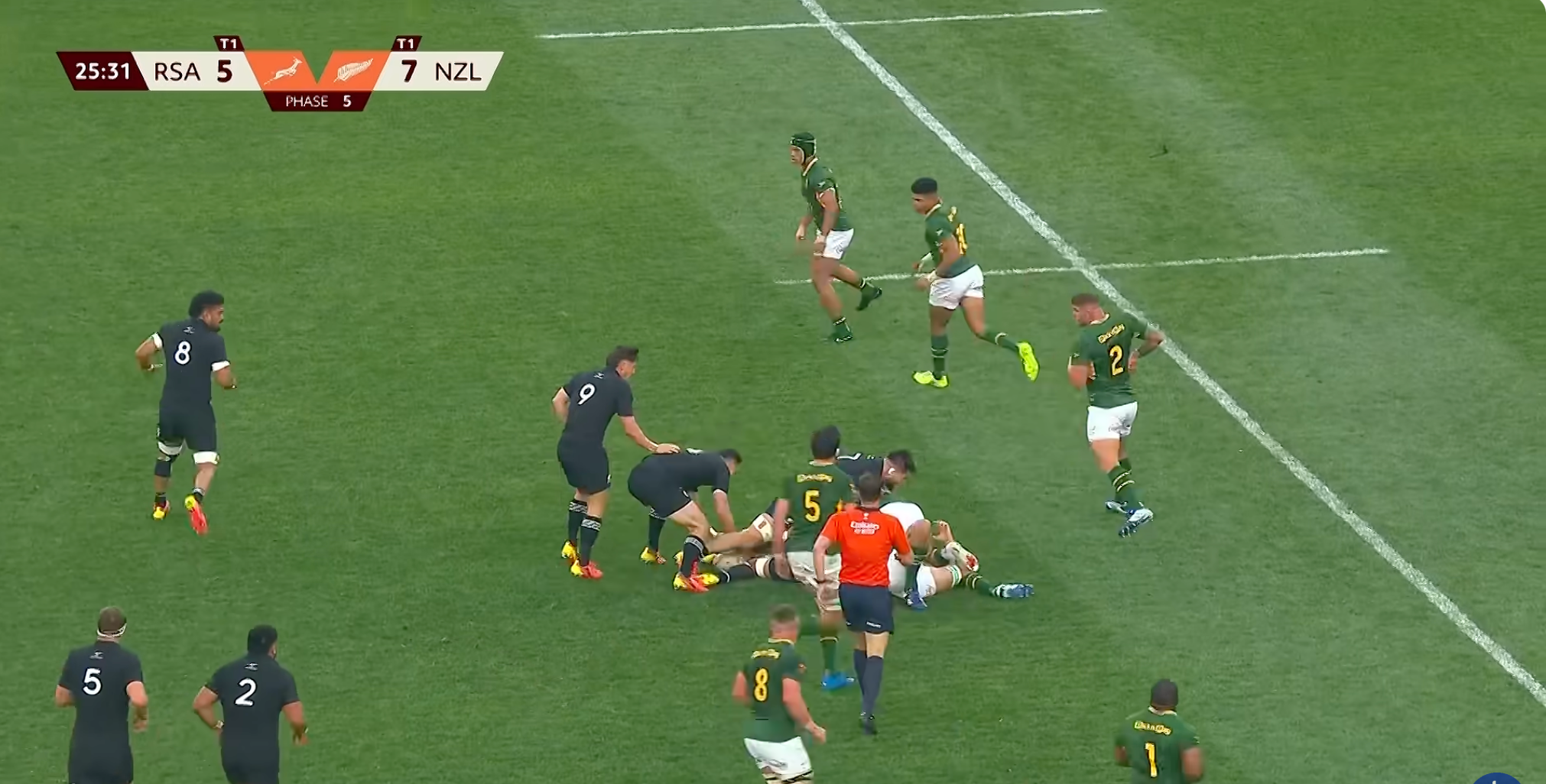
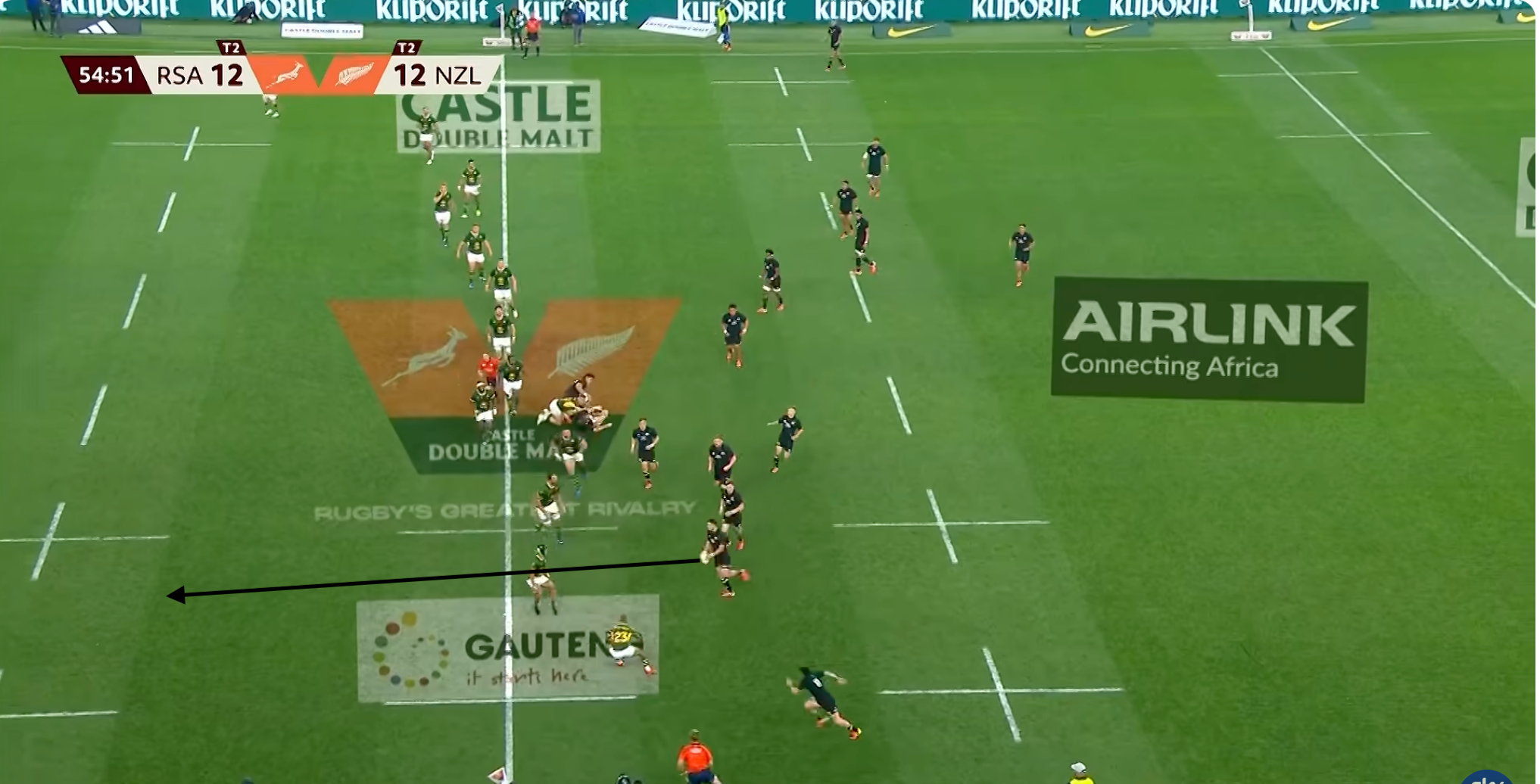
Later in that same Test, Jordan finishes off the try himself. His exploitation of space here is excellent: South Africa’s wing Ethan Hooker is covering the opposite backfield due to the threat of a 50:22, leaving room for Jordan (flooding the opposite 15-metre channel) to thread a grubber through. It is well-weighted for Leroy Carter, who completes the elongated one-two to set up the try.
“We feel like we’re pretty interchangeable in our roles within the attacking system and I think we’ve got a back-line now that has played a lot of rugby together, so we’ve got quite good connections across the park,” Jordan explained. “It’s about executing your role, whatever that is; whether it’s coming around as a link man to feed the outsides or being on the end of the chain and using your speed to breach the defence. I’ve always enjoyed looking to use the ball and I think that’s been especially paramount this year.”
Though New Zealand have looked to keep ball in hand, they also pose a significant contestable kicking threat. Where they went to extremes against France and Italy at the start of this competition to instil Rennie’s preferred ball retention style, they have since reverted to a more normal kick to pass ratio in Tests since; indeed, three of their best performances of the year have come with that balance – against South Africa at Ellis Park (kick to pass ratio: 1 to 6.2), Australia in Auckland (1 to 7.8) and Scotland at Murrayfield (1 to 6.5).
Their desire to challenge in the air is a clear area of development under Rennie and Blair, and much of it centres around the outstanding abilities of Jordie Barrett. The youngest of the three siblings is often used as an extra inside chaser in support of a wing, getting after the accurate box kicks of Roigard’s left boot.
This is a typical set-up in the very first minute of that Wallabies clash at Eden Park. Even from inside their 22, New Zealand give no thought to kicking for touch, instead sending Barrett and Jordan after a Roigard high hoist.
Later, his aerial prowess provides an attacking opportunity. From a similar set-up, Barrett and Jordan put huge pressure on Joseph-Aukuso Suaalii, with the All Blacks centre towering over him to claim.
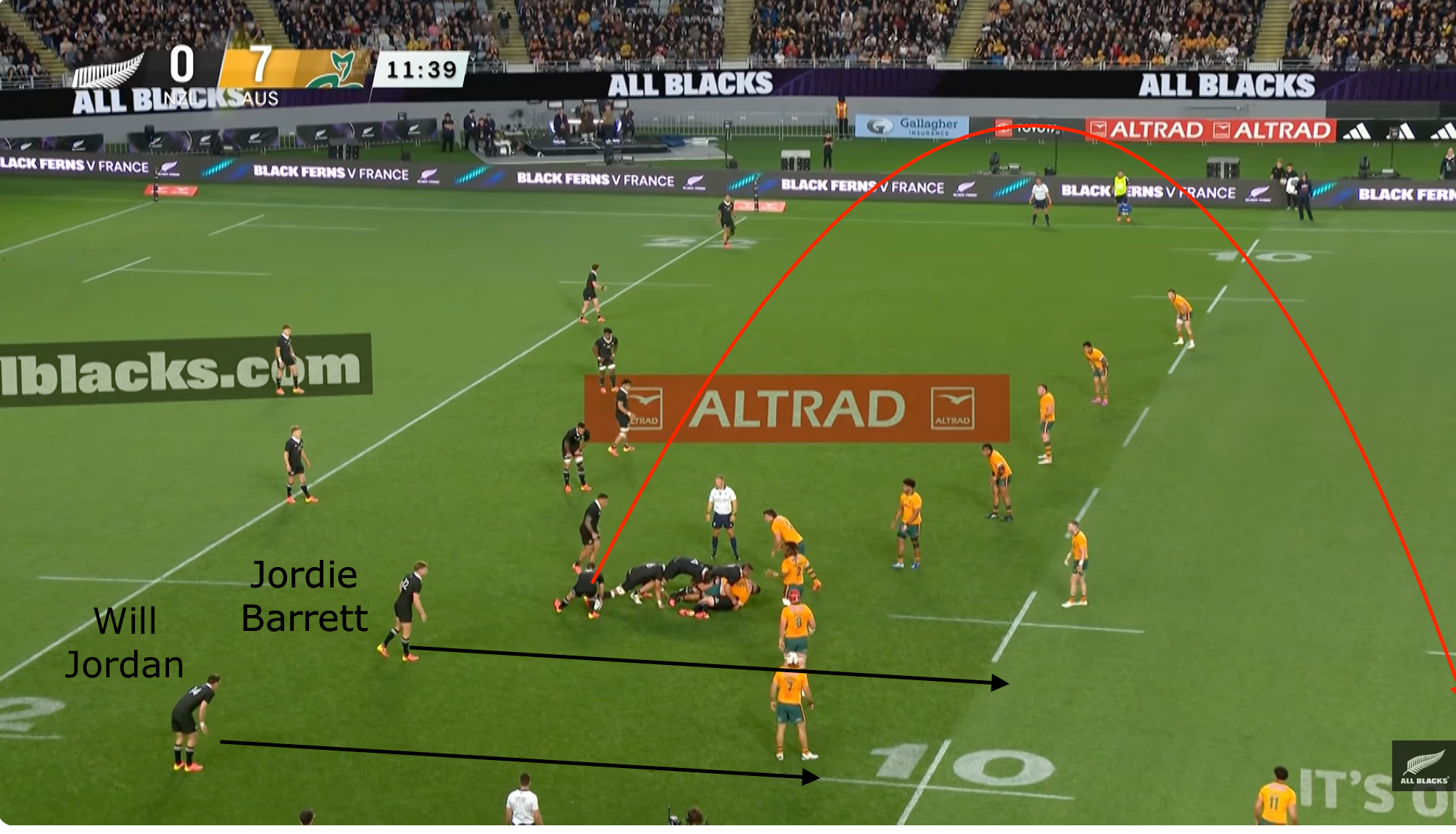
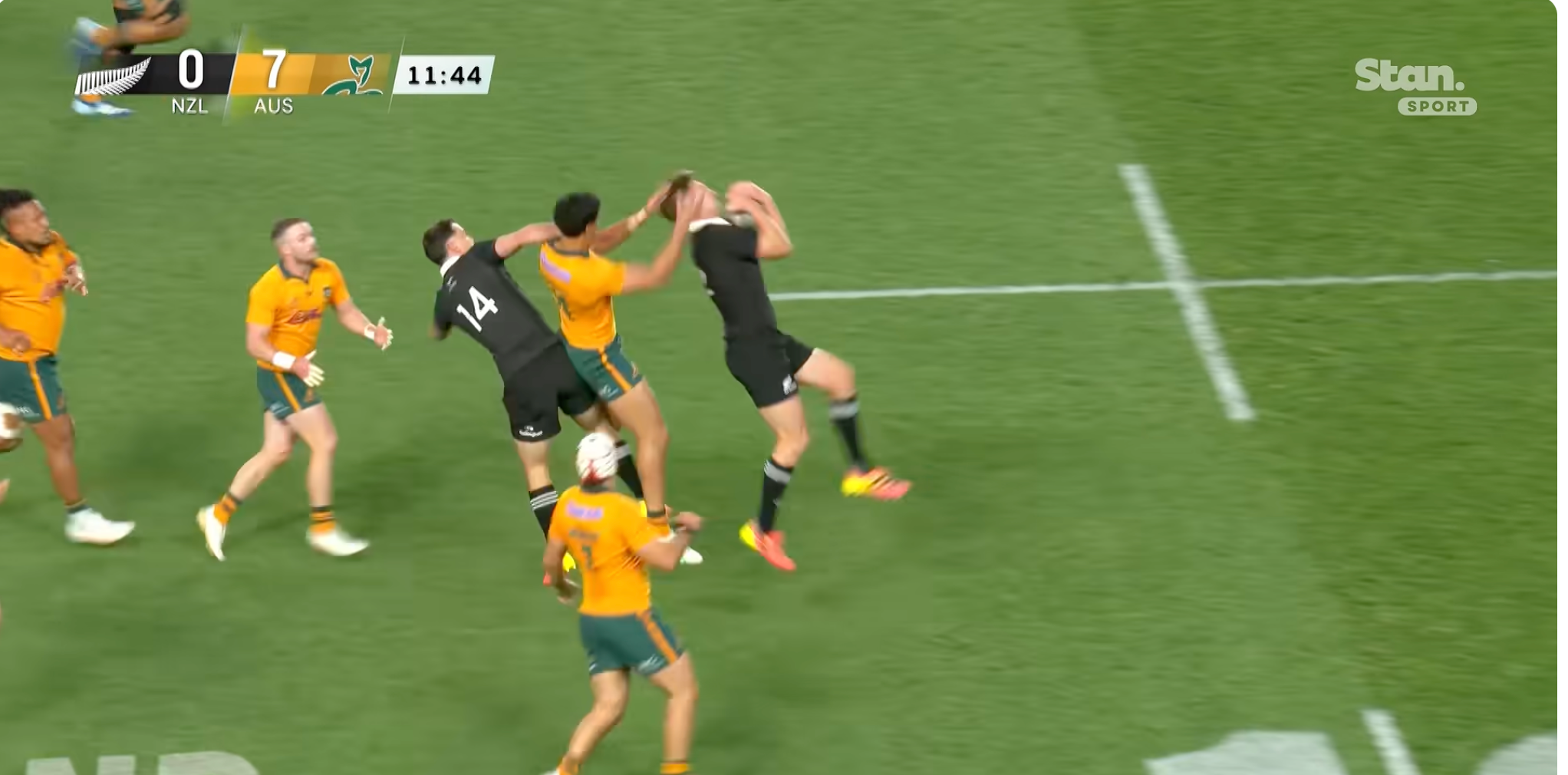
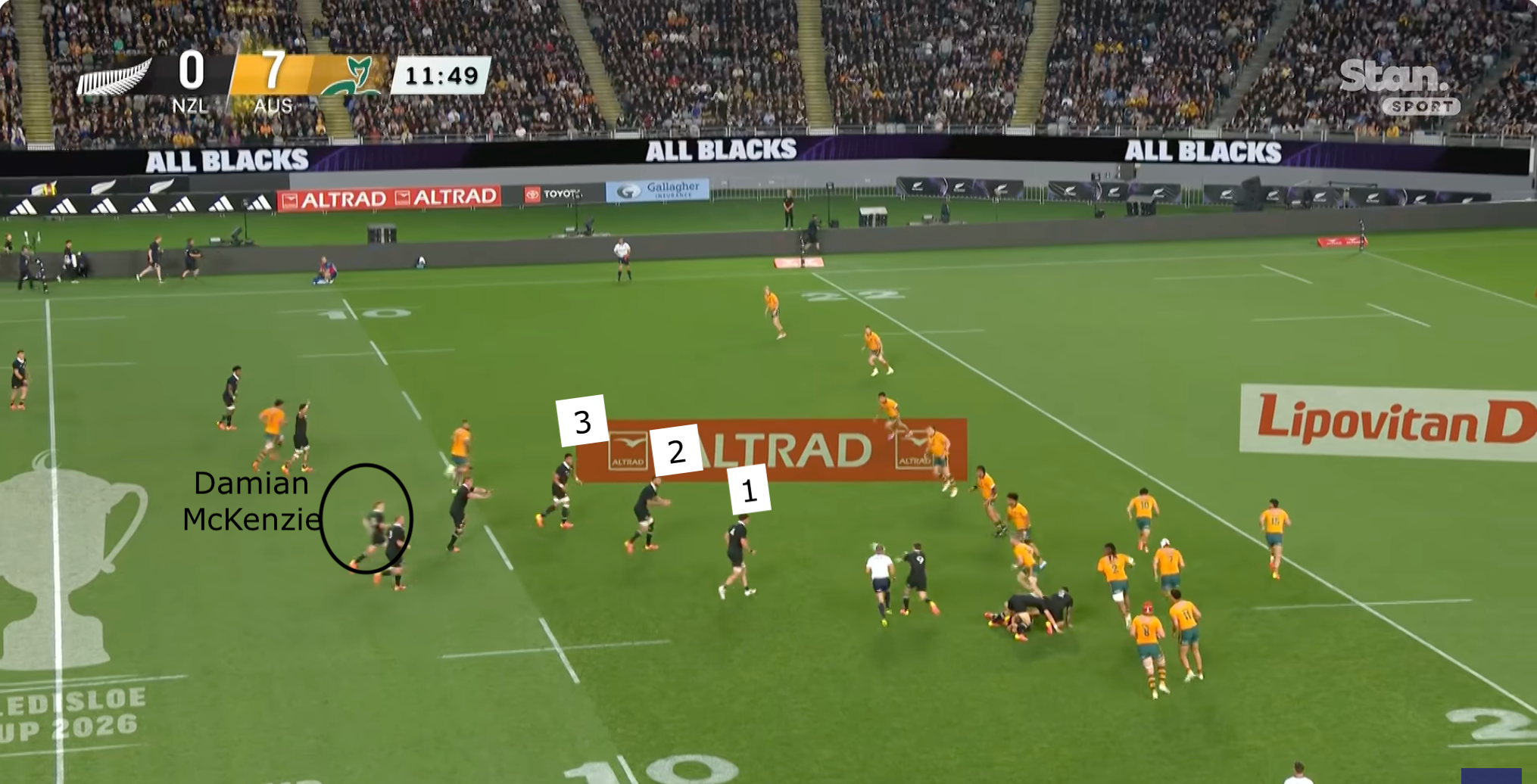
From there, New Zealand settle into shape quickly, and McKenzie takes a pull-back pass from a three-man pod of forwards before dashing into space to create a line-break from which a try results. It is the perfect marriage of kick chase and running rugby.
Barrett doesn’t even always have to claim the ball back. Watch his effort here as he comes from even further away to clatter Australia’s Ben Donaldson as he hits the deck, earning a breakdown penalty.
While there are plenty of reasons why kick numbers can fluctuate, Roigard made 16 in the first Bledisloe Cup clash and just four the week after when Jordie Barrett was unavailable. England have done an excellent job so far at contracting rucks and then putting pressure on the box kickers of Australia and Japan.
They anticipate that Roigard will kick plenty, and contemplated selecting Freddie Steward to combat Barrett’s chasing threat. Those within camp have emphasised, though, George Furbank’s strength under the high ball – and the opportunities that may be available to an athletic backline, again including Will Joseph, in transition, counter-attack opportunities.
No doubt, though, this will be a mighty test of their defensive development.
England XV to face New Zealand: 1 Fin Baxter, 2 Jamie George, 3 Joe Heyes; 4 Maro Itoje (capt.), 5 Alex Coles; 6 Ollie Chessum, 7 Ben Curry, 8 Ben Earl; 9 Jack van Poortvliet, 10 Fin Smith; 11 Will Joseph, 12 Seb Atkinson, 13 Henry Slade, 14 Tommy Freeman; 15 George Furbank.
Replacements: 16 Luke Cowan-Dickie, 17 Ellis Genge, 18 Will Stuart, 19 George Martin, 20 Greg Fisilau, 21 Henry Pollock; 22 Ben Spencer, 23 Marcus Smith.
New Zealand XV: 1 Ethan de Groot, 2 Codie Taylor (capt.), 3 Fletcher Newell; 4 Scott Barrett, 5 Fabian Holland; 6 Tupou Vaa’i, 7 Peter Lakai, 8 Wallace Sititi; 9 Cam Roigard, 10 Damian McKenzie; 11 Josh Moorby, 12 Jordie Barrett, 13 Anton Lienert-Brown, 14 Will Jordan; 15 Beauden Barrett.
Replacements: 16 Asafo Aumua, 17 George Bower, 18 Pasilio Tosi, 19 Anton Segner, 20 Leicester Fainga’anuku; 21 Cortez Ratima, 22 Richie Mo’unga, 23 Rieko Ioane.
Match images courtesy of All Blacks YouTube
