
Wild, dream-like photos of India’s monsoon season

Yash Sheth, The Monsoon Project
Gallery / 27 images
When I look at Yash Sheth’s photographs of Mumbai and hear him speak about his long afternoons walking around the city, camera in hand, writer Vivian Gornick’s memoir The Odd Woman and the City comes to mind. Gornick writes about observing New York City through long, fairly unplanned walks, feeling a thrill shoot through her body when the city comes alive and she begins to think about all the varied experiences that make up urban life. A similar thrill accompanies looking at Sheth’s photographs, each image a kaleidoscopic, sometimes dizzying account of human expressiveness and the city that houses it.
Five years into documenting Mumbai, Sheth still finds something new to photograph every day, exploring lanes and neighbourhoods often overlooked by tourists, speaking to residents and taking notice of everything. “I began like anyone would by taking photographs of the Gateway of India, Marine Drive and popular neighbourhoods like Bandra; places people go to whenever they come to visit Bombay. But soon I just started getting off at any train station and began walking”, Sheth explains.
Sheth, who is trained as an engineer, describes his initial foray into photography as casual. One day while he was still a student, he bought the cheapest DSLR camera on the market and began taking photographs without any concrete plans. After he finished his degree, he spent three years supervising the installation of fibre-optic cables before deciding that he was miserable and could no longer tolerate doing something he didn’t love. He began going out every day, sometimes briefly and other times for hours on end, walking through Mumbai and photographing whatever caught his eye. “In those years,” he recalls, “I wanted so badly to make a career out of photography; I discovered there was nothing else I wanted to do.”
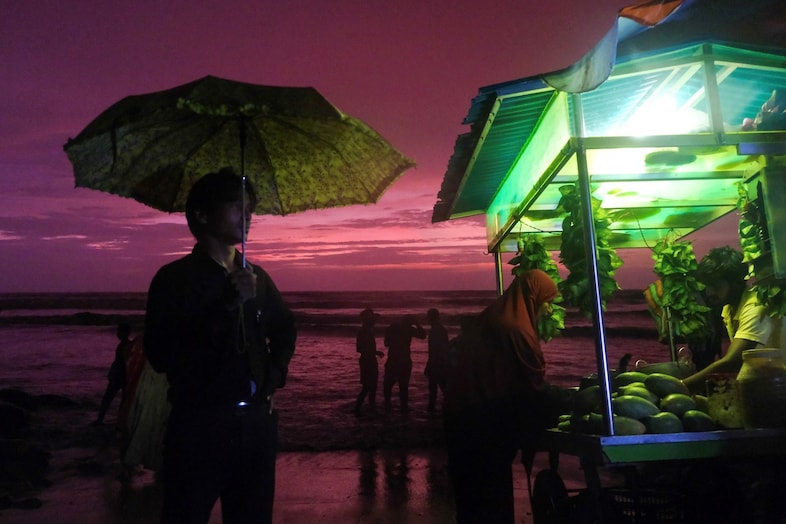
His documentary photography leans more toward the experimental and surreal, as seen in his crowded compositions, tightly framed shots and an attentive use of light, particularly in moments when he opts to use an intense flash in spite of Mumbai’s glaring sun. “When I first started getting into photography, I spent a lot of time on YouTube and Magnum Photos, spending hours and hours looking at photographs and studying compositions and the way a photograph looks online,” he explains. “I would look at a picture for hours and hours, noticing details, people’s expressions and hand movements. Now I don’t think too deeply about composition; everything I studied comes out when I make an image. It has become a part of my consciousness.”
Scrolling through his Instagram, where his photography primarily lives, you can see moments where his extraordinary attention to detail and composition comes through. In one image, he takes a close-up shot of a goat wandering the beach with a slice of watermelon barely in their mouth; in another, he photographs a muscular man being painted metallic at Mumbai’s bodybuilding championships. There are series of men in fishing villages adorned with gold pomfret necklaces, photographs of underground queer parties and perfectly composed shots of children in playgrounds that look staged, despite his repeated assurances that he has never purposefully orchestrated a scene, just “been at the right place at the right time.” Sheth is curious about everything, an infectious curiosity that you can discern from his images. However, nothing captures his undivided attention like the monsoon, which has been a focus since 2021.

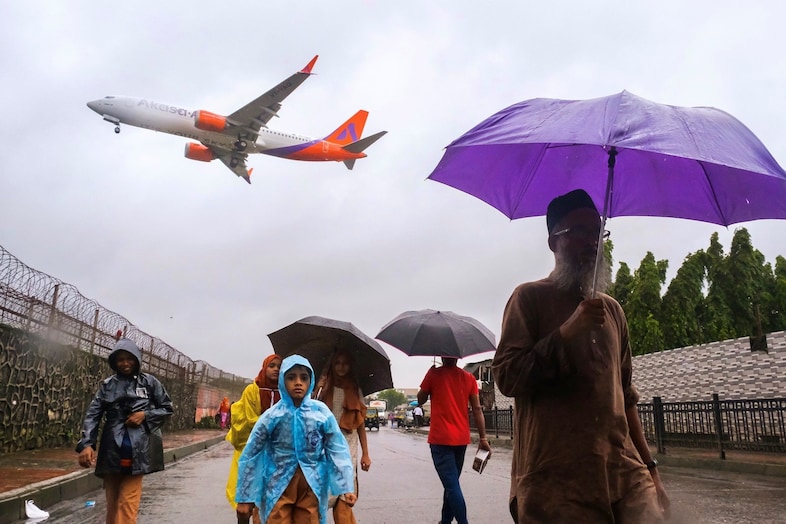
When Sheth first began photographing the monsoons, the season was primarily a source of pleasure, a childhood ritual that brought relief after Mumbai’s long, punishing summers. “Whenever it rains, I would go out,” he shares. “It has always been my favourite time of the year, when I would run outside to play football or cricket with my friends.” His ongoing project Varsha Ritu, meaning “rain season” in Sanskrit, began in 2021, initially as an attempt to capture the beauty of Mumbai in the rain. The photographs were full of umbrellas, saturated colours and the change of temperament that descends on the city when it first begins to rain in June. However, five years of watching the season closely revealed to Sheth the city and country’s changing relationship with the rains. “The project is not solely about the Bombay rains anymore. It has evolved into a study of the Indian monsoon, climate change and how it is impacting the lives of the people across the country,” he explains.
The shift in practice has taken him towards low-lying, flood-prone neighbourhoods, where heavy rainfall can force families living in informal settlements to shift entirely to the first floor or leave homes waterlogged for days. It has also taken him beyond Mumbai, towards the rest of India and agricultural communities whose livelihoods depend on knowing when the rain will arrive. “Climate change has meant that the monsoons are delayed, and when it does come, it is intense and can flood the region,” he says. “I try to document the communities where the crop depends on the rain and how farmers across the country have been impacted by rain.”
Throughout our conversation, he reiterates how obsessive his relationship with the country’s mercurial rainfall patterns has become. “I have started to study meteorology to understand the weather patterns in the country better,” he shares. “You can actually make out how long it will rain somewhere, so as the clouds move, I move with them. I have started using the Indian Meteorological Department website to see exactly where it is raining or is predicted to rain that afternoon; I then quickly take a local train to that area of Mumbai and wait for the rain to begin.”
Sheth refers to The Monsoon Project as a tree, “one trunk with increasingly many branches”. Photography is only one of them now, but he also shares his interest in writing, research and archiving the stories of the communities whose lives are shaped by the monsoon. His practice is deeply intertwined with the people he photographs. “I’m not hiding in bushes, trying to be secretive about the image. I respect their influence on the photograph and spend some time speaking to them and make sure to share the image with them on WhatsApp if they want to see it,” he explains. “There are some villages I am always going back to. In those villages, families know me and invite me to their house for lunch. They are not just people I am photographing – they are my friends. I think that’s what photography, and this project, has given me. It’s a bridge to build a connection with the people you don’t know.”
Follow Yash Sheth on Instagram here for updates on The Monsoon Project and more.
