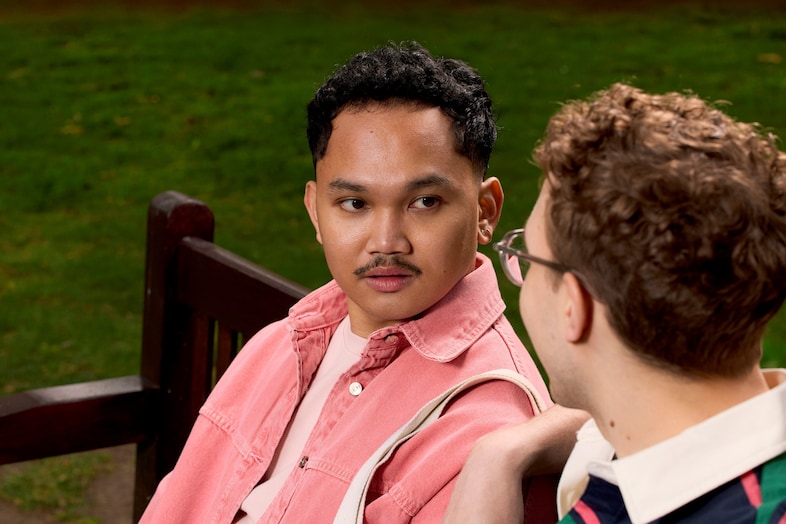
Curtis Garner and William Rayfet Hunter on staying true to yourself in love

Writers William Rayfet Hunter and Curtis Garner have somewhat opposing approaches to love. Garner is a sucker for big, grand gestures, while Hunter is one to relish in the quieter, more understated moments. Though the two British authors’ love languages may differ, they’ve both managed to capture the hearts of readers through their vivid, London-set novels that capture the messiness of modern dating. Hunter penned the novel Sunstruck, released in 2025, and Garner is the author of Isaac (2024) and Orange (2026).
Recently, for Hinge’s No Ordinary Love audiobook – which celebrates the risks we take in dating and reinforces the importance of saying the hard thing out loud – Garner once again used London as a backdrop for a romance. Only this time, the characters, Oden and Edward, were a real-life couple that matched on Hinge and had a miscommunication early on in their relationship. Along with Garner’s story, the new audiobook features real love stories written and read by Tembe Denton-Hurst, Nicola Dinan, Raven Smith, and Rufi Thorpe.
You can listen to Oden and Edward’s story, The Sound It Leaves, now on Spotify or Substack. Ahead of the campaign’s release, Garner joined Hunter in conversation to chat about queer relationships, undoing shame in dating, asking for clarification and more.
William Rayfet Hunter: Curtis, your No Ordinary Love story The Sound It Leaves follows a real couple, Oden and Edward, who took a risk and said how they felt out loud. I know you’ve written a lot about love before, but how did working with a real couple feel different?
Curtis Garner: Well, the obvious difference is you can’t make it up, which is both a luxury and a challenge. I had to ask Oden and Edward a lot of questions, and I had lots of meetings with them beforehand to make sure that we covered everything. I actually remember in our second meeting, they were laughing at all of the details I was asking them.
It’s tough because you want enough creative license that it’s interesting and relatable, but you also want to be faithful to them because it’s their actual lives, and the story is really personal to them. It’s about how they met and how they fell in love, and so their liking it was really important to me.
William Rayfet Hunter: Can you think of a time in your life where saying the hard thing has paid off, whether it was romantically, platonically or professionally?
Curtis Garner: Well, I should start by saying that I always say the wrong thing. I rarely think before I speak, which has been the cause of many, many hard conversations throughout my life. But one time I remember it paying off was when I first got published.
Much like you, Will, I didn’t take the traditional route into publishing at all. My first novel, Isaac, came out of several really tricky conversations. I remember one day, I got this really stinging rejection from a literary agent, who all but said, ‘Maybe this isn’t for you. You should do something else’.
I, of course, felt purposeless and depressed and bedridden. But the next day, I got an email from my now editor who asked me if the world rights to my book were still available. Getting my book in her inbox was also the result of many previous – I want to say conversations – but more sort of various cringe DMs from my end to people who worked at the publisher. I was just so desperate for it, and I really was willing to stop at nothing to make it happen, and it worked.
William Rayfet Hunter: Yeah. I love that. I was gonna say something quite similar. When I did get my book deal, at the time, I was working as a doctor in the NHS, and I was not enjoying it a huge amount.
I could not get the book done, and I could not fully focus on my medical work. Eventually, I had to sit down, initially with myself, and admit, ‘I can’t do both. I have to pick one.’ Then, I had to sit down with my parents and communicate that choice. And I think that was a hard conversation to have with myself and a hard conversation to have with the people around me who were worried.
I’m not gonna say that being a freelance writer isn’t without risk, financially and emotionally to an extent. But yeah, that was a big one. I think in my romantic life, I’m probably quite bad at saying the hard thing. I think I often shy away from it, and that’s why I found this story quite compelling. That misconstrual, and then this restitution that happens from this moment of honesty… I’m getting better at it, and that’s why we read, right? To hopefully learn how to do things like that.
Curtis Garner: The interesting irony, I think, with both of us being writers, is that writing itself is a huge risk. We do this thing where we put a piece of ourselves into a tangible object that we then separate from ourselves and sell to strangers in bookshops. And we’re fine with that, but emotionally articulating ourselves is quite a different matter, isn’t it?
William Rayfet Hunter: It’s weird because I think once it’s on the page, you can distance yourself from it. When you’re just writing a novel, you get to control everything that happens. You get to control all of the variables. It’s like playing with dolls. You’re just getting them to say what you want them to say, and you’re working out this sort of perfect imperfect version of a conversation or version of a story. And then, you put it out into the world, and you’re like, ‘I hope someone connects to that.’ But when it comes to taking it out of the doll’s house and into my real life, that is sometimes where I struggle a bit.
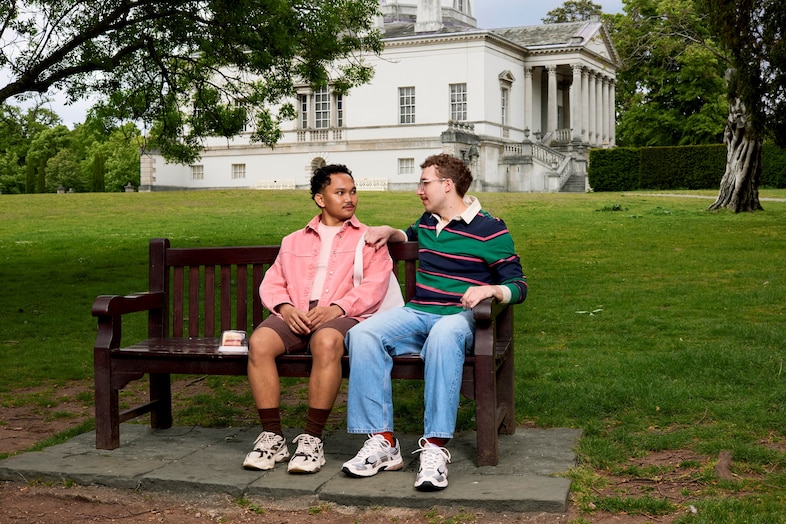
Curtis Garner: Your novel Sunstruck chronicles a relationship that begins as a summer fling. So thinking now about emotional risk, would you say there’s more at stake in queer relationships?
William Rayfet Hunter: I think in some ways all relationships and all of the search for love can be a big risk. I think as queer people, we start with this emotional risk built in.
It’s that ‘I don’t necessarily feel safe to explore this part of myself’ or ‘I don’t feel safe to walk in the street’, maybe. And so I think that with turning yourself over to someone else, opening up your heart to someone, the risk feels bigger, because it’s like, not only is this about my romantic life and about who I am choosing to be with, it’s also this thing about me that I’ve been told was bad or wrong that I’ve learnt I should maybe be ashamed of, and I’m trying to undo that shame. You’re looking at your relationship through that lens as well.
Curtis Garner: What’s a small but meaningful risk you’ve taken in a relationship?
William Rayfet Hunter: I think the smallest but also biggest thing is when you’re early on, just admitting that you like someone… It’s always quite tender. Just that first moment when you say, ‘I really like you…I’m really enjoying hanging out with you or spending time with you or getting to know you.’ That always feels so big inside, even though it’s a tiny moment. Because most of the time, someone’s going to reciprocate anyway. But when you really feel it, and you feel it reciprocated, I think that can be such a beautiful transition moment where you’re then like, ‘Okay, it’s safe for me to be enjoying it this much. It’s safe for me to lean into this feeling a little bit more.’ It’s always a beautiful moment.
Curtis Garner: It’s true. I love the little moments too. But while I wouldn’t consider myself an overly brave person, I love a huge gesture. I can’t help myself. I’m a romantic, I really am. An example is with my boyfriend who, hilariously, I also met on Hinge; I wanted to marry him on our very first date. And I think on our third date, I told him I loved him.
For his sins, he stayed with me, and we’re still together, so it worked. But, yes, I also love those small intimate moments. I just wish I was more capable of having them myself and not asking someone to marry me on the first night. But I can’t help myself.
William Rayfet Hunter: But that worked. Maybe that’s where I’m going wrong, because I’m still single. I’ve been holding back those declarations. I often think that in love, bravery and foolishness are just two sides of the same coin. They are a hair’s breadth away.
In The Sound It Leaves, Oden describes being in love as the most awful feeling he’s ever had. Why do you think that love evokes such strong fear in us?
Curtis Garner: It’s a tough question, really, because real love, I’ve come to learn, is totally egoless. For example, the love that I have for my partner is such that I want him to be happy even if it’s not with me. And that’s a very strange feeling. I find myself being so in love that that love doesn’t really involve me. A bit like writing, really. It feels separate from me. And that is absolutely terrifying because it feels so primal and innate and unequivocal that it makes me feel kind of naked.
It’s so lovely, and I wouldn’t change it for the world, but it’s not easy. Love is also, of course, about being vulnerable, which is difficult not just for me, but for most people on the planet… So yeah, it’s wonderful, but it’s horrible at the same time. I think it can be both.
William Rayfet Hunter: I agree. I think it is horrible. Every time I’ve fallen in love, which is a very small handful of times, and I’m lucky to have done it, it’s the worst feeling in the world.
I can’t think about much else. It’s this fact, right? It just appears. As you say, it’s external to me. That is something that I can’t really control. I’m quite independent. I’m quite self-sufficient. I’m really bad at asking for help or being vulnerable to an extent. And falling in love forces you to, well, reckon with that and make a choice over whether you’re able to do that because suddenly your heart doesn’t just belong to you. Your vulnerabilities don’t just belong to you. They become something else. And I think when love works, it is a space where those things can be held and protected.
What was your biggest takeaway from Oden and Edward’s story?
Curtis Garner: It’s quite an easy one for me. [The story] reasserts that one should always try to be honest and forthcoming and true to oneself. If something feels off, communicate it, because it’s the basis of any healthy relationship or friendship. Save yourself the time and the agony, and just be honest. Be upfront. You’ll be fine.